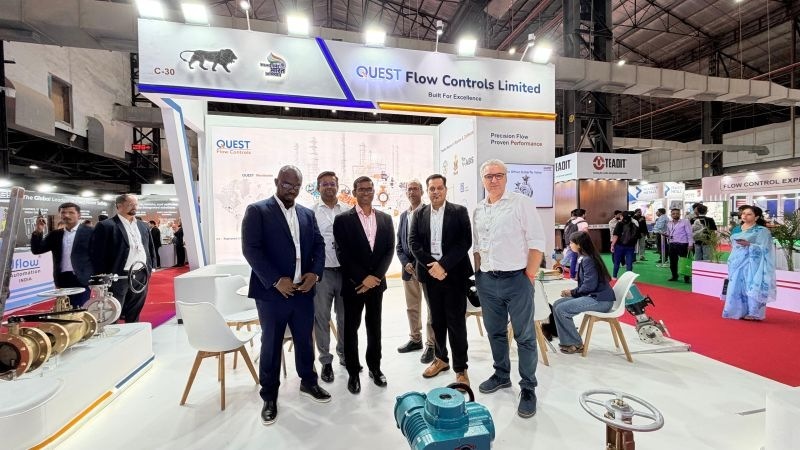
Quest Flow Controls FY26: A ₹5.29 Cr Other-Income Cushion, a 0.10% Operating Margin, and 295 Debtor Days
Spotted a factual error — a wrong number, date, or fact? Tell us and we will check the source.
General information and entertainment, not investment advice. The author is not a SEBI-registered adviser or research analyst. No recommendation, no promised returns. Markets carry risk including loss of capital. Figures may not be current. Consult a registered adviser before acting.
1. At a Glance
Here is a company that closed FY26 with sales of ₹62.36 crore and an operating profit of ₹0.06 crore. Not ₹6 crore. Six lakh. The operating margin, which stood at 23.39% two years earlier, arrived at 0.10% — the kind of number that looks like a rounding artifact until you check it twice and realise it isn’t.
What kept the profit-before-tax line from cratering entirely was ₹5.29 crore of other income, a figure roughly eighty-eight times the operating profit it was propping up. Strip it away and the year’s real business barely registers. PBT still landed at negative ₹0.32 crore, and net profit at negative ₹4.28 crore, dragged further by a loss booked from the US associate.
Meanwhile the investor deck tells a story of submarine valves, US shipments, API certification, and a ₹100 crore-plus order book — genuine milestones, all of them. The tension of this entry is the gap between that narrative and the P&L underneath it. Debtors sit at 295 days. The statutory auditor resigned in June 2026. And a company that reduced its borrowings to near zero still burned ₹8 crore of operating cash.
A young valve maker with real defence credentials and a set of books that got harder to read this year. Where the story goes from here lives in the sections below.
2. Introduction
Quest Flow Controls Limited — formerly Meson Valves India Limited, a name it shed in FY25 — was incorporated in 2016 and listed on the BSE SME platform. It manufactures industrial valves and flow-control systems from a facility in Chakan, Pune, serving shipbuilding, defence, oil and gas, power, and chemical customers. Its clientele, per company disclosures, includes HPCL, IOCL, BHEL, Cochin Shipyard, and Mazagon Dock.
FY26 was a year of aggressive portfolio surgery. The company divested its entire stake in subsidiary H2O Dynamics India Limited to Stellarin Research for ₹7.35 crore, and sold its 70.33% stake in foundry subsidiary TAMR Alloys for ₹70,330 — yes, seventy thousand three hundred and thirty rupees, total. In the other direction, it acquired a 45% stake in a US entity, Quest Flow Controls LLC, for $600,000.
Alongside the reshuffle came orders: a ₹19.89 crore BHEL naval IPMS order (July 2025), a ₹23.55 crore Garden Reach Shipbuilders order (August 2025), a ₹2.17 crore Mazagon Dock order (January 2026), and a ₹90.02 lakh Ministry of Defence purchase order for naval valves (March 2026). The company also raised over ₹16.75 crore through a preferential allotment of shares and warrants at ₹410 each in August 2025.
The orders are real. The FY26 income statement is where the questions collect.
3. Business Model: WTF Do They Even Do?
They make valves. Specifically, the kind of valves that go where failure is not an option — ship engine rooms, submarine hulls, high-pressure oil and gas lines, thermal power stations. Butterfly valves, ball valves, gate valves, globe valves, quick-closing marine emergency shut-offs, and remote-controlled valve systems, across 50-plus SKUs in both ferrous and non-ferrous materials. Pressure ratings run ASME Class 150 to 1500, which is engineer-speak for “this will not burst.”
The moat, such as it is, is certification. QFCL holds triple ISO certification and classification approvals from IRS, DNV, ABS, and Lloyd’s Register — the rare stack that lets an Indian MSME sell into naval and marine programmes at all. The company also supplied its first submarine valve to Mazagon Dock during the year, a genuinely hard door to get through.
The strategic pitch is “pure-play valve company.” Having divested H2O Dynamics (water) and TAMR Alloys (foundry), management’s framing is that every rupee of capital now points at valves. That is a clean story. It also means the business has voluntarily narrowed itself to a single segment at precisely the moment that segment’s margins evaporated. Focus is a virtue when the focused thing is working. The FY26 operating line invites the reader to hold that thought.
A company can be technically excellent and commercially fragile at the same time. Valves that pass naval type-tests are one achievement; valves that convert into operating profit are a separate one, and FY26 delivered only the first.
Reader question: does a submarine-grade certification stack matter if a full year of it produced ₹0.06 crore of operating profit?
4. Financials Overview
Figures are consolidated, in ₹ crore.
The results are reported half-yearly. The latest period is H2 FY26 (ended March 2026), compared year-on-year against H2 FY25 and sequentially against the prior half, H1 FY26.