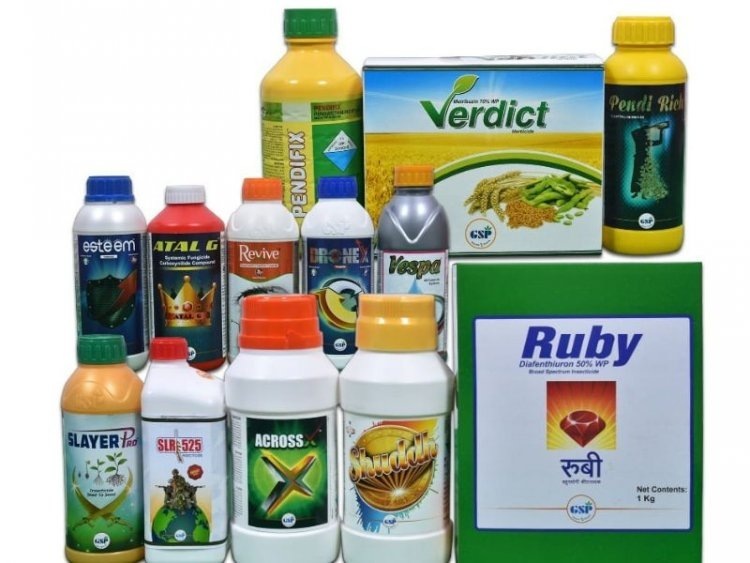
GSP Crop Science Mar 2026: The ₹2,103 Cr Valuation That Prefers Chemistry Over Cash Flow
Date of Publishing -
Spotted a factual error — a wrong number, date, or fact? Tell us and we will check the source.
At a Glance
The corporate lifecycle occasionally produces a structural pivot where a multi-decade asset base is suddenly supercharged by public capital. GSP Crop Science Limited, freshly listed on March 24, 2026, after raising ₹400.00 crore via its Initial Public Offering (IPO), represents exactly this transition. Headline metrics reveal an enterprise scaling its top line to ₹1,517.11 crore in FY26, alongside a trailing twelve-month profit after tax of ₹101.17 crore. However, these numbers obscure a profound alteration in the underlying balance sheet: the infusion of ₹240.00 crore in fresh equity has been primarily directed toward the systematic dismantling of both long-term and short-term debt obligations, driving total borrowings down to ₹262.11 crore.
Investor intrigue is fundamentally anchored to an expanding intellectual property estate, featuring 102 granted patents and 108 pending applications. This technical engine has successfully shifted the company’s revenue mix away from low-margin, commoditized generics toward high-barrier patented combination formulations, which now account for 17.00% of total sales.
Yet, this operational momentum is accompanied by clear financial vulnerabilities. Working capital intensity remains structural and severe, with debtor days stretching to 133 days and total trade receivables consuming ₹553.00 crore of capital. Furthermore, a 40.00% reliance on Chinese supply chains exposes the operating margin to geopolitical freight volatility and input cost shocks. For public markets, the core question is no longer about the efficacy of GSP’s chemical processes, but whether its capital efficiency can break free from the gravitational pull of traditional agrochemical working capital cycles.
Introduction
GSP Crop Science arrives on the public bourses with a 40-year operational heritage dating back to 1985. Operating as an integrated agrochemical manufacturer, the company has constructed a footprint that spans the entire value chain from active technical ingredients to end-consumer branded formulations.
The strategic evolution of the business is defined by its recent transition into a listed entity. By concluding its public market debut in the final weeks of March 2026, management has chosen to alter its capital structure at a time when the broader agrochemical sector faces intensifying regulatory scrutiny and erratic climatic patterns. The deployment of the fresh issue proceeds toward debt rationalization indicates an explicit intent to fortify the company’s credit risk profile before embarking on its next phase of international capital expenditure.
Business Model: WTF Do They Even Do?
GSP Crop Science makes its money by designing, cooking, and packaging the chemical armor that stops bugs, weeds, and fungi from eating a farmer’s profits. They slice their business into two main production models: Formulations (the finished, retail-ready crop juices) at 71.81% of revenue, and Technicals (the pure, raw active ingredients) at 28.19%.
If you look at what actually goes into the drums, Insecticides are the undisputed heavy lifters at 58.80% of the mix, followed by Fungicides at 15.30% and Herbicides at 14.90%.
The commercial strategy relies on a multi-track distribution layout. The domestic B2C business accounts for 45.00% of sales, moving branded products like Platform, PCT-410, and Raavan through an army of 5,000 to 6,000 distributors across 20 states. Meanwhile, the B2B division behaves like a back-alley kitchen for the elite of Indian agrochemicals, selling raw technical components and white-labeled formulations to major houses including Rallis India, Sumitomo Chemical, and Bharat Rasayan.
The real economic engine, however, is their “first-in-India” process innovation. GSP identifies heavy-hitting molecules whose product patents have expired—like the massive insecticide Chlorantraniliprole (CTPR)—invents a new, non-infringing manufacturing process, and launches it domestically while global innovators are still packing up their legal briefs. They then take that molecule, fuse it with another compound to create a branded, patented combination cocktail, and enjoy gross margins of 55.00% to 60.00%, leaving the basic generic grinders to fight over the 35.00% crumbs.
Financials Overview
Figures are consolidated, in ₹ crore.
Quarterly Performance
Metric
Latest Quarter (Mar 2026)
YoY
QoQ
Revenue
₹402.47
+30.68%
+48.89%
EBITDA / Operating Profit
₹36.29
-8.57%
+172.65%
PAT
₹20.48
-9.62%
Turnaround from -₹5.37
EPS (₹)
₹4.40
-24.27%
N/A
What is Management Promising in the Coming Quarters?
During the April 2026 interactions, management outlined a clear trajectory for their asset utilization and international footprint. With current technical plant capacity utilization hovering at 70.00% to 75.00% and formulations at a seasonal 30.00% to 40.00%, the executive team stated that the existing infrastructure provides an embedded revenue runway up to ₹1,900.00 crore to ₹2,000.00 crore without requiring large-scale capital expenditure. “Our plant capacity is sufficient to cover almost our three-year strategy,” the management team confirmed, indicating that near-term volume growth will be driven by operational debottlenecking and a structural pivot toward low-volume, high-value chemistry.
Crucially, the company has established a corporate subsidiary in Brazil with the explicit purpose of replicating its domestic high-margin patent model in Latin America. Rather than exporting cheap generic bulk, the CFO noted that GSP is actively registering its premium patented combinations directly in international jurisdictions to capture structural pricing power over the next 36 months.
When sequential operational jumps fail to translate into year-on-year bottom-line protection, the quality of your raw material pass-through demands deep scrutiny.
Does a massive sequential jump in operating profit matter if the net profit line still shrinks on a year-on-year basis?
Valuation Discussion: Fair Value Range Only
To determine where GSP Crop Science sits on the value spectrum, we examine its trailing financial performance against historical public market