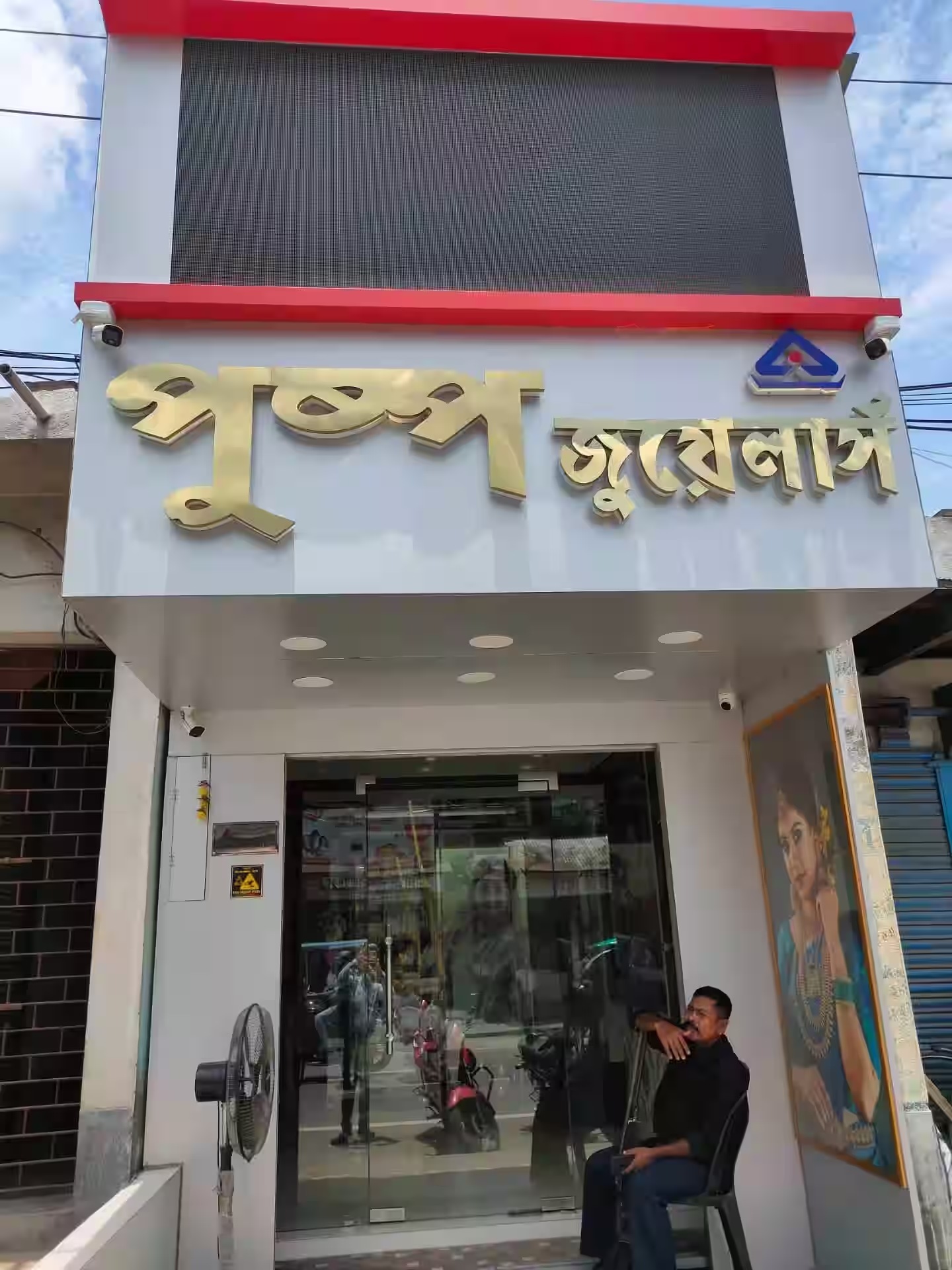
Pushpa Jewellers FY26: Revenue Up 49%, Operating Cash Flow Down ₹51 Crore, and a Freshly Listed Balance Sheet Learning to Walk
Spotted a factual error — a wrong number, date, or fact? Tell us and we will check the source.
General information and entertainment, not investment advice. The author is not a SEBI-registered adviser or research analyst. No recommendation, no promised returns. Markets carry risk including loss of capital. Figures may not be current. Consult a registered adviser before acting.
1. At a Glance
Pushpa Jewellers closed FY26 with ₹418 crore of sales, up 49% on the year, and a net profit of ₹25.9 crore. On paper, a growth story that behaved itself. Then the cash flow statement walks in and sets the tone: operating activities consumed ₹51 crore during the year, against a positive ₹0.15 crore the year before.
The gap between the two is the whole entry. Profit sits at ₹25.9 crore; operating cash sits at negative ₹51 crore. The reconciliation lives in the working capital lines — inventory rose from ₹35 crore to ₹91 crore, receivables from ₹20 crore to ₹36 crore. A B2B gold manufacturer grew fast, and growth in this model is paid for in stock and unpaid invoices before it is paid for in cash.
The company also joined the public markets in July 2025, raising ₹78.9 crore of fresh equity, which is precisely why the financing line reads +₹65 crore and plugged the hole. A business can grow its way into a cash squeeze; here the IPO arrived to fund the squeeze. Whether inventory that quintupled in two years is a growth engine or a parking lot is the question the rest of this entry keeps circling back to.
2. Introduction
Incorporated in 2009 in Kolkata, Pushpa Jewellers manufactures gold jewellery and sells it wholesale — B2B, in bulk, to retailers and other jewellers rather than to walk-in buyers. It converted from private to public limited and listed on the NSE Emerge SME platform on 7 July 2025.
The listing year was eventful beyond the IPO. In November 2025 the company disclosed an FIR and the arrest of its Data Management Manager. Two independent directors departed across the year — one in September 2025, one in March 2026. In May 2026 shareholders voted down a proposed preferential issue of 20 lakh warrants at an EGM, and in June 2026 the board appointed a new independent director and revised the remuneration of its managing director and CEO.
The reported financials, meanwhile, kept climbing: sales compounding 53% over five years, profit 72%. The business is run by the Tibrewal family — Anupam as Chairman and Managing Director, Mridul as Whole-Time Director and CEO, Madhur as CFO. The narrative below is what the numbers say, in the order they say it.
3. Business Model: WTF Do They Even Do?
Pushpa designs jewellery in-house and outsources the actual making of it to roughly 33 independent Kolkata artisans — karigars — paid per job. The company owns the designs, the quality checks, and the customer relationships; it does not own the factory. This is the asset-light model in its purest form: scale the volume without scaling the fixed assets, and let variable karigar costs flex with orders.
The catalogue runs to 2,367 designs at an average product price around ₹62,000 — necklaces (about 74% of H1-FY26 revenue), earrings (~15%), and mala (~10%). It is a necklace business wearing a full-portfolio costume.
Two facts deserve to sit next to each other. First, the customer base is concentrated: the top ten clients were about 38% of FY25 revenue. Second, the geography is concentrated: southern states accounted for roughly 87–88% of revenue, with Telangana and Karnataka alone near two-thirds. A wholesale manufacturer whose revenue leans on a handful of big southern retailers is a company whose fortunes move when a few phone calls do.
The strangest line in the file is the volume trend. Gold sold fell from 423 kg in FY23 to 356 kg in FY24 to 297 kg in FY25 — down every year — while revenue rose across the same span. Fewer kilograms, more rupees. Rising gold prices and a lightweight-design strategy explain the direction; the arithmetic still means the business sold less metal for more money three years running.
Does a design-led, lightweight strategy still count as a moat when 88% of it ships to one region?
4. Financials Overview
Figures are standalone, in ₹ crore. The latest reported period is the half-year ended March 2026.
Metric
Latest Half (Mar 2026)
YoY (vs Mar 2025)
Prev Half (Sep 2025)
Revenue
247
+80%
171
Operating Profit
22
+22%
16
PAT
15
+15%
11
EPS (₹)
6.13
—
4.55
Revenue in the March 2026 half was the biggest six-month figure the company has printed, and it roughly matched the entire FY24 year in a single half. Operating profit grew, but slower than sales — the margin held at 9% rather than expanding, so the top-line surge did not carry an equivalent profit surge with it.