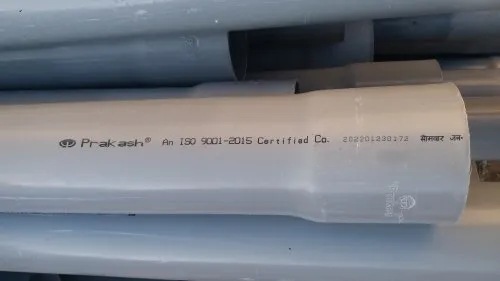
Prakash Pipes FY26: Pipes Held Steady, Packaging Took the Wheel
General information and entertainment, not investment advice. The author is not a SEBI-registered adviser or research analyst. No recommendation, no promised returns. Markets carry risk including loss of capital. Figures may not be current. Consult a registered adviser before acting.
1. At a Glance
FY26 brought two tales. The PVC pipes division—the company’s bread-and-butter—stumbled on raw material volatility and unseasonal rain, pushing segment revenue down 3% to ₹424 Cr and forcing the division into lower-margin territory. The flexible packaging arm, smaller but nimbler, grew 1% to ₹365 Cr and delivered better momentum on customer wins and exports.
Net profit tumbled 48% year-on-year to ₹43 Cr, though Q4 alone (₹13 Cr) showed stabilisation. Debtors stretched 4 days further to 45 days, while inventory bloat hit 52 days—the highest in five years, signalling either slowing takeaway or hedged input costs. Margins compressed sharply: operating profit margin fell from 16% to 8%.
The balance sheet shed ₹39 Cr of debt in the year, but cash fell ₹201 Cr because capex ran wild—₹197 Cr went out investing. A 34% dividend was declared for the year (24% final plus 10% interim), the highest payout since 2024.
The tension: A company fixing its debt while growing capacity, but profits fell off a cliff.
2. Introduction
Prakash Pipes Ltd, incorporated in 2017, operates two divisions: PVC pipes & fittings for infrastructure and agriculture, sold through ~600 dealers; and flexible packaging laminates and pouches for FMCG, food, and pharma, supplied to ~180 customers. The company’s plants sit in Kashipur, Uttarakhand.
FY25 was strong. Revenue grew 17% to ₹780 Cr, PAT hit ₹83 Cr, and cash from operations was ₹73 Cr. Management pitched steady growth: new CPVC and HDPE capacity, overseas customer diversification, and capex plans.
FY26 changed the script. Raw material price swings hammered PVC pipes; the sector faced pricing wars and volume pressure. Flexible packaging compensated partly—new lamination machinery came online, and the pitch turned to higher-margin structures. But profit swing—from ₹83 Cr down to ₹43 Cr—was bigger than the business had absorbed in recent years.
3. Business Model: WTF Do They Even Do?
Two businesses, not one.
PVC Pipes & Fittings (54% of FY26 revenue) makes SWR pipes, plumbing pipes, casing pipes, CPVC products, and solvent cement. These go into agriculture (wells, drip), construction (house plumbing), and waste management. Installed capacity is ~60,000 MT/year. The division shipped 42,632 MT in FY25 and 48,118 MT in FY26 (up 13%), but revenue fell 3% because the price per kilogram collapsed. A 600-dealer network handles distribution—mostly in North India (UP, Uttarakhand, Delhi NCR account for ~80% of sales).
Flexible Packaging (46% of FY26 revenue) makes laminates, pouches, prefab bags, and blown PE films. Clients are blue-chip: Patanjali, Dabur, DS Group, Haldiram, Ruchi Soya. Installed capacity is 19,200 MTPA, expanding to 26,400 MTPA by end-FY26. Volume jumped 37% to 15,458 MT in FY25, then fell 7% to 15,458 MT … (check: FY25 = 15,458; FY26 = hmm, data shows 15,458 for FY25, no FY26 volume in sheet; the announcement says -7%, so ~14,400 MT). The business is capex-heavy and newer; its margin profile is wider.
Why two divisions? Hedging. PVC pipes is cyclical, commoditised, and vulnerable to resin prices. Packaging is higher-touch, customer-concentrated, but growing and exports-capable.
The topline eked out 1% growth, but the bottom fell out. Depreciation jumped to ₹14.67 Cr (from ₹11.06 in FY25)—a 32% spike, reflecting capex coming online. Interest halved to ₹2.94 Cr as debt fell. Taxes stayed at 26% of PBT.
Quarterly Trend (FY26)
Q1-Q3 showed weakness: PAT averaged ₹10 Cr per quarter. Q4 jumped to ₹13 Cr, driven by 22% revenue growth YoY (₹223 Cr vs ₹183 Cr). Operating profit in Q4 stood at ₹17 Cr (8% margin), below the company’s typical 12–16% band but stable quarter-on-quarter.