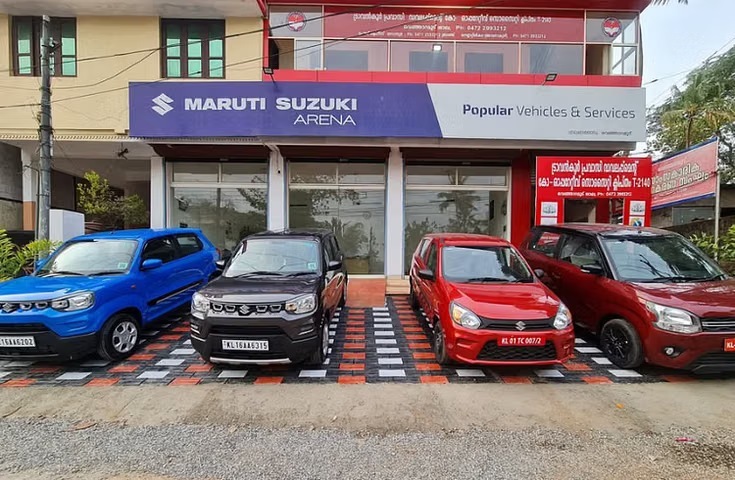
1. At a Glance – The Comeback Kid With EMI Problems
₹763 crore market cap. ₹1,785 crore quarterly sales. 30.8% YoY revenue growth. Q3 PAT at ₹0.67 crore after a string of red quarters. Stock at ₹107, down 26.6% in 3 months. Debt at ₹1,111 crore. ROCE 4.85%. ROE -2.25%.
Ladies and gentlemen, this is Popular Vehicles & Services Ltd (PVSL) — a dealership empire trying to do a financial U-turn while carrying a truckload of borrowings.
After posting losses through FY25, Q3 FY26 has finally turned green. Not “Diwali fireworks green,” but “at least the inverter started working” green.
Sales are flying. Margins? Still gasping.
The business runs 450+ touchpoints across 4 states, sells 44,000+ new vehicles annually, 10,000+ used cars, and services over 10 lakh vehicles. That’s scale. But scale without margin is like selling dosa at cost price — crowd milega, paisa nahi.
So the real question:
Is this a dealership giant quietly rebuilding…
Or a revenue machine running on thin oxygen margins?
Let’s pop the hood.
2. Introduction – Welcome to India’s Car Dealership Mahabharat
If you think selling cars is glamorous, you’ve never seen dealership margins.
PVSL is part of the Kuttukaran Group and operates across Kerala, Tamil Nadu, Karnataka, and Maharashtra. Kerala alone contributes 62% of revenue. Translation: If Kerala sneezes, PVSL catches cold.
The company partners with heavyweights — Maruti Suzuki, Honda, JLR, Tata Motors, Bharat Benz, Piaggio, and Ather Energy. That’s a solid OEM lineup. They’re not some backlane used-car broker.
But dealership economics are brutal:
- OEMs dictate pricing.
- Inventory needs working capital.
- Interest cost eats profits.
- Margins hover at 2–3%.
So what does PVSL do?
It’s pushing higher-margin verticals:
- Services & repairs
- Spare parts distribution
- Premium and luxury vehicles
Smart move. Because new car sales are volume game. Service business is margin game.
And now, after divesting subsidiaries for ₹70 crore and redeploying capital, they’re trying to sharpen focus.
But here’s the twist — despite ₹5,999 crore TTM sales, PAT for TTM is negative ₹20 crore.
How do you sell nearly ₹6,000 crore worth of cars and still struggle for profit?
Time to inspect the engine.
3. Business Model – WTF Do They Even Do?
Imagine this:
You buy a Maruti.
You insure it.
You finance it.
You service it.
You buy spare parts.
You upgrade in 5 years.
PVSL wants a cut at every step.
Revenue Mix (FY25)
- New Vehicles (incl. luxury): 60%
- Commercial Vehicles: 34%
- EVs: 2%
- Spare Parts: 5%
This tells you something important.
They are still heavily dependent on new