01 — At a Glance
The Unicorn That Went Public & Actually Made Profits
- 52-Week High / Low₹284 / ₹166
- Q3 FY26 Revenue₹744 Cr
- Q3 FY26 PAT₹42.4 Cr (ex-item: ₹52 Cr)
- Q3 FY26 EPS₹0.37
- Annualised EPS (Q3×4)₹1.48
- Book Value₹32.3
- Price to Book5.33x
- Market Cap₹19,814 Cr
- Debt₹858 Cr
- IPO Proceeds₹3,890 Cr (Nov 2025)
The Story in Numbers: Pine Labs, India’s first payments unicorn to go public, is no longer a loss-making venture looking for scale. Q3 FY26 delivered ₹744 crore revenue (+24% YoY), ₹171 crore adjusted EBITDA (+42.5% YoY, margin now 23%), and a genuine profit of ₹42.4 crore (₹52 Cr ex-exceptional items). The company processed $51 billion in payments in a single quarter. Listed just 4 months ago on the NSE. Zero downtime during peak loads. And yet, trading 40% below IPO price. Markets remain unconvinced. Data remains brutally honest.
02 — Introduction
Welcome to the Payments Apocalypse, Population: Fintech
Pine Labs is India’s answer to “what if a company made it its life mission to become completely indispensable to every merchant, bank, and brand trying to do business in India?” Founded in 1998 (yes, before the iPod), it’s been quietly reinventing commerce digitization for over two decades—first in POS systems, then in payment processing, then in merchant financing, then in affordability (BNPL), then in issuing and acquiring platforms, and now in building what they call “agentic commerce” with AI agents handling financial transactions.
For non-fintech people: Pine Labs is the invisible infrastructure that makes payments work. Your local electronics shop runs on Pine Labs POS. Your Reliance store processes EMIs on Pine Labs BNPL. Your bank issues prepaid cards on Pine Labs platforms. Amazon Pay? Running on Pine Labs tech. HDFC Bank, Axis Bank, ICICI Bank—all rely on Pine Labs for transaction processing, issuing, acquiring, and infrastructure services.
In Q3 FY26 (just ended), the company finally did the thing everyone was waiting for: it became profitable. Not just barely—it crushed profitability targets. The CFO’s framework for every ₹100 in contribution margin flowing to ₹50–60 in adjusted EBITDA is already proving out. Management says “one of the best Q3s in Pine Labs history.” And yet the stock crashed 29% in 3 months post-IPO. The IPO priced at ₹540 and the stock is at ₹172. Do the math. Markets, apparently, hate profitable fintechs that haven’t yet solved the “will it ever make money?” riddle. Hint: it already has.
Concall Note (Feb 2026): “We crushed it in Q3… one of the best, best Q3s in Pine Labs history.” — Management. Then, casually: “85% of transaction throughput for major merchants runs on Pine Labs platforms.” Translation: you can’t even replace us if you wanted to.
03 — Business Model: Payments Unicorn Disaggregated
They Sell Payment Experiences. To Everyone. Everywhere.
Pine Labs operates across two broad segments (though internally they track 5–6 different revenue streams). The business is best understood as a “payments stack”—meaning they sit at the intersection of merchants, banks, consumers, and brands, tokenizing value at every layer.
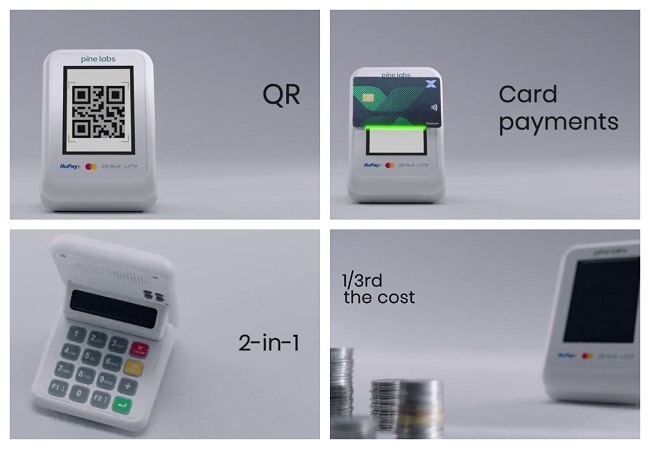
Segment 1: Digital Infrastructure & Transaction Platform (70.5% of FY25 revenue). This is the core—in-store POS systems (physical card swipers and digital checkout points, now 1.84 million deployed), payment gateways (like their “Plural” brand), UPI soundboxes, dynamic currency conversion, BNPL/EMI at point of sale, and fintech infrastructure for banks & FIs. A merchant pays a subscription + per-transaction fee. A bank pays for API access. A consumer gets instant EMI at checkout without filling forms. Pine Labs collects fees from every side.
Segment 2: Issuing & Acquiring Platform (29.5% of FY25 revenue). This is where prepaid cards, closed-loop loyalty solutions, and corporate gifting live. Brands create prepaid products (think Myntra gift cards). Financial institutions issue them. Pine Labs processes the entire stack. They’ve cumulatively issued 367 crore prepaid cards. In Q3 alone, 71.30 crore prepaid cards were in circulation.
Revenue model: subscription + per-transaction fees + percentage of GTV. For affordability (BNPL), they take processing fees + underwriting margins. For issuance, margins are lower but volume is tremendous. The company’s own concall emphasized: “We are not a single-product company.” Correct. They are a multi-segment, multi-buyer, multi-geography cash machine that monetizes every friction point in Indian commerce.
Merchants988KAs of H1 FY26
Digital Checkout Points1.84MDCPs Deployed
Prepaid Cards Issued225MIn FY25
Transactions Processed1.75BIn FY25
GTV Reality Check: In FY25, Pine Labs processed 11.43 lakh crore (₹1,143,000 Cr) in gross transaction value across 568 crore transactions. That’s 1.14x India’s entire FY24 GDP running through their pipes. One. Single. Company.
💬 If Pine Labs processes ₹11.43 lakh crore annually, what does it tell you about their moat vs payment disruption risk? Comments?
04 — Financials Overview: Q3 FY26
The Profits Arrived. Finally.
Result type: Quarterly Results | Q3 FY26 EPS: ₹0.37 | Annualised EPS (Q3×4): ₹1.48 | Note: Prior year Q3 included ₹12 Cr exceptional item (labor code); adjusted PAT was ~₹52 Cr
| Metric (₹ Cr) |
Q3 FY26
Dec 2025 |
Q3 FY25
Dec 2024 |
Q2 FY26
Sep 2025 |
YoY % |
QoQ % |
| Revenue | 744 | 602 | 650 | +23.6% | +14.5% |
| Operating Profit | 132 | 77 | 75 | +71.4% | +76.0% |
| OPM % | 18% | 13% | 12% | +500 bps | +600 bps |
| PAT (reported) | 42 | -57 | 6 | N/A | +600% |
| PAT (ex-exceptional) | 52 | N/A | N/A | N/A | baseline |
| EPS (₹) | 0.37 | -0.67 | 0.13 | N/A | +184% |
P/E Note (Important): Standard P/E is unreliable because FY25 was loss-making (EPS: -₹1.73). FY26 annualised basis Q3 earnings (₹1.48) would imply a P/E of ~116x, which is nonsensical. Price-to-Sales (8.71x) and Price-to-Book (5.33x) are more meaningful here. However, the trajectory is what matters: FY25 loss of ₹145 Cr → Q3 FY26 profit of ₹42 Cr (ex-items, ₹52 Cr). Operating margin improved from 13% to 18% YoY, demonstrating genuine operating leverage, not accounting magic.
05 — Valuation: The Difficult Conversation
Is ₹172 a Bargain or a Trap?
Join 10,000+ investors who read this every week.