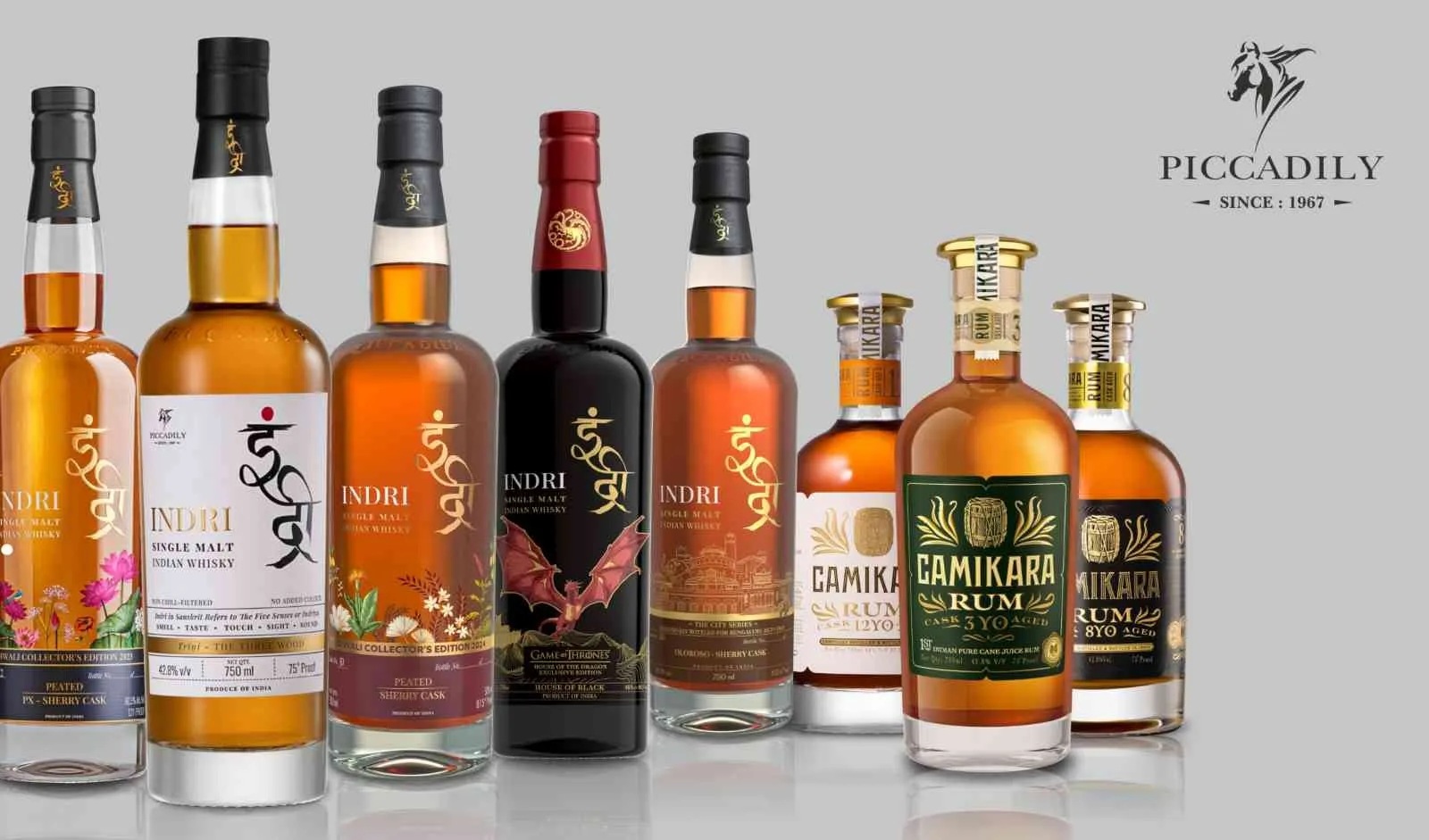
1. At a Glance – A Distillery Wearing a Sugar Mask, About to Tear It Off
Sometimes a company does not transform gradually. It mutates.
Piccadily Agro looks like one of those cases.
A few years ago, this was largely a sugar-linked cyclical business, the kind markets usually treat with suspicion and low multiples. Today, the market is valuing it at roughly 44x earnings while legacy sugar businesses often struggle to command half that.
Question worth asking:
Why is the market paying premium-liquor multiples to a company still technically called an agro business?
Because something strange has happened in the numbers.
IMFL revenue mix has risen from just 2% in FY22 to 43% in FY25 and 42.6% of FY26 revenue from operations came from IMFL. That is not a product mix change.
That is a personality transplant.
Revenue crossed ₹1,143 crore in FY26 versus ₹893 crore in FY25, a 28% rise. PAT climbed to nearly ₹140 crore. EBITDA touched ₹243 crore.
Meanwhile the distillery business grew 41.7%, while sugar declined.
The company is literally telling you what it wants to become.
Not a sugar business.
A premium spirits company.
And then came the demerger proposal.
That is where this gets interesting.
Because markets love narratives, but they worship pure-play narratives.
A sugar division separation could change how this business is valued.
But there is another layer.
This is not just about selling whisky.
This may be one of India’s rare listed premium spirits stories trying to move from commodity economics into luxury economics.
Huge difference.
Commodity businesses fight on price.
Luxury businesses fight on perception.
And perception can mint margins.
Distillery EBITDA margins reportedly touched 31.5%.
Sugar margin was 1.5%.
That spread almost looks like two unrelated businesses accidentally sharing the same balance sheet.
Now ask:
If one business makes barely anything…
and the other may become globally scalable…
which one deserves the multiple?
That is the central mystery.
Even more curious:
Indri is no longer behaving like an experiment.
It looks like a brand.
Awards pile up.
Distribution expands.
Barrels under maturation rise from 45,000 to 83,800.
Storage moving toward 100,000.
Scotland expansion appears on the horizon.
This is not how a management behaves if they plan to remain a regional liquor producer.
This looks more like empire planning.
Now the detective in us asks uncomfortable questions.
Can a fast-growing premium alcobev story sustain growth when valued richly?
Can execution keep pace with storytelling?
Can working capital and rising debt behave?
Can brand power outrun valuation gravity?
Because this stock is no longer priced for “good.”
It is priced for continued excellence.
And markets are ruthless when excellence merely becomes ordinary.
Still, the ingredients are hard to ignore:
- 83% profit CAGR over 3 years
- 50% profit CAGR over 5 years
- ROE 17.4%
- ROCE 18%
- Debt/equity 0.59 despite expansion
- Distillery becoming the economic engine
This does not look like a sleepy sugar company anymore.
It looks like a premium spirits company trapped in an old legal shell.
And maybe that is why the market keeps staring.
But is it genius…
Or intoxication?
Keep reading.
2. Introduction – When a Sugar Mill Starts Thinking It Is Macallan
Some companies diversify.
Others reinvent.
Piccadily appears to be attempting the second.
Originally built around sugar processing in 1997 and distillery operations from 2007 onward, it spent years looking like a fairly ordinary agro-industrial operation.
Then premium alcohol happened.
Then Indri happened.
And suddenly investors stopped looking at molasses.
They started looking at barrels.
That is a very different lens.
Today the business sits across:
- Premium and luxury IMFL
- Single malt whisky
- Cane rum
- Vodka
- Ethanol and ENA
- Sugar (soon possibly separated)
One part commodity.
One part premium aspiration.
One part valuation puzzle.
Management seems to have walked some of what it talked.
Older strategy centered around premiumisation, expansion, barrel maturation and distillery-led growth.
What happened?
Capacity expanded.
Revenue mix changed.
Distribution widened.
Brand awards multiplied.
FY26 distillery revenue surged.
That is management walking at least some distance.
Not