General information and entertainment, not investment advice. The author is not a SEBI-registered adviser or research analyst. No recommendation, no promised returns. Markets carry risk including loss of capital. Figures may not be current. Consult a registered adviser before acting.
1. At a Glance
Revenue climbed ₹419 Cr to ₹5,288 Cr, a year-on-year jump of 8.6%, yet net profit collapsed from ₹288 Cr to ₹197 Cr—a gut-punch decline of 32%.
The problem was structural, not accidental. Gross margin erosion from commodity inflation and currency losses carved deep, while the balance sheet absorbed ₹785 Cr in capex. The company remains a contract manufacturer for room AC and washing machines, both sectors where pricing power is a luxury. RAC production still grew despite the industry contracting 15%, suggesting market share gains—a quiet win that got swallowed by arithmetic.
At ₹470 per share (prices referenced are not live), the market prices the stock at 68x trailing earnings, nearly double the median consumer durables peer and starkly above its own 5-year average.
The central tension: margin recovery hinges on input cost stabilization and working capital discipline, both of which management claims are already underway.
2. Introduction
PG Electroplast is a contract manufacturer of consumer durables—room air conditioners, washing machines, coolers—and plastic components for the sector. The company also has a newly acquired refrigerator division and was backing a JV for TV assembly before that shifted to Goodworth Electronics in FY24.
The firm operates 11 manufacturing units spread across Roorkee, Greater Noida, Bhiwadi, and Ahmednagar. It supplies 50+ leading brands in India and globally: LG, Carrier, Voltas, Whirlpool, Godrej, and others.
FY26 was a year of simultaneous demand and supply shocks. An early monsoon strangled RAC sales in June-July. GST rate cuts announced in August pulled forward purchases into December. A BEE rating transition drained winter demand. Meanwhile, commodity prices and INR depreciation (~20% vs USD over the year) squeezed input costs relentlessly. The concall management quantified Q4 operational losses at ₹420 Cr, mostly from LPG shortage and truck shortage events that idled factories.
The company raised ₹1,500 Cr via QIP in May 2025, signaling its appetite for growth via land acquisition and greenfield capacity. Capex in FY26 touched ₹785 Cr against guidance of ₹700–750 Cr.
3. Business Model: WTF Do They Even Do?
Products (formerly 61% of consolidated revenue, now ~85% at ₹1,412 Cr in Q4 FY26, or roughly ₹5,600 Cr annualized) remain the engine. Within products:
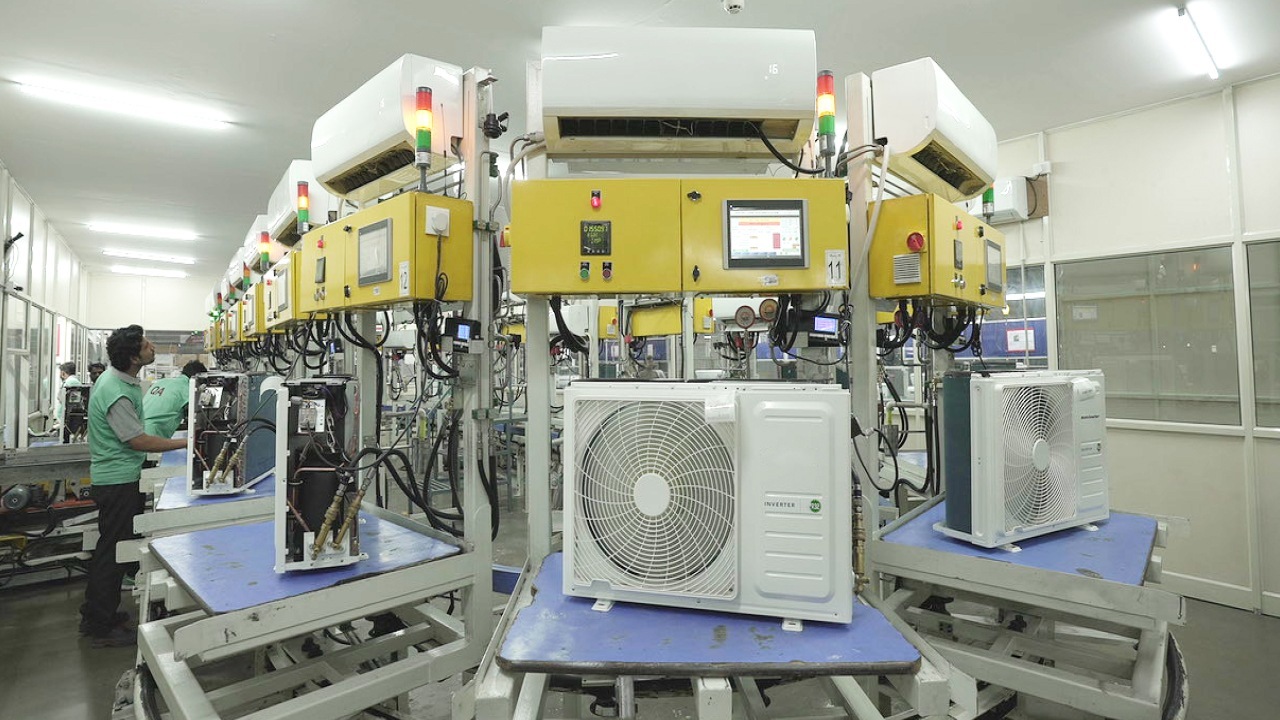
RAC (room air conditioners) is the king. The company is India’s 2nd largest ODM (Original Design Manufacturer) player for finished AC units, servicing over 30 brands with indoor, outdoor, and window units. In FY24 it sold 2m RAC units; FY25 capacity expanded to 475,000 units/month (or ~5.7m per year). FY26 showed resilience—revenue grew 9% on-year despite the industry declining 15%, implying wallet gains even amid seasonality chaos. Q4 FY26 RAC revenue hit ₹1,210 Cr, down 12% YoY but still strong given the operational disruptions.
Washing machines (both semi- and fully automatic, 6–7.5 kg capacity) showed the biggest voltage. The division grew 52% in FY26 full-year and 70% in Q4 alone. It is India’s 2nd largest ODM vendor for washers, servicing 25+ brands. The concall framed expected FY27 growth at 30–35%, conditional on post-Q1 order visibility.
Coolers (window, desert, personal models) flat-lined in FY26, hurt by unseasonal rain.
Plastic moulding (25% in FY24, now ~20%) is the company’s longest-standing strength. It is India’s largest precision plastic component vendor for consumer durables. Growth was muted (27% FY22–24), but it is a steady cash-cow business that avoids the fashion and seasonality of finished ACs.
Electronics (formerly 13%, now ~7%) assembles PCBs for TV manufacturers. A new JV with Goodworth Electronics took over most TV business in FY24, so this segment is slated to shrink.
The model is asset-light in parts (outsourced raw materials and components) but capex-heavy in land and equipment. The company is backward-integrating into refrigerant and compressor manufacturing to deepen margin control and supply resilience.
4. Financials Overview
Figures are consolidated, in ₹ crore.
FY26 Results vs FY25
Metric
FY26
FY25
YoY Change
Revenue
5,288
4,870
+8.6%
EBITDA
442
519
-14.9%
PAT
197
288
-31.7%
EPS (annualized)
6.89
10.07
-31.6%
The collapse in PAT relative to revenue growth shows the squeeze: topline grew but profitability contracted sharply. EBITDA margin fell from 10.6% to 8.3%. Net margin plummeted from 5.9% to 3.7%.
Q4 FY26 (Mar 2026 Quarter)
Revenue ₹1,717 Cr (down 10.1% YoY). Net profit ₹65 Cr (down 55.3% YoY from ₹145 Cr in Q4 FY25). The concall quantified ₹420 Cr in lost revenue due to LPG shortage (2-week plant halts) and truck shortages (₹300 Cr + ₹120 Cr respectively), which meant Q4 “would have crossed ₹2,100 Cr in sales” without these discrete shocks. PAT impact estimated at ~₹120 Cr due to fixed-cost absorption.
Input cost inflation (commodity + FX) carved a 250 bps gross margin hit in Q4 that the company could not fully pass through to customers.
Management Guidance & Concall Notes
From the May 2026 concall for FY26 results: the company reaffirmed its appetite for growth, noting that “channel inventory normalized materially” from a peak of ~5m units during FY26, and April–May demand trends were “better” YoY. FX remains the “big joker in the pack”—MTM losses on import liabilities hit ₹38.8 Cr in FY26 vs a gain of ₹18 Cr in FY25. Management expects EBITDA margins to improve towards ~8% in FY27 as operating leverage returns and input pressures