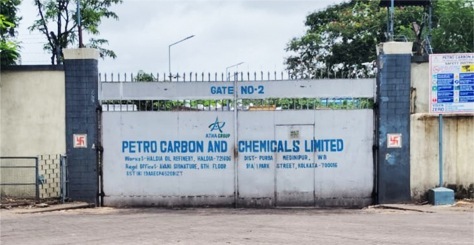
Petro Carbon & Chemicals Ltd H1FY26 – Coke, Carbon & Corporate Comedy in the Atha Style
1. At a Glance
If you thought the only “carbon” that could make you rich was in ESG greenwashing, think again. Petro Carbon & Chemicals Ltd (PCCL), part of the mighty Atha Group, is here to prove that burning stuff for a living can still be… well, profitable-ish. At ₹186 per share (as of Nov 26, 2025), the stock has been stuck between ₹150–₹246 like a pressure cooker waiting for the next whistle. Market cap stands at ₹458 crore, which is roughly what NALCO spends on coffee in a fiscal quarter.
The company just declared its H1FY26 results (Sept 2025): Revenue ₹260 crore, PAT ₹2.93 crore — down 64.6% YoY. P/E stands at an absurd 111x, EV/EBITDA 30.8x, and the dividend yield is an existential zero. The return ratios are modest — ROE at 5.4% and ROCE at 4.98% — both low enough to qualify as PSU cosplay. The firm has debt worth ₹258 crore (D/E 1.49x), and despite an “earnings yield” of 2.59%, it continues to capitalize interest like an overenthusiastic student taking a compound interest class.
But hold on — they’ve also commissioned a 10 MW captive power plant, bagged MoEFCC approval for 72,000 TPA Advanced Carbon Materials, and revamped their carbon paste facility. Clearly, the Athas are turning up the heat — quite literally.
2. Introduction
Let’s set the stage: a Kolkata-based carbon manufacturer, selling to metal giants like NALCO and Hindalco, is quietly powering India’s aluminium dreams — and maybe your EV batteries too. PCCL’s single product — Calcined Petroleum Coke (CPC) — is one of the purest forms of carbon available. Fancy name aside, it’s just heated petroleum residue — but in the industrial world, it’s black gold.
The Atha family’s business empire spans steel, mining, and power, and PCCL is their carbon cash cow. With a production facility nestled inside Haldia Refinery (30 acres of fiery ambition), it churns out 93,744 metric tonnes per annum of CPC — a product critical for aluminium smelting and electrode manufacturing.
Yet, despite all that fire and energy, profitability remains lukewarm. Revenue growth is steady, but profits? Not so much. The company’s last five years saw sales CAGR of just 10%, and profit growth that looks like an ECG during an earthquake — erratic, unpredictable, but somehow still alive.
So, what’s keeping this carbon crusader running? A mix of monopoly-grade customers, government orders, and a well-timed expansion plan that could make or break the next chapter. Let’s dig into the soot-covered spreadsheets.
3. Business Model – WTF Do They Even Do?
In the simplest terms, PCCL bakes petroleum residues into something industries can’t live without: Calcined Petroleum Coke. Imagine taking leftover crude oil sludge, giving it a spa day at 1200°C, and selling it to aluminium plants for anode production. That’s PCCL’s bread and butter — or rather, coke and carbon.
Their clients include the holy trinity of metal manufacturing: NALCO, Hindalco, and other chemical and metallurgical players. About 70% of their output goes to the aluminium industry, and nearly 90-95% of total revenue comes from just two clients — a level of dependence that makes Indian startups jealous.
Operating on a pure B2B model, PCCL supplies to sectors that rarely delay payments but also rarely negotiate premiums. The company’s customer base is loyal (because there aren’t many alternatives), but this also means it’s locked in a low-margin game.
Production happens at Haldia, West Bengal, inside the refinery ecosystem. This proximity to raw materials keeps logistics costs manageable, but given the power-intensive nature of calcination, energy costs are always a sword dangling overhead. Hence, that new 10 MW captive power plant — an effort to self-fuel and self-heal.
4. Financials Overview
Lock Type: Half Yearly Results (Standalone Figures in ₹ Crore)
Metric
H1FY26 (Sep 2025)
H1FY25 (Sep 2024)
H2FY25 (Mar 2025)
YoY %
QoQ %
Revenue
260
176
120
47.6%
116.7%
EBITDA
16
9
4
77.7%
300%
PAT
2.93
8
1
-64.6%
193%
EPS (₹)
1.19
3.35
0.48
-64.4%
148%
Witty Commentary: It’s a quarter where revenue doubled, but profits fainted. Classic industrial economics: burn more, earn less. Operating margins stand at 6%, still recovering from last year’s rollercoaster — remember that 26% OPM back in Mar’24? Well, that was the peak; now we’re back to “PSU mode.”
EPS annualized at ₹2.38 gives a mind-bending P/E of 78x. If carbon had feelings, it would