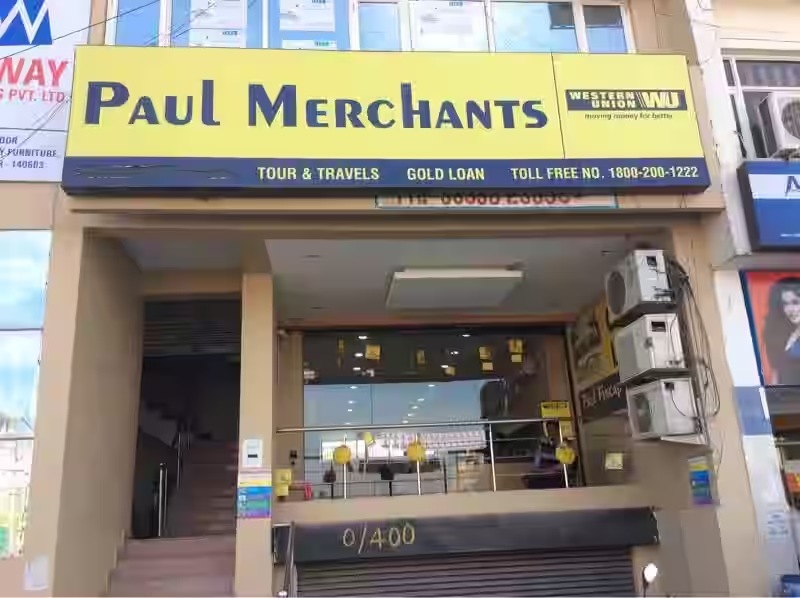
Paul Merchants FY26: A ₹2,074 Cr Business That Made Its Money Everywhere Except The Business
Spotted a factual error — a wrong number, date, or fact? Tell us and we will check the source.
General information and entertainment, not investment advice. The author is not a SEBI-registered adviser or research analyst. No recommendation, no promised returns. Markets carry risk including loss of capital. Figures may not be current. Consult a registered adviser before acting.
1. At a Glance
Paul Merchants closed FY26 with consolidated revenue of ₹2,074 Cr, down from ₹6,506 Cr two years earlier — a top line that has shrunk to less than a third of its FY23 peak. Yet net profit for the year landed at ₹269 Cr, the largest in the company’s recorded history. Both facts are true, and the distance between them is the entire story.
The operating business lost money at the profit line. Full-year operating profit was negative ₹15 Cr. What carried the year sat elsewhere: ₹300 Cr of other income and a subsidiary’s one-time gold-loan sale to L&T Finance. Strip those out and the core forex engine is idling.
The market has drawn its own conclusion about the durability of that profit. A company with roughly ₹897 Cr of net worth and near-zero debt carries a market capitalisation of ₹151 Cr — it trades at 0.16 times book. Book value works out to ₹2,909 per share.
Here is the tension worth holding for the next 2,000 words: the balance sheet says one thing, the income statement says another, and the two have not agreed for three years running.
2. Introduction
Incorporated in 1991 and headquartered in Chandigarh, Paul Merchants is the flagship of the Paul Group, operating in money changing and cross-border remittances. It holds an RBI Authorized Dealer Category II licence and acts as a sub-agent for inbound international money transfers. It is also an IATA-accredited travel agency.
The recent history is one of contraction and redirection. Forex revenue fell on a sustained basis, which Infomerics attributed to a sharp drop in students going overseas after Canada and the UK tightened norms from January 2024, cutting the sale and purchase of foreign exchange in the process.
Meanwhile the group has been rearranging itself. Its material subsidiary, Paul Merchants Finance, sold its entire Gold Loan business undertaking to L&T Finance for ₹660.64 Cr, a transaction completed on 9 June 2025. And capital has begun flowing toward real estate: the board approved a term-loan limit to wholly-owned realty subsidiary PMRPL, raised from ₹100 Cr to ₹150 Cr on 27 May 2026, with a delegated buffer of a further ₹50 Cr.
A forex company, funding a real-estate subsidiary, booking its best-ever profit from selling a lending business. The FY26 accounts are less a report card than a transition document.
3. Business Model: WTF Do They Even Do?
On paper, Paul Merchants does a lot: International Money Transfer, Foreign Exchange, Tours & Travel, Domestic Money Transfer, Business Payment Solutions, International SIM cards, and (until recently, via subsidiary) Gold Loans. In practice, the forex vertical does the heavy lifting — the segment results show it dwarfing Travel and Money Transfer combined.
The model is a spread business. On money changing, the company earns the margin between buy and sell rates; on remittances, prepaid forex cards and referrals, it earns fees and commissions. This is honest work, and it is thin work — the credit assessor describes the operations as largely trading-oriented, which is why the margins are structurally slim. FY26 operating margin was negative 0.75%. When a business runs on a spread that narrow, volume is not a nice-to-have; it is the whole plan.
And volume is exactly what left. Total forex turnover has fallen as overseas student flows dried up. The segment that generates the majority of revenue is the one most exposed to visa policy in the US and Canada — F-1 rejection rates, student visa revocations, and the fate of the Optional Practical Training program. A remittance house whose core customer is a student abroad is, functionally, long on other countries’ immigration paperwork.
Which raises a reader question: when a business is a spread on volume, and the volume is set by foreign immigration policy, what exactly is management steering?
4. Financials Overview
Figures are consolidated, in ₹ crore.
Metric
Latest Q (Mar 2026)
YoY (Mar 2025)
QoQ (Dec 2025)
Revenue
482.12
582.46
504.79
Operating Profit
-0.42
-2.97
-3.16
PAT
2.29
16.69
-14.40
EPS (₹)
7.43
54.12
-46.69
Revenue fell 17% year on year. PAT was up 225% against the March 2025 quarter on the screener basis, but the fuller picture is the swing from