Patels Airtemp FY26: A ₹253 Cr Heat-Exchanger Maker Where Revenue Fell a Third and Q3 Nearly Skipped Work
Spotted a factual error — a wrong number, date, or fact? Tell us and we will check the source.
General information and entertainment, not investment advice. The author is not a SEBI-registered adviser or research analyst. No recommendation, no promised returns. Markets carry risk including loss of capital. Figures may not be current. Consult a registered adviser before acting.
1 — At a Glance
Patels Airtemp closed the year ended March 2026 with revenue of ₹253 Cr, down from ₹388 Cr a year earlier — a 34.8% drop that the company’s own machine-read summary doesn’t soften. Net profit fell in step to ₹10.3 Cr from ₹16.5 Cr, a 37.8% decline. For a four-decade maker of heat exchangers and pressure vessels supplying oil refineries and petrochemical plants, this was a year the order book thinned and the top line followed it down.
The shape of the year is stranger than the annual number suggests. The September 2025 quarter recorded just ₹22 Cr of sales — roughly a quarter of a normal three-month run for this company — before the business clawed back to ₹89.5 Cr by March 2026. A company that builds custom equipment on 4-to-18-month execution cycles will show lumps; this was less a lump than a crater followed by a recovery.
The market currently pays 20.8x earnings here, against an industry P/E of 32.9x. The balance sheet carries ₹88 Cr of borrowings against ₹166 Cr of net worth, debtor days sit at 154, and the order book had moderated to ₹224 Cr by September 2025 from ₹297 Cr a year before. A capital-goods firm lives and dies by its working-capital cycle, and Patels’ cash conversion stretched well past 200 days again this year.
The tension worth holding through the rest of this entry: a company with a clean audit, an unbroken dividend, and a 9.5% ROCE, recording its sharpest revenue contraction in years.
2 — Introduction
Incorporated in 1972 and converted to a limited company in 1993, Patels Airtemp (India) Ltd designs and fabricates process equipment — heat exchangers, pressure vessels, and the turnkey HVAC projects that bracket them. Two manufacturing facilities in Gujarat feed an order book dominated by oil and gas, petrochemicals, and refining.
The promoter story turned over recently. Narayanbhai Patel, the founder-chairman, died in October 2023; his son Sanjiv Patel became Chairman and Managing Director that same month and has run operations for over a decade. In February 2026 the board moved to re-appoint him as CMD for a fresh term running 20 May 2026 to 19 May 2029, at ₹5,50,000 per month, subject to a postal ballot. Shivang Patel was re-appointed Whole-time Director in March 2025.
The company also tidied its corporate structure, approving the wind-up of its dormant US subsidiary, Patels Airtemp (USA) Inc., in December 2023 — an entity that, per the filing, had never traded.
FY26 was the year the order book’s earlier moderation reached the income statement. CARE’s October 2025 note had already flagged that the thinner book would likely pull FY26 revenue down 15–20% year on year; the actual move was steeper.
3 — Business Model: WTF Do They Even Do?
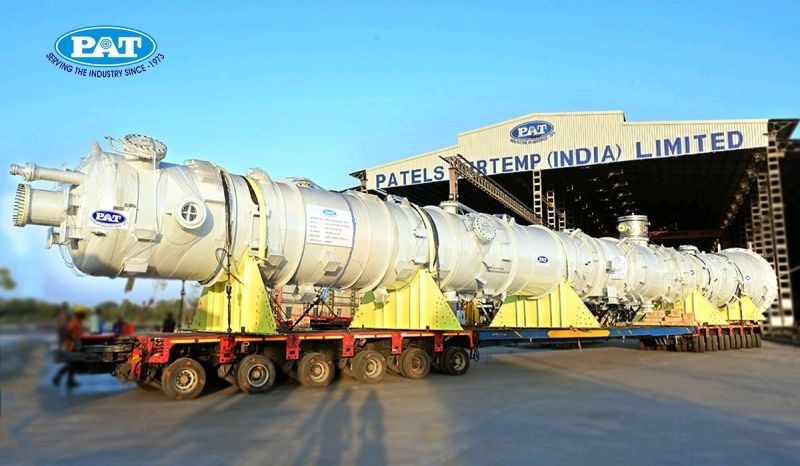
Patels makes the unglamorous metal that keeps refineries from melting. Shell-and-tube heat exchangers, air-cooled heat exchangers, pressure vessels, separators, drums, oil coolers, fin tubes — the kind of equipment that transfers heat between two media without letting them touch, which is exactly as exciting and exactly as essential as it sounds. Heat exchangers alone contributed roughly 93% of net sales in FY25, per CARE’s report, with pressure vessels making up most of the rest.
This is a tender-based business selling to people who buy in bulk and pay in installments. The clientele reads like a roll-call of Indian heavy industry — IOCL, BPCL, HPCL, ONGC, Reliance, plus EPC contractors. PAIL holds ASME “U”, “U2” and “S” stamp authorisations and sits in HTRI, USA — credentials that matter when your product ends up inside a nuclear reactor or a petrochemical column.
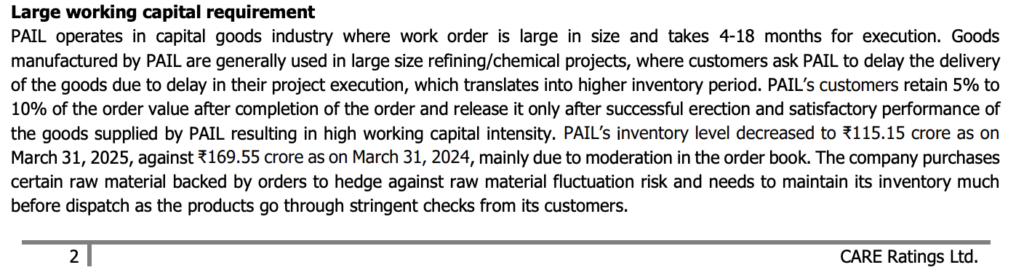
The catch is baked into the model. Customers ask Patels to hold finished goods until their own projects are ready, then retain 5–10% of the order value until the equipment is erected and proven. So inventory piles up before dispatch and cash arrives last. Inventory days ran 201 in FY26 and the cash conversion cycle stretched to 317 days. A company whose products take up to 18 months to build will always have more money locked in steel than in the bank.
Concentration adds spice: of the ₹224 Cr unexecuted order book at September 2025, 93% was heat exchangers, per CARE — a single product family for a single cluster of end-industries. When refinery capex slows, there is no second leg to stand on.
Does a 93%-single-product order book read as focus or as fragility when the