Search for stocks /

Patanjali Foods:₹594 Cr PAT. 68% Profit Surge.Can FMCG Actually Save the Oils Business?

Patanjali Foods Q3 FY26 | EduInvesting
Q3 FY26 Results · Jan–Mar Fiscal Year Reporting

Patanjali Foods:
₹594 Cr PAT. 68% Profit Surge.
Can FMCG Actually Save the Oils Business?

Record quarterly revenue of ₹10,484 crore. FMCG now 30% of revenue but 66% of EBITDA. The biscuits business has already crossed ₹1,000 crore annually. And this company is trading at 32x P/E because India hasn’t realized yet.

Market Cap₹54,456 Cr
CMP₹501
P/E Ratio32.4x
Div Yield0.67%
ROCE15.6%

The Commodity Trap with a Premium Twist

  • 52-Week High / Low₹671 / ₹480
  • Q3 FY26 Revenue₹10,484 Cr
  • Q3 FY26 PAT₹594 Cr
  • Q3 EPS₹5.46
  • Annualised EPS (Q3×4)₹21.84
  • Book Value₹111
  • Price to Book4.50x
  • Dividend Yield0.67%
  • Debt / Equity0.24x
  • Sales Growth YoY16.5%
The Bottom Line: Patanjali Foods just posted a record quarterly revenue of ₹10,484 crore with profit surging 68% YoY. But here’s the rub: the edible oils business (72% of revenue) operates at barely 2–4% EBITDA margins, while FMCG (30% of revenue) is printing 11% margins and 25% margins in Home & Personal Care. The stock is trading at 32.4x P/E, which is a bet that FMCG will eventually dominate the portfolio. Is it a justified bet, or a house of cards built on Rs-denominated pricing in a dollar-based commodity world?

The Most Confusing Stock in the Edible Oil Universe

Let’s establish the identity crisis first. Patanjali Foods is not a company. It’s a corporate portfolio masquerading as a company. Born as Ruchi Soya Industries (a liquidation case in 2019, acquired by Patanjali Ayurved in CIRP), it’s evolved into a bizarre multi-headed creature: part commodity processor, part direct-to-consumer FMCG beast, part plantation operator, and part nutraceutical speculator. That whirlwind transformation is why the stock has rallied 10x from ₹50 to ₹500 in five years.

But here’s the uncomfortable truth: most of that 10x came from mixing portfolio segments at different margins. Buying low-margin edible oil business, bolting on high-margin biscuits and shampoo, and watching the blended EBITDA expand is portfolio alchemy, not operational excellence. Once the mix stabilizes, where’s the next leg of growth?

Q3 FY26 is the inflection moment. The company just delivered the highest-ever quarterly revenue (₹10,484 Cr) and record 9-month results. But dive into the segment performance, and the story splits: oils are grinding along at near-single-digit growth; FMCG is booming at 39% YoY with brutal execution in distribution. The market is paying 32x P/E. Most analysts are silent because they can’t figure out how to model this beast either.

Concall Tone (Feb 2026): Management kept emphasizing “transition and execution” and “repricing actions.” Translation: GST 2.0 disrupted inventory, we’re passing through costs selectively, and demand is coming back. But here’s what they didn’t emphasize: the edible oils EBITDA margin is capped by commodity dynamics, and no amount of distribution can fix that.

Portfolio Play Masquerading as a Conglomerate

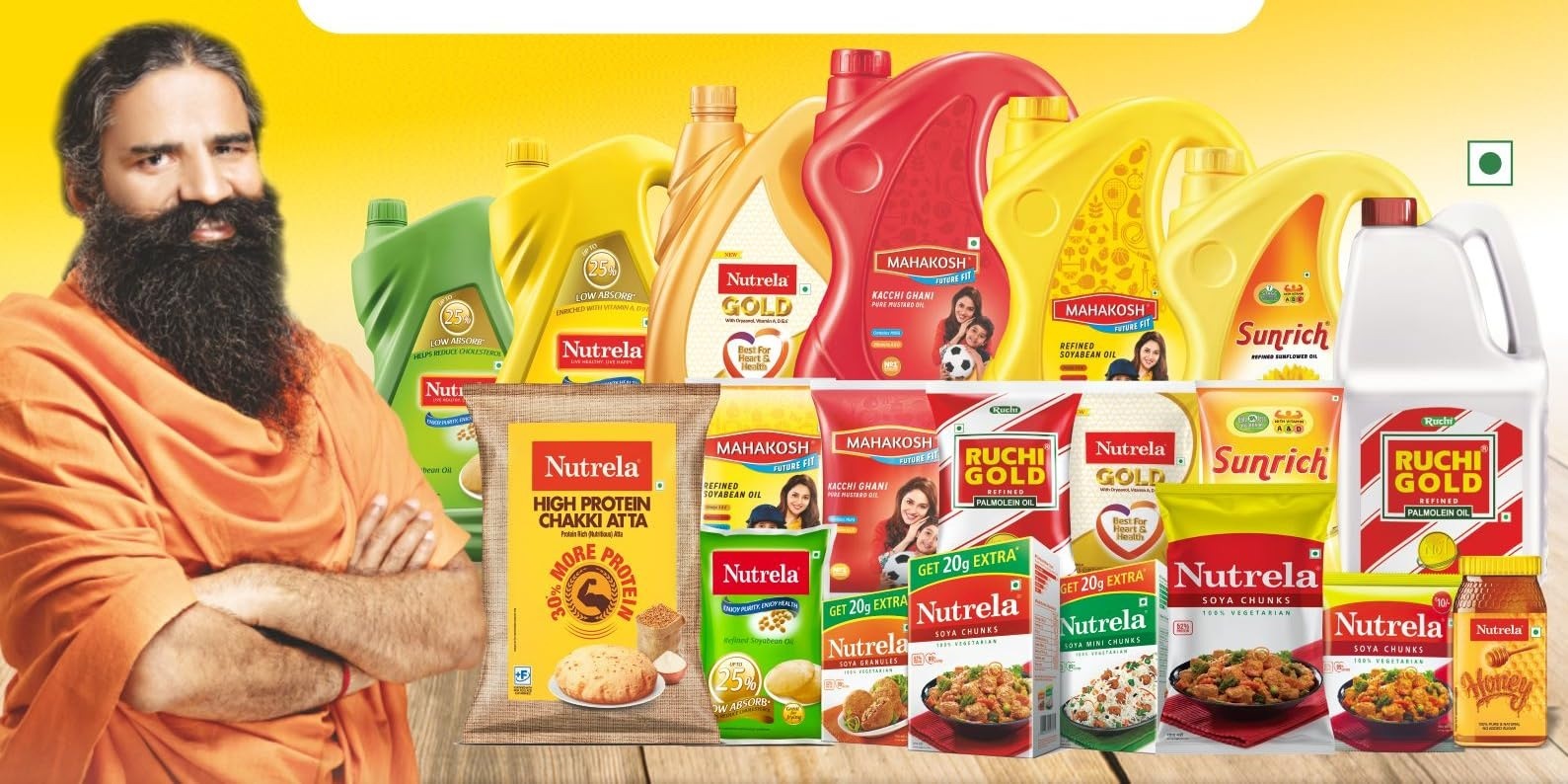
Segment 1: Edible Oils (72% of revenue, 10% of EBITDA). Patanjali sells palm oil (Ruchi Gold), soybean oil (Mahakosh), sunflower oil (Sunrich), and unbranded commodity oil. They crush oil palm, refine it, package it, and distribute through 8,000+ distributors reaching 1.5 million retail touchpoints. Revenue: ₹7,336 Cr in Q3. EBITDA margin: 2.4%. Why so low? Commodity pricing. When palm oil prices fall 12.6% YoY globally, retailers demand lower prices. When they rise, input costs spike. The company hedges FX and commodities, but margin compression is structural. Market share: ~51% in branded automotive oils… wait, wrong company. Here, it’s palm oil at 1st position, soybean at 2nd. The margin framework is 2–4% — and management proudly targets “closer to 4%.”

Segment 2: Foods (16% of revenue, part of 11% EBITDA). Biscuits (Doodh brand), staples (atta, pulses, honey, ghee), ethnic foods. Biscuits alone crossed ₹1,000 crore in 9M FY26 sales. Growth is 26–38% YoY. Margins: ~9–10%. This is where the actual business magic happens. No commodity chaos, brand loyalty exists, and pricing power is present. Ghee in Q3 hit ₹468 Cr (seasonally strong, +46% YoY). Staples is the margin drag — ₹1,256 Cr in Q3 at lower margins because it’s a revenue driver, not a margin play. Near-term innovation: premium biscuits launching in Q4 FY26.

Segment 3: HPC — Home & Personal Care (6% of revenue, 36% of EBITDA). Dental care (₹339 Cr in Q3), hair care, skin care, home care. EBITDA margin: 25%. Dant Kanti (toothpaste) is the growth engine. Management claims dental care is the fastest-growing segment in the HPC portfolio, competing directly against Colgate and Crest. Market intensity? “Fairly intense,” management admitted. But Patanjali’s dental grew ~₹116 Cr YoY to Q3’s ₹340 Cr level, driven by variants and rural/B&C town penetration. The company targets 15% growth in HPC; it’s tracking toward that with 25% margins as proof of execution.

Segment 4: Oil Palm Plantation (1.5% of revenue, 22% EBITDA). High-margin beast. The company operates 108,000 hectares of plantation land (farmer-owned, company manages for 35 years), crushes 300,000 MT of fresh fruit bunches, and extracts 22% EBITDA margins. FY26-27 expansion: +40,000 hectares planned (20,000 Northeast, 20,000 South). This is optionality — long-term, low-leverage growth.

Why This Matters: The portfolio mix is shifting. FMCG was 30% of Q3 revenue but accounted for 66% of EBITDA. Management explicitly targets a “50-50 mix between edible oils and non-edible oils” eventually, with corporate EBITDA “towards double-digit” margins. If they execute, the stock re-rates. If not, it’s a glorified commodity processor trading at a 60% premium to sector multiples.
💬 Here’s the question: Is Patanjali executing a smart portfolio diversification, or is management just inflating reported EBITDA by buying high-EBITDA-margin businesses and bolting them onto a low-margin core? Which camp are you in?

Q3 FY26: Record Revenue, Lumpy Profitability

Result type: Quarterly Results  |  Q3 FY26 EPS: ₹5.46  |  Annualised EPS (Q3×4): ₹21.84  |  9M FY26 EPS (cumulative): ₹11.73

Metric (₹ Cr) Q3 FY26
Dec 2025
Q3 FY25
Dec 2024
Q2 FY26
Sep 2025
YoY % QoQ %
Revenue10,4848,9979,777+16.5%+7.2%
Operating Profit435558552-22.1%-21.0%
OPM %4.1%6.2%5.6%-210 bps-150 bps
PAT594371517+68.2%+14.9%
EPS (₹)5.463.424.75+59.6%+14.9%
The Red Flag & The Green Flag: Revenue is spectacular (+16.5% YoY, record ₹10,484 Cr). But operating profit (EBIT) is down 22% YoY — because Q3 FY25 benefited from a one-off duty-related gain that didn’t repeat. Strip that out, and core EBIT is up QoQ. PAT is up 68% YoY because of an exceptional item (labour code benefit of ₹30 cr in Q3 FY26). So the headline profit surge is partly exceptional. On adjusted basis, the business is growing revenue solidly and maintaining margin, but not expanding it. The market is fine with this because FMCG growth is accelerating and oils are stabilizing post-GST 2.0 disruption.

Is 32x P/E Justified? Let’s Do The Math

Join 10,000+ investors who read this every week.
Become a member
error: Content is protected !!