1. At a Glance
The healthcare sector is a game of beds, but for Park Medi World Limited (PMWL), it has become a game of aggressive, cluster-based conquest. If you’ve been ignoring the second-largest private hospital chain in North India, the FY26 numbers are designed to grab you by the collar. We are looking at a company that just delivered its finest year in history, characterized by a simultaneous explosion in growth, profitability, and financial discipline—a rare “triple threat” in a capital-intensive industry.
The curiosity here isn’t just about the ₹16,794 million revenue (a 21% YoY jump); it’s about how they are doing it. While the big metro players fight for the elite 1%, Park is digging deep into the “bottom and middle of the pyramid.” They have turned government-backed schemes—often viewed as a margin drag by others—into a defensive moat. With an 83% government panel mix, they’ve made it practically impossible for smaller players to compete and too operationally “gritty” for luxury chains to enter their territory.
But here is where it gets sensational: In a single year, PMWL added 610 beds, increasing capacity by 20% in a single stroke through the largest acquisition in its history (Agra) and its largest greenfield project (Panchkula). Most companies would buckle under the interest burden of such expansion. Instead, Park did the unthinkable: they went debt-free. As of February 2026, the company wiped out its term debt, transforming from a leveraged builder into a cash-rich predator.
Yet, before you get lost in the euphoria, look at the red flags. The company’s receivable cycle from the government remains a structural drag at 4.5 months. They are sitting on a massive expansion pile—aiming for 5,460 beds by FY28. This aggressive inorganic “pivot” into Uttar Pradesh (Agra, Kanpur, Gorakhpur) carries significant execution risk. Will these acquired assets ramp up as fast as the spreadsheets suggest, or will the pre-opening costs bleed the margins?
2. Introduction
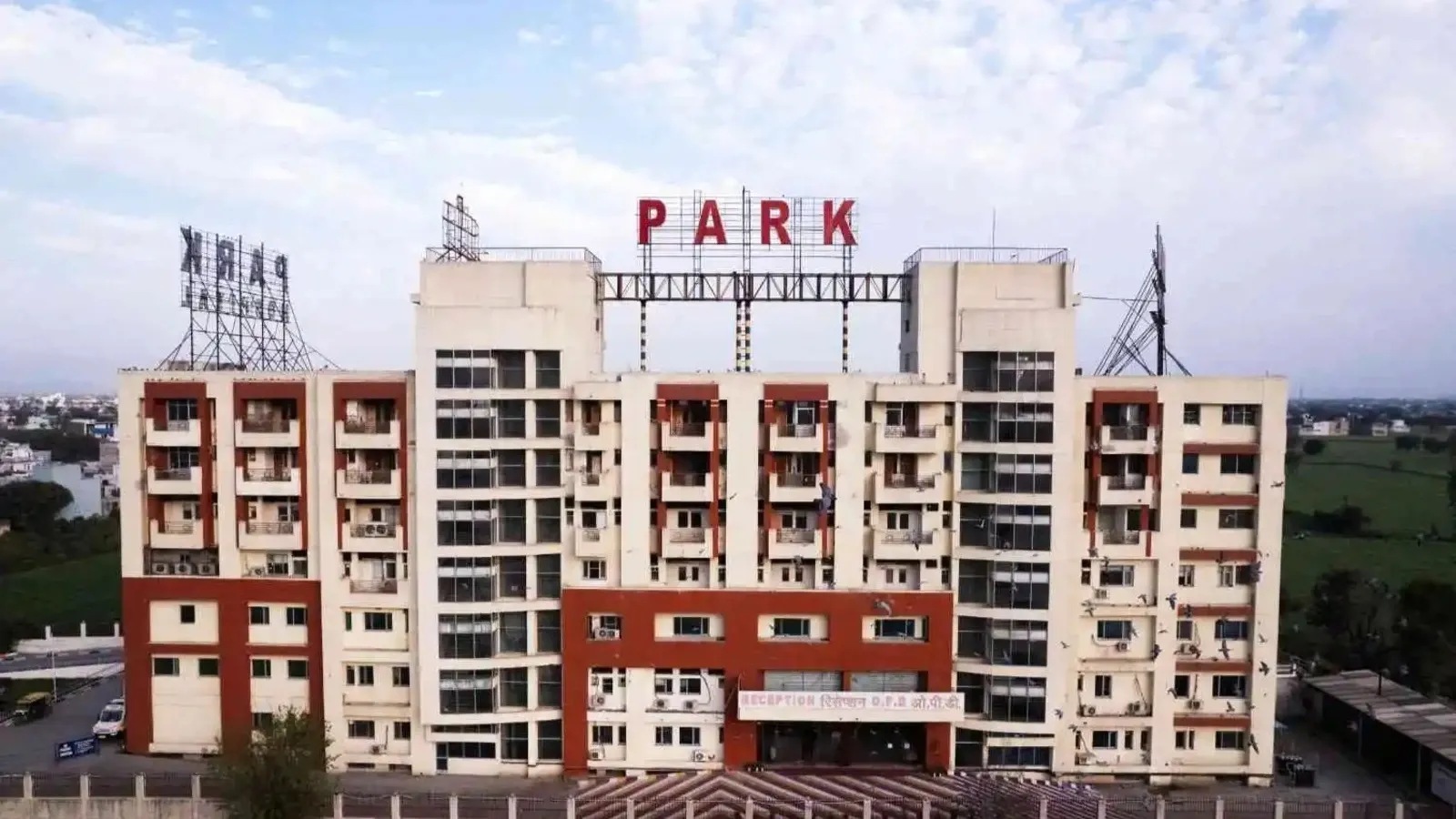
Park Medi World isn’t just a hospital; it’s a regional powerhouse that has spent two decades quietly colonizing Haryana and Punjab. What started as a small clinic in New Delhi by Dr. Ajit Gupta has morphed into a 16-hospital empire with 3,960 operational beds (as of current date).
The strategy is simple but bold: The Cluster Approach. Instead of planting flags randomly across the country, Park builds “pearl necklaces.” They saturate a region, shared-resource synergies like HR and equipment, and dominate the local market share. They are currently the largest private chain in Haryana and the Tricity area.
The recent IPO in December 2025 was the catalyst. It provided the fuel to pay off debt and fund a massive 2,010-bed expansion roadmap. For the smart investor, the story isn’t just about the hospitals they have today, but the massive construction sites in Panchkula, Rohtak, and Kanpur that are about to go live.
Is this a lean, mean medical machine or an overextended chain reaching for too much, too fast? Let’s peel back the financial layers.
3. Business Model – WTF Do They Even Do?
They treat the people that other “premium” hospitals ignore. Park Medi World has built a business on Affordable High-Quality Care. They don’t cherry-pick patients based on their wallets; they welcome the masses covered by ESIC, CGHS, and Ayushman Bharat.
The Secret Sauce:
- The Full-Time Model: Unlike most Indian hospitals that rely on “visiting consultants” (who take a massive cut and leave whenever they want), Park employs a Full-Time Doctor Model. No visiting policy. This keeps clinical consistency high and costs under control.
- The Payer Moat: By embracing government payers (83% of the mix), they secure massive volume. While the ARPOB (Average Revenue Per Occupied Bed) is lower than luxury chains, the “stickiness” of this volume is unmatched.
- Inorganic Growth Junkies: They are masters of the “Turnaround.” They buy underperforming assets (like the 360-bed KPIMS in Agra) and plug them into their management system to flip them into profitability within 2-3 years.
4. Financials Overview
The numbers for Q4 FY26 are out, and they look like a steroid-injected balance sheet. Revenue is up 30% YoY for the quarter, and Net Profit has surged by a staggering 47%.
| Particulars | Latest Quarter (Mar ’26) | Same Qtr Last Year (YoY) | Previous Qtr (QoQ) |
| Revenue | ₹4,604 Mn | ₹3,539 Mn | ₹4,100 Mn |
| EBITDA | ₹1,274 Mn | ₹884 Mn | ₹994 Mn |
| PAT (Net Profit) | ₹768 Mn | ₹524 Mn | ₹528 Mn |
| Annualised EPS | ₹6.56 | ₹5.44 | ₹4.68 |
Witty Commentary: Management is definitely “walking the talk.” In previous concalls, they promised a debt-free status post-IPO, and by end-Feb 2026, they delivered. The EBITDA margin of 27.7% in Q4 is a “pleasant surprise” considering they are in the middle of a massive expansion. Usually, margins dip when you open new beds; Park seems to have cracked the code of keeping the lights on profitably while the paint is still wet in new wards.
5. Valuation Discussion – Fair Value Range
Let’s do the math. PMWL is currently trading at a P/E of 41.7. Is it overvalued? Let’s break it down using the current data.
Method 1: P/E Based Valuation
- Annualised EPS (FY26): ₹5.98 (Reported)
- Industry Median P/E: 46.8
- Implied Value: $5.98 \times 46.8 = ₹279.8$
Method 2: EV/EBITDA
- EV: ₹10,677 Cr
- EBITDA (FY26): ₹444.3 Cr
- EV/EBITDA Multiple: 24.0x
- Given the aggressive growth, a 22x-25x multiple is the sweet spot for the sector.
Method 3: DCF (Simplified)
Taking a 15% growth rate for the next 5 years (conservative given the 50% capacity expansion) and a terminal growth of 5% with a 12% WACC.
- Estimated Fair Value: ₹265 – ₹295
Fair Value Range: ₹255 — ₹285
Disclaimer: This fair value range is for educational purposes only and is not investment advice.
6. What’s Cooking – News, Triggers, Drama
The drama in the Park boardrooms isn’t about scandals; it’s about Land Grabs.
- The Agra Pivot: They just dropped ₹245 Crore to acquire KPIMS in Agra. It’s a 360-bed monster that was only half-operational. Park is going to “re-skin” it with neurosciences and oncology. This is their gateway to Uttar Pradesh.
- Panchkula Launch: On April 10, 2026, they finally opened the 350-bed Panchkula facility. This makes them the “King of Tricity.”
- The CGHS Windfall: The government just hiked CGHS rates by 12-15%. Since 83% of Park’s business is linked to these rates, this is basically “free money” dropping straight to the bottom line by H2 FY27.
- CHRO Shuffle: Manoj Khanna (CHRO) is moving to a regional role. Usually, “transitioning” management is a red flag, but here it looks like a “boots on the ground” move to manage the new 4-unit GTR Circle.
Question for you: Would you trust a company that gets 83% of its money from the government, or does that receivable delay scare you?
7. Balance Sheet
The Balance Sheet has undergone a total transformation. From a debt-heavy regional player to a cash-surplus national contender.
| Row | Mar 2024 | Mar 2025 | Mar 2026 (Latest) |
| Total Assets | ₹1,912 Cr | ₹2,134 Cr | ₹2,813 Cr |
| Net Worth | ₹883 Cr | ₹1,119 Cr | ₹2,104 Cr |
| Borrowings | ₹687 Cr | ₹682 Cr | ₹364 Cr |
| Other Liabilities | ₹343 Cr | ₹382 Cr | ₹427 Cr |
| Total Liabilities | ₹1,912 Cr | ₹2,134 Cr | ₹2,813 Cr |
Balance Sheet Roast:
- Borrowings dropped from ₹682 Cr to ₹364 Cr in a year while they were busy buying hospitals. It’s like buying a Ferrari and paying off your home loan at the same time.
- Net Worth doubled. The IPO was basically a “Get Out of Debt Free” card, and they played it perfectly.
- Total Debt/Equity is now 0.18. They are so deleveraged it’s almost boring.
8. Cash Flow – Sab Number Game Hai
Cash is king, especially when the government is your biggest customer and they take their sweet time to pay.
| Year | Operating Cash Flow (CFO) | Investing Cash Flow | Financing Cash Flow |
| Mar 2024 | ₹361 Cr | (₹255 Cr) | (₹130 Cr) |
| Mar 2025 | ₹191 Cr | (₹91 Cr) | (₹74 Cr) |
| Mar 2026 | ₹329 Cr | (₹333 Cr) | ₹121 Cr |
Where did the money go? Park is a vacuum for capital. They generated ₹329 Cr from operations and immediately dumped ₹333 Cr into “Investing Activities” (read: buying hospitals and medical robots). They aren’t hoarding cash for a rainy day; they are building a storm.
9. Ratios – Sexy or Stressy?
| Ratio | Mar 2025 | Mar 2026 |
| ROE | 17% | 20% |
| ROCE | 19% | 18% |
| Debt to Equity | 0.61 | 0.17 |
| PAT Margin | 15.5% | 16.3% |
| Debtor Days | 161 | 129 |
Judgement: The ROE is ticking up to 20%, which is the “Golden Threshold” for hospitals. More importantly, Debtor Days dropped from 161 to 129. This means they are getting faster at chasing down the government for their money. That’s the real operational victory here.
10. P&L Breakdown – Show Me the Money
| Year | Revenue | EBITDA | PAT |
| Mar 2024 | ₹1,231 Cr | ₹312 Cr | ₹152 Cr |
| Mar 2025 | ₹1,394 Cr | ₹375 Cr | ₹213 Cr |
| Mar 2026 | ₹1,679 Cr | ₹444 Cr | ₹274 Cr |
The Stand-up Comedy: Revenue growth is 21%, but Profit growth is 27%. This is what we call “Operating Leverage,” or as I like to call it, “The Art of Doing More with Less.” They added 600 beds and the margins stayed flat. Usually, new beds are like new-born babies—they cry and eat all your money for the first year. Park’s babies are apparently born with jobs.
11. Peer Comparison
| Company Name | Revenue (Qtr) | PAT (Qtr) | P/E |
| Apollo Hospitals | ₹5,163 Cr | ₹303 Cr | 63.4 |
| Max Healthcare | ₹2,067 Cr | ₹300 Cr | 68.4 |
| Narayana Hrudaya | ₹2,151 Cr | ₹126 Cr | 45.4 |
| Park Medi World | ₹460 Cr | ₹77 Cr | 41.7 |
Sarcastic Notes:
Apollo and Max are living in the “valuation stratosphere” with P/E ratios in the 60s. Park is sitting at 41.7, looking like the budget-friendly relative at a high-society wedding. Apollo is winning on scale, but Park is “crying” less about valuation.
12. Miscellaneous – Shareholding and Promoters
| Category | Dec 2025 | Mar 2026 |
| Promoters | 82.89% | 82.89% |
| FIIs | 1.28% | 0.86% |
| DIIs | 8.58% | 8.95% |
| Public | 7.06% | 6.98% |
Promoter Roast:
Dr. Ajit Gupta and Dr. Ankit Gupta own a massive 82.9%. They are holding on so tight they might leave fingerprint marks on the share certificates. FIIs seem to be fleeing a bit (dropped to 0.86%), but the Domestic Institutions (DIIs) like Kotak Contra Fund are doubling down.
Small Promoter Note: The Guptas have 40+ years of clinical experience. They aren’t just spreadsheet warriors; they are actual doctors who know how to run a ward.
13. Corporate Governance – Angels or Devils?
On the surface, everything looks “Auditor Approved.” They received an unmodified opinion for FY26.
However, investors should watch the Related Party Transactions. In the medical world, the lines between the hospital, the pharmacy, and the equipment leasing companies can get blurry. Park has 22 subsidiaries. Managing 22 different legal entities is an auditor’s nightmare.
The transition of the CHRO and the focus on “unidentified inorganic acquisitions” from the IPO funds means they have a blank check. We need to ensure they don’t buy “vanity assets” just to hit the 10,000-bed aspiration.
14. Industry Roast and Macro Context
The Indian healthcare industry is a mess of contradictions. We have a “Bed Density” of 15 per 10,000 people—global averages are 33. In states like UP and Rajasthan, where Park is expanding, the density is even more pathetic.
The Roast:
The entire sector is currently obsessed with “Robotic Surgery” and “iMARS” because it sounds cool in investor presentations and allows them to charge higher ARPOBs. Park is no different; they have 3 da Vinci robots. It’s essentially an arms race where the patients pay for the expensive toys.
Macro Context: With the 12-15% CGHS rate hike, the government has basically admitted they can’t provide healthcare and need the private sector to do it. Park is the primary beneficiary of this admission of failure.
15. EduInvesting Verdict
Park Medi World is a classic “Growth at a Reasonable Price” (GARP) story, but with a aggressive twist.
Past Performance: They have a 5-year Sales CAGR of 17% and an ROE of 24%. They have successfully integrated 10 acquisitions, which proves their “Buy and Fix” model works.
Headwinds:
- UP Execution: Turning around 360 beds in Agra and 300 in Kanpur is a massive lift.
- Government Dependency: 83% of revenue from one source (Govt) is a concentration risk. One policy change could slice their margins.
Tailwinds:
- Debt-Free: They are now funding expansion through internal accruals.
- CGHS Hike: A guaranteed revenue boost is coming in FY27.
- The 5,460 Bed Target: They have a clear line of sight to 50% capacity growth.
SWOT Analysis:
- Strengths: Debt-free, cluster dominance, high promoter skin-in-the-game.
- Weaknesses: Long receivable cycle, high government concentration.
- Opportunities: Rate revisions, UP expansion, medical tourism.
- Threats: Aggressive inorganic growth leading to operational indigestion.
Final Thought: Park Medi World is no longer just a “Haryana play.” It is attempting to become the dominant healthcare provider for the North Indian middle class. The balance sheet is ready for the fight; the question is, can the management handle the scale?
Question for the comments: Do you think Park can maintain its 27% EBITDA margins as it expands into the hyper-competitive UP market? Let us know below!