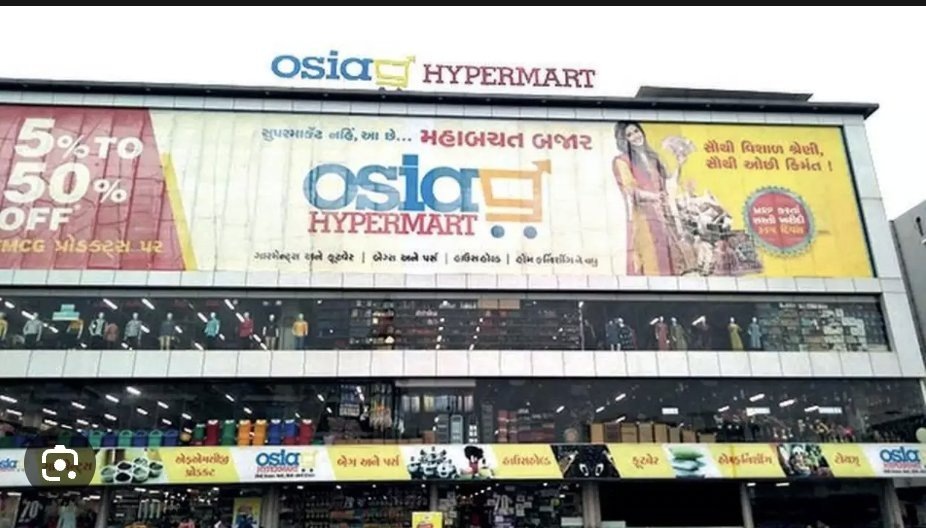
Osia Hyper Retail Ltd Q2 FY2026 – Retailing, Fund-Raising & Financial Fireworks Wrapped in a Gujarati Discount Sale!
1. At a Glance
Welcome to Osia Hyper Retail Ltd (NSE: OSIAHYPER) — the Gujarati juggernaut that decided “Big Bazaar gaya, ab Osia aaya.” The company’s ₹305 crore market cap comes packaged with 37 stores, an ever-expanding franchise model, and more drama than your favourite family soap. As of Q2 FY2026 (September 2025), the stock sits at ₹18.6 — down 41% in a year, because the market seems to think “discount” applies to the share price too.
The revenue for Q2 FY26 came in at ₹373 crore, up 5% QoQ, while PAT jumped 55% to ₹5.1 crore. An OPM of ~3.6% isn’t bad for retail, but the low ROE (6.6%) says management is probably earning less than your FD returns. Still, at a P/E of 13.5x, it’s priced like a budget hypermart among luxury peers (V-Mart at 61x, Avenue Supermarts at 95x — all selling the same detergent).
Oh, and CRISIL recently downgraded its rating to Default — not the vibe you want when you’re planning a ₹450 crore warrant issue. But Osia keeps rolling. Because, in Gujarat, retail and optimism are both renewable energy sources.
2. Introduction
Let’s be honest — Osia Hyper Retail is the kind of company that makes you go, “Wait, this isn’t DMart?” You google it, find 37 stores across Gujarat and Uttar Pradesh, and suddenly realize it’s a hypermart built on ambition, not advertising.
Founded in 2014, Osia took the Desi Big Bazaar route — groceries, clothes, cosmetics, furniture, electronics, kitchenware — you name it, they’ll sell it. But unlike the once-mighty Future Retail, Osia is still standing (and even expanding), which deserves a slow clap.
Its 0.7 million sq. ft. of retail area and 50:50 mix between food and non-food items give it a fairly balanced product portfolio. Think half kirana, half fashion influencer’s wishlist. The brand’s tagline might as well be “Bhai, sab milega – par thoda sambhalke.”
But here’s the twist — most of Osia’s stores are now on a franchise model. Why own the stress when you can outsource it? That’s how Osia expanded across Gujarat and Jhansi, adding stores while others were closing shutters.
And while the company’s financials are improving, it’s the frequent fund-raising updates, warrants, and capital expansions that grab headlines. If corporate actions were a sport, Osia would be India’s Virat Kohli.
3. Business Model – WTF Do They Even Do?
Osia’s business model is deceptively simple — open giant hypermarts, fill them with everything a middle-class family could possibly need (and a few things they don’t), and keep the prices “budget friendly.”
Their store formats are divided into:
Osia Hypermart: The main stores — big, flashy, all-encompassing, selling groceries to garments.
Mini Osia: Smaller, grocery-focused stores.
Warehouse: For backend and logistics (because you can’t sell 3 lakh SKUs from thin air).
The revenue split of 50:50 between food and non-food ensures steady footfall — groceries bring people in, apparel and home decor make them stay (and spend).
In FY23, Osia opened five new hypermarts but closed three mini stores — a reminder that retail is all about location, location, and the right kind of masala packets. All new stores were franchise-operated, which keeps expansion asset-light and margins somewhat lean but predictable.
They’ve also launched an online delivery platform via their app and website. But let’s face it, nobody opens Osia’s app to beat Blinkit’s 10-minute promise — they just want to see discounts on floor mats and kurta sets.
So, WTF do they really do? They sell everything under one roof, but with a Gujarati twist — “margin kam le lo, volume zyada le lo.”
4. Financials Overview – Q2 FY2026 (Sep 2025)
Metric (₹ Cr)
Latest Qtr (Sep’25)
YoY Qtr (Sep’24)
Prev Qtr (Jun’25)
YoY %
QoQ %
Revenue
373.0
355.2
326.5
5.0%
14.3%
EBITDA
13.5
15.8
18.6
-14.6%
-27.4%
PAT
5.1
3.3
8.0
55.5%
-36.3%
EPS (₹)
0.31
0.25
0.49
24%
-36.7%
Despite the revenue jump, profits slipped QoQ because the company’s operating margin dropped to 3.6%, partly due to store expansion and higher costs. Still, PAT more than doubled YoY, so let’s call it a “half smile quarter.”