Spotted a factual error — a wrong number, date, or fact? Tell us and we will check the source.
General information and entertainment, not investment advice. The author is not a SEBI-registered adviser or research analyst. No recommendation, no promised returns. Markets carry risk including loss of capital. Figures may not be current. Consult a registered adviser before acting.
Prices referenced are not live — the ₹90.8 CMP is the last available figure and is used as a reference point throughout.
1 — At a Glance
Om Freight Forwarders closed FY2026 with consolidated revenue of ₹476.92 crore — down from ₹490.14 crore in FY2025. PAT (consolidated) came in at ₹16.04 crore, against ₹22.02 crore the prior year, a 27% decline. Operating margins compressed: OPM sat at roughly 5.85% for the full year versus 8% in FY2025. EPS (consolidated, full-year) landed at ₹4.90 against ₹6.91 the prior year.
The balance sheet is expanding — total consolidated assets grew from ₹312 crore to ₹384 crore — but operating cash flow turned negative at ₹-7.08 crore for the year, reversing a ₹32.64 crore positive in FY2025. Borrowings climbed: consolidated short-term borrowings moved from ₹19.21 crore to ₹42.44 crore.
Against that, the company completed an IPO in October 2025 raising ₹24.44 crore, acquired a 1.98 lakh sq. ft. warehouse for ₹32 crore in May 2026, and hit 116,457 TEUs handled in FY2025 (the most recent operational figure available). The market currently prices the stock at roughly 20x trailing earnings.
The tension the record poses: a company whose revenue scale has grown dramatically over five years — ₹80 crore in FY2020 to ₹477 crore — but whose profits are now declining from that scaled base, while the balance sheet is absorbing new asset commitments. A business in motion.
2 — Introduction
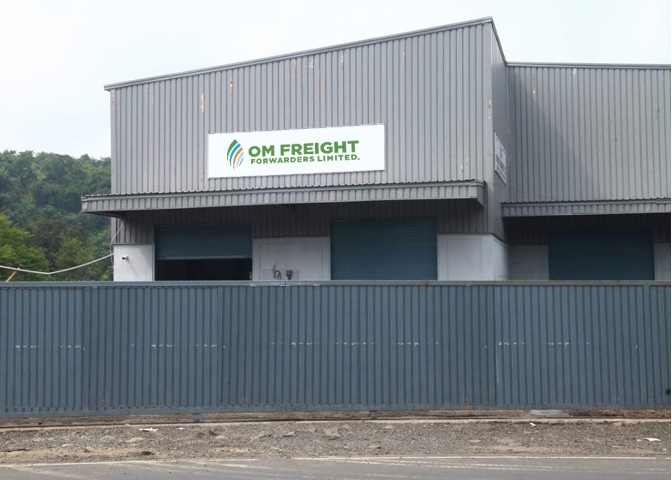
Om Freight Forwarders Limited was incorporated in June 1995. Headquartered in Mumbai at Andheri East — directly opposite the Sahar Cargo Complex, which is not an accident — it describes itself as a third-generation logistics company. The family that built it is still very much running it: Rahul Jagannath Joshi holds the Chairman and Managing Director role, reappointed in February 2026 for a term running through March 2031, and the broader Joshi family accounts for the overwhelming majority of promoter holdings.
The company’s trajectory over the past several years involves a sharp revenue step-up — from the ₹80–109 crore band of FY2020–FY2023 to ₹410 crore in FY2024 and ₹489 crore in FY2025 — followed by the current slight pullback. FY2026 revenue at ₹477 crore represents a 3% decline on that FY2025 base.
The IPO milestone deserves a note: 1,81,0,042 fresh equity shares were allotted on October 6, 2025, and the stock listed on NSE and BSE on October 8, 2025 at an offer price of ₹135 per share. The gross proceeds of ₹24.44 crore were earmarked for capital expenditure and general corporate purposes. The company has disclosed that utilisation of IPO funds differs from the originally stated prospectus objects in terms of allocation, model, quantity of assets, and timeline — and has stated it is in the process of filing a Statement of Deviation.
On the corporate changes front: Company Secretary Hiren Bhanushali resigned effective February 16, 2026; Manisha Kaur Saluja was appointed as replacement on May 13, 2026. Independent Director Ravi Patwa resigned effective May 31, 2026. Postal ballot in June 2026 confirmed Rahul J. Joshi’s reappointment as CMD and Keval M. Shah’s appointment as Independent Director.
3 — Business Model: WTF Do They Even Do?
Om Freight is what the industry calls a 3PL — third-party logistics — which is the polite way of saying it does the parts of moving cargo that nobody else wants to think about. A manufacturer in Pune who needs steel coils at a port in Rotterdam does not call a shipping line, a customs agent, a trucker, a crane operator, and a warehouse separately. They call Om Freight, who calls all of those people, takes a margin, and ideally ensures nothing ends up in the wrong ocean.
The service architecture has six components. Freight Forwarding — the largest at 52% of revenue — handles sea and air cargo, LCL/FCL consolidation (that is, grouping smaller shipments together so someone doesn’t pay for an entire container for half a container’s worth of goods), route optimisation, documentation, and regulatory compliance. Custom Clearance at 17.5% covers import/export clearance at major Indian air and seaports. Vessel Agency Services (14.5%) is the boutique: port coordination, crew management, berth booking — the unglamorous logistics of keeping ships from waiting indefinitely at anchor. Transportation (10%) covers multimodal movements including heavy and over-dimensional cargo, which requires both specialised equipment and the kind of paperwork that makes normal paperwork look fun. Value-Added Services at 6% covers fumigation, palletizing, reverse logistics, and a list of other services that suggests the company has learned to say yes to most requests.
The asset base behind this is a hybrid model: 135 owned commercial vehicles, one cargo vessel of 7,823 tonnes, 10 cranes ranging from 10 to 150 tonnes, 26 forklifts, 77 trailers, and 22 logistics partners supplementing the owned fleet. The warehouse footprint includes a bonded warehouse at Uran, Maharashtra (10,662 sq. ft.), and the recently acquired 1.98 lakh sq. ft. site in Raigad.
Geographically, Maharashtra accounts for 89% of FY2025 revenue, Chennai 7.4%, and Kolkata 3.3%. The company operates 28 domestic branches and reaches 800+ global destinations through third-party partnerships. On the customer side: 1,715 clients served in FY2025, 75% repeat, with the top 10 accounting for 40.5% of revenue — a concentration worth holding in mind.
4 — Financials Overview
Figures are consolidated, in ₹ crore. This is a full-year (Annual) result — FY2026 is the year ended March 31, 2026.
Revenue declined modestly — roughly ₹13 crore on a ₹490 crore base. The sharper story is the profit line: PAT fell ₹6 crore, operating margins compressed from approximately 8.6% to 7.2% at the EBITDA level, and employee costs in FY2025 at ₹65.08 crore dropped to ₹50.02 crore in FY2026 — a notable reduction that partially offset operating cost growth. Other expenses moved the other direction, rising from ₹21.33 crore to ₹26.57 crore.
The company also absorbed a ₹3.63 crore OCI loss related to its Norway-based investment — the entity sold its assets during the quarter,