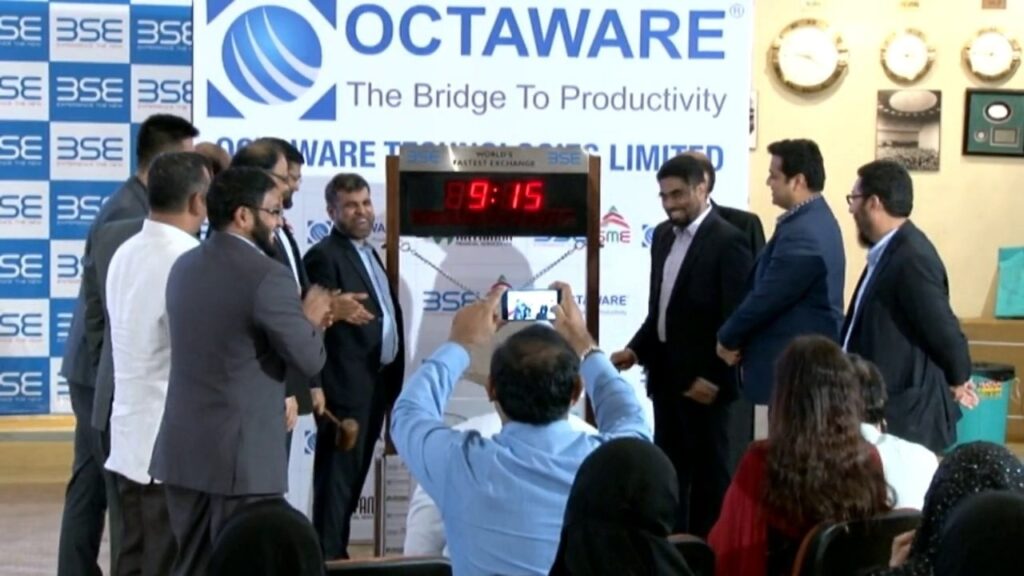
Octaware Technologies Ltd is that classic BSE SME stock which wakes up one fine morning, rallies 151% in three months, and then calmly reminds you that it is still loss-making. Market cap sits at about ₹24.1 crore, current price hovers near ₹67, and the stock has conveniently touched both ₹22 and ₹67 in the same year—because volatility is the only employee that never resigns here. Latest half-year numbers show revenue of ₹7.07 crore with PAT at -₹0.05 crore, meaning Octaware is still practicing the ancient art of “digital transformation with analog profits.” ROE is a humble ~2%, ROCE ~2.25%, debt is low at ~₹1.14 crore, and promoter holding has jumped sharply to ~65.9% thanks to a spicy open-offer-driven ownership shuffle. On paper, this company does AI, ML, RPA, IoT, cloud, healthcare software, and probably quantum computing in PowerPoint. On the P&L, however, it mostly does patience-testing. And yet, the stock chart looks like it drank three Red Bulls. Curious already? Good. You’re exactly where Octaware wants you—confused but interested.
2. Introduction – Welcome to the IT Multiverse of Madness
Octaware Technologies Ltd was incorporated in 2005, back when “cloud” still meant looking at the sky and AI was just a villain in sci-fi movies. Fast forward to today, and Octaware claims to do everything from low-code/no-code platforms to AI, ML, IoT, RPA, healthcare software, accessibility compliance, and enterprise consulting. Basically, if it ends with a buzzword, Octaware has it on the brochure.
The company is SEI-CMMI Level 3 and ISO certified, which means processes exist, documentation exists, and auditors probably sleep well. It serves clients across healthcare, education, government, BFSI, oil & gas, real estate, retail, manufacturing, and IT/ITES. In short, the client list reads like a UPSC optional subject syllabus.
Geographically, Octaware is Mumbai-based but earns ~97% of its revenue from overseas markets—USA, Middle East, and nearby time zones where billing rates sound better in dollars and dirhams. It is also a Microsoft Gold Partner, especially around Dynamics 365, which adds credibility and a steady pipeline… at least in theory.
But theory and reality often go through a messy divorce in SME IT companies. Despite being around for two decades, Octaware’s financial trajectory looks like a heart rate monitor during a horror movie—periods of profit, followed by sudden losses, followed by “TTM improvement” headlines. Add to this a full-blown management reshuffle and an open offer in 2025, and you don’t have a boring IT stock anymore. You have a corporate daily soap.
So the question is: is this a genuine turnaround story or just another “AI-themed hope trade”? Let’s open the files like a sarcastic auditor with Wi-Fi issues.
3. Business Model – WTF Do They Even Do?
Imagine a client walks into Octaware and says, “Boss, we want software.” Octaware replies, “Which decade, which platform, which cloud, which regulation, which device, which industry?” That’s their business model.
At its core, Octaware is an IT services and solutions company. It designs, develops, enhances, and maintains software systems for enterprises. Revenue primarily comes from project-based software development, consulting assignments, enterprise solutions, and ongoing maintenance contracts. No flashy SaaS-style recurring ARR disclosures here—this is old-school IT services with modern jargon.
Their offerings span:
Enterprise and business applications
Low-code / no-code platforms
Cloud infrastructure and security
Data analytics, AI, ML, RPA
Mobility and e-commerce solutions
Healthcare-focused products like Hospice, Sifa Care MD, and OTM
Healthcare seems to be a recurring theme, which is good because healthcare IT budgets are sticky and compliance-heavy—meaning clients don’t switch vendors every Diwali.
The company also operates through overseas subsidiaries in Dubai and Qatar, helping it stay close to Middle Eastern clients and bill in stronger currencies. About 97% of revenue is overseas, which reduces domestic demand risk but increases dependence on foreign clients and currency movements.
The catch? This is still a manpower-heavy, project-based model. Margins depend on utilization, billing rates, and execution discipline. And judging by the negative operating margins in recent years, execution has not always been Octaware’s best friend. So ask yourself: can a company doing everything under the IT sun actually do at least one thing profitably and consistently?
4. Financials Overview – Numbers That Need Therapy
Result Type Lock: The latest official heading clearly states Half Yearly Results, so EPS annualisation will be based on H1 × 2. No mid-article jugaad.
Half-Yearly Performance Snapshot (₹ Crore)
Metric
Latest H1
Same H1 Last Year
Previous H2
YoY %
QoQ %
Revenue
7.07
7.89
7.86
-10.4%
-10.0%
EBITDA
0.09
0.42
-0.12
-78.6%
NA
PAT
-0.05
0.42
-0.15
-112%
NA
EPS (₹)
-0.14
1.17
-0.42
-112%
NA
Annualised EPS (Half-Yearly ×2): -₹0.28 Yes, still negative. No Excel tricks here.
Commentary: Revenue declined YoY, margins collapsed, and profits went from positive to negative faster than a junior analyst during budget season. EBITDA barely stayed above zero, suggesting the company is surviving, not thriving. The only silver lining? Losses are smaller than some previous disasters. But should investors clap for “less bad”? That’s your call.
Do these numbers scream turnaround, or do they whisper “structural issues”? Drop your thoughts—this is where debates begin.
5. Valuation Discussion – Fair Value, Not Fairy Tales
Let’s value Octaware like adults, not Twitter gurus.