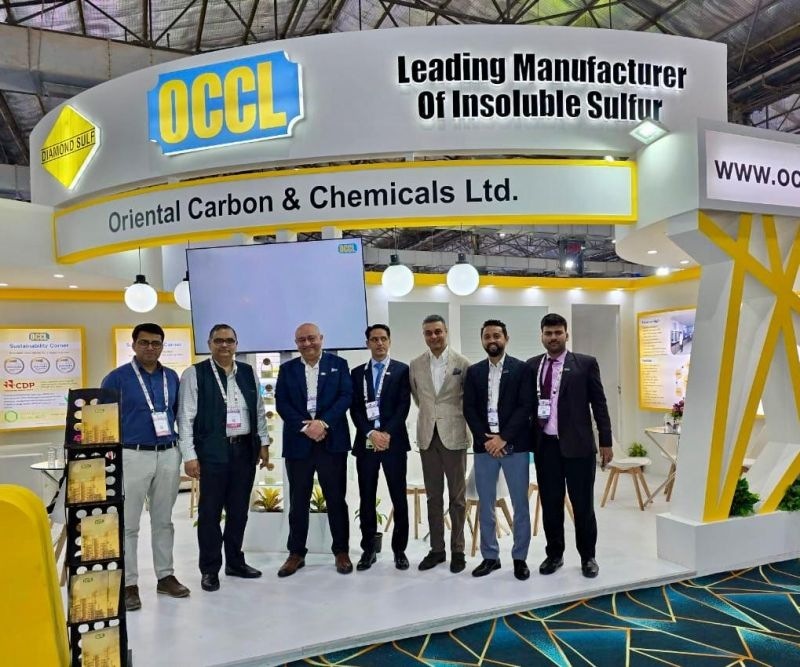
OCCL Ltd FY26: A 112% Profit Explosion Swallowed by a Hot Sulphur Spike
At a Glance
The corporate restructuring of OCCL Ltd has culminated in a clean, pure-play specialty chemical entity, yet its maiden full-year numbers reveal a classic battle between regulatory tailwinds and severe raw material inflation. For the full fiscal year ended March 31, 2026, the company posted a headline revenue of ₹505.90 crore, representing a rapid expansion in its operating scale. Net profit for the fiscal reached ₹47.71 crore, a massive 112.4% leap compared to the transitional figures of the previous year. This dramatic bottom-line spike was heavily protected by the government’s strategic imposition of anti-dumping duties on Chinese and Japanese insoluble sulphur imports, which effectively handed OCCL back its domestic pricing leverage.
However, beneath the surface of this profit surge lies a structural vulnerability. Raw material expenses escalated sharply to ₹251.86 crore for the full year, driven primarily by an unprecedented spike in global elemental sulphur prices. While domestic tyre demand remains robust, the company’s inability to pass through these extreme cost increases to its long-term international contract holders has severely compressed its global export margins. Furthermore, significant geopolitical and trade disruptions in the US market forced the company to extend deep operational discounts, adding additional pressure to its realisations. Capital efficiency remains structurally sound with a Return on Capital Employed (ROCE) at 12.85%, but the massive build-up of working capital highlights the cash costs of running a global supply chain during a raw material crisis. Specialty chemical structures are fundamentally built on raw material arbitrage, and when that arbitrage turns toxic, even trade protection cannot fully preserve the cash flow.
Introduction
OCCL Ltd is the newly minted avatar of the demerged chemicals business of Oriental Carbon & Chemicals Limited. Under a comprehensive group-level restructuring, the company hived off its legacy investments and non-chemical assets into a separate entity named AG Ventures Limited, leaving OCCL as a streamlined, pure-play operator in the rubber chemicals domain. The company operates a highly specialized manufacturing model across three advanced production units—two situated at Dharuhera in Haryana and a modern export-focused facility located within the Mundra SEZ in Gujarat. By severing ties with its slow-moving investment portfolio, the operating entity was designed to provide public markets with an unencumbered vehicle to play the global automotive and tyre manufacturing value chain.
Business Model: WTF Do They Even Do?
OCCL’s business model can be accurately summarized as a high-stakes, single-product bet on the global tyre industry. The company is the absolute monarch of the Indian domestic market, operating as the country’s sole manufacturer of insoluble sulphur—a mission-critical vulcanising agent that prevents tyres from losing their structural integrity before they are baked into shape. This core product, branded globally as “Diamond Sulf”, accounts for a staggering 86% of the company’s total production volume. The remaining 14% of the volume consists of commercial and battery-grade sulphuric acid and oleum, which acts as a highly volatile, low-margin industrial byproduct.
OCCL controls a dominant 55% to 60% share of the Indian domestic market and handles roughly 10% of the entire global demand for insoluble sulphur. This is a classic high-entry-barrier business: tyre majors require a minimum of 24 months just to audit, validate, and approve a new supplier’s plant to ensure their tyres don’t spontaneously delaminate at 120 km/h. However, this moat comes with a massive catch. Over 55% of OCCL’s revenues are derived from exports across 21 countries, meaning the company spends its days exposed to global shipping chaos, foreign exchange volatility, and international trade wars. It is a textbook example of a highly concentrated niche monopoly that is entirely dependent on global tyre companies deciding to buy rubber from India rather than China.
Financials Overview
Figures are consolidated, in ₹ crore.
Metric
Latest Quarter (Mar 2026)
YoY
QoQ
Revenue
₹149.00
38.63%
30.51%
EBITDA / Operating Profit
₹23.89
28.51%
21.21%
PAT
₹19.35
112.41%
196.32%
EPS
₹3.87
112.41%
196.32%
Did Management Walk the Talk?
During the prior investor interactions, management painted a picture of absolute structural protection flowing from the anti-dumping duties (ADD) imposed against Chinese and Japanese imports. The actual financial results show that while the ADD acted as an excellent defensive shield, global raw material markets completely rewrote the script. Elemental sulphur prices spiked from an average of ₹29 to over ₹52 during the fiscal year, a brutal cost inflation that management openly admitted “ate away” the anticipated 11 to 14 crore rupee windfall from trade protections. Quarterly earnings quality is highly erratic; the massive profit surge in the final quarter was heavily supported by a negative tax adjustment of -₹2.26 crore rather than pure operating leverage.
“The Chinese did not increase the price even though raw material prices have increased, taking away the whole benefit of the anti-dumping duty.”
The CFO explicitly highlighted that global capacity utilization is stuck at a mediocre 70% to 75%, indicating a global supply glut that will take four to five years to fully normalize. To make matters worse, the corporate sales division suffered from internal instability, with VP of Sales Muneesh Batta resigning in January 2026, forcing a rapid replacement with Rajneesh Dhiman in February to arrest the bleeding in international accounts.
Valuation Discussion: Fair Value Range Only
With a total of 5.00 crore adjusted equity shares outstanding, the company’s reported full-year FY26 Earnings Per Share (EPS) stands at ₹9.55. At the current market price of ₹118.03, the stock trades at a trailing price-to-earnings (P/E) multiple of 12.36x. This represents a significant discount to the broader commodity chemical median P/E of 19.0x, reflecting the market’s deep skepticism regarding the company’s single-product concentration and global margin headwinds.
P/E Method: Applying a conservative peer-band multiple of 11.0x to a normalized 14.5x onto the full-year EPS of ₹9.55 yields an implied valuation range of ₹105.00 to ₹138.00.
EV/EBITDA Method: The full-year FY26 EBITDA calculated from the annual financial statements stands at ₹89.47 crore (PBT of ₹55.48Cr + Interest of ₹5.03Cr + Depreciation of ₹28.96Cr). At an Enterprise Value of ₹670.00 crore, the stock trades at an EV/EBITDA multiple of 7.49x. Utilizing an normalized sector multiple range of 7.0x to 9.0x yields an enterprise value range that translates to a per-share value band of ₹110.00 to ₹145.00.
Discounted Cash Flow (DCF) Valuation: Assuming a conservative cash flow growth rate of 6.0% over the next five years—constrained by the multi-year global supply glut outlined by management—and utilizing a weighted average cost of capital (WACC) of 12.0%, the simplified present value of future free cash flows anchors the lower operating boundary of the business near ₹100.00 per share.
Combining these three distinct methodologies establishes a stable financial assessment zone.
Fair Value Range: ₹100.00 to ₹142.00
This fair value range is for educational purposes only and is not investment advice.
What’s Cooking: News, Triggers, Drama
The operational landscape at OCCL has been anything but quiet, featuring a mix of geopolitical trade wars and boardroom shakeups.
The US Tariff Shock: The US market became a major battleground after import tariffs on Indian insoluble sulphur skyrocketed to 50%. To maintain its long-term relationships with major American