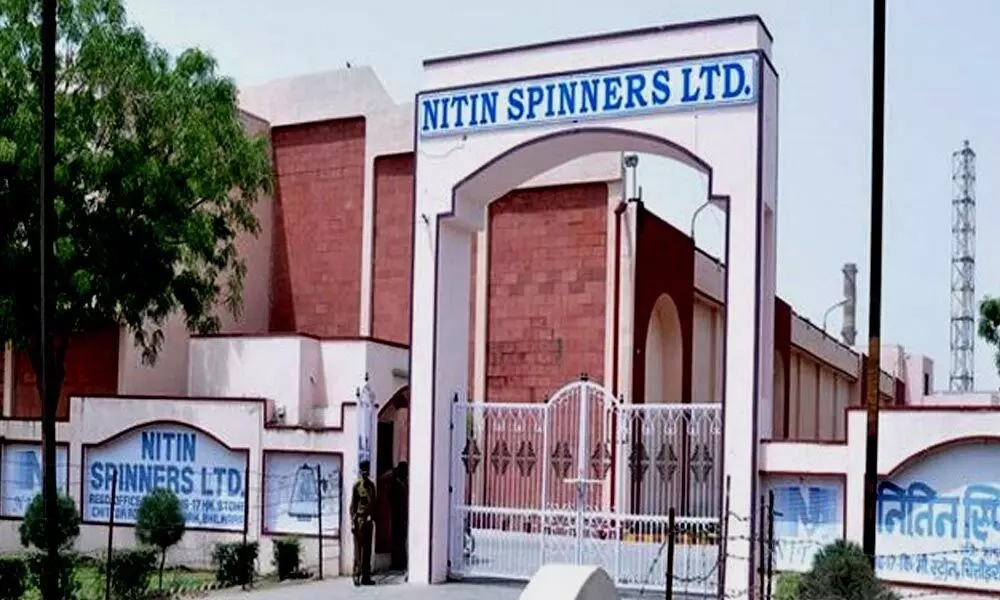
Nitin Spinners Ltd Q2FY26 Results: The Bhilwara Yarn Barons Spin ₹760 Crore of Fabric-Fueled Resilience Amid Textile Whirlwinds
1. At a Glance
Welcome to Bhilwara — the land where yarn isn’t just twisted, it’s strategized, solar-powered, and occasionally overleveraged. Nitin Spinners Ltd, one of India’s leading cotton yarn and fabric manufacturers, has once again demonstrated that you can still keep the looms running even when global textile markets look like a tangled spool. For Q2FY26 (quarter ending September 2025), the company reported revenue of ₹76,472 lakh (₹760 crore) and a net profit of ₹3,478 lakh (₹34.8 crore).
At a market cap of ₹1,795 crore and a P/E ratio of just 10.8x (versus the industry average of 22.3x), this Bhilwara-based textile craftsman seems criminally underpriced — like a Raymond shirt sold at a Chor Bazaar stall. Yet, the 3-month stock return of -8.27% suggests investors have been snoozing while the spinning machines hum on renewable energy. The operating profit margin clocked in at a solid 13%, and ROE stands at a respectable 14.3%. With ₹915 crore debt, 18.8 MW of solar power, and ₹1,100 crore in ongoing capex, Nitin Spinners looks like a company balancing between ambition and interest payments — and doing a surprisingly decent job at it.
2. Introduction
If Rajasthan had an industrial anthem, it would sound like a loom. Founded in 1992, Nitin Spinners has grown from a small cotton yarn producer to a vertically integrated textile player with a presence in 50+ countries. It’s headquartered in Bhilwara — India’s denim and yarn hub — where every third person either sells fabric, weaves fabric, or dreams about powerlooms.
Nitin Spinners’ story isn’t about fancy fashion shows or designer collaborations. It’s about machine oil, cotton bales, and the kind of industrial grit that only Rajasthan can supply with a side of scorching heat. The company’s primary strength lies in its ability to control the full chain — from spinning yarn to knitting fabric and finishing woven textiles.
But let’s face it: the textile business isn’t glamorous. Margins swing like a yo-yo tied to cotton prices, and forex fluctuations can turn exporters into insomniacs. Yet, Nitin has held on — partly through relentless capacity additions and partly through renewable energy efficiency. While most peers are busy doing influencer marketing for their fabric brands, Nitin prefers spinning faster and exporting harder.
3. Business Model – WTF Do They Even Do?
Nitin Spinners isn’t your fashion influencer’s fabric partner — it’s the quiet, behind-the-scenes enabler of brands that hog the spotlight. The company manufactures cotton yarn, knitted fabrics, and finished woven fabrics, and yes, it does all of this on a scale that makes polyester blush.
Their product portfolio is a full buffet:
Yarn (72.6% of Q3FY25 revenue): Includes everything from basic ring-spun cotton to exotic blends like Supima, Giza, and Cotton-Linen. There’s even recycled fiber yarn — the woke version of spinning.
Fabrics (22.3%): Both knitted and woven, from twills and canvas to antibacterial, water-repellent finishes. Basically, if it can be worn, sat on, or turned into curtains, Nitin’s probably making it.
Other products (5.1%): Specialty textiles and miscellaneous fabric-related goods — the textile world’s equivalent of “miscellaneous income.”
The company operates out of Bhilwara and Chittorgarh, where it’s practically built a mini textile city. With 4,34,832 spindles, 5,864 rotors, 77 knitting machines, and 222 air-jet looms, the capacity figures read more like a war arsenal than a textile setup.
They export 65% of revenue to 50+ countries, including fashion giants like Zara, H&M, and Benetton. The domestic clientele includes Raymond, Siyaram’s, and D’Decor — basically the entire wardrobe and home décor of upper-middle-class India.
And the kicker? The company runs 18.8 MW of solar power, with 14 MW more on the way. Because even cotton wants to be carbon-neutral now.