NILE Ltd March 2026: The 90% Customer Trap and a ₹55 Crore Lead Alchemy Act
Section 1 — At a Glance
An extreme concentration of commercial dependency defines the operational reality of NILE Ltd, yet its latest fiscal performance has managed to command significant market attention. The company concluded March 2026 with an annual revenue of ₹1,041 crore, marking a 13.15% expansion year-on-year, while its net profit surged by 52.78% to reach ₹55 crore. This robust bottom-line growth is accompanied by an exceptional return on capital employed of 25.30% and a near-total liquidation of corporate debt, leaving a mere ₹12 crore on the balance sheet against cash equivalents of ₹34.10 crore.
Beneath these healthy aggregate figures lies a systemic vulnerability that continues to cloud the company’s long-term terminal value. A single counterparty, Amara Raja Energy & Mobility Limited, together with its group entity Mangal Industries, historically commands up to 100% of NILE’s lead product sales. This dominant client is actively constructing its own internal lead smelting infrastructure, threatening a significant volume offtake dislocation for NILE.
While the equity market has responded favorably to the current earnings momentum, pricing the stock at a trailing P/E of 9.83, the underlying investment thesis remains pinned to a structural race against time. Management’s capital allocation has pivoted toward multi-million investments in lithium-ion battery recycling through its subsidiary Nile Li-Cycle Private Limited to diversify the risk. Diversification is rarely an elegant corporate choice; it is a defensive necessity when your primary structural engine faces an impending operational sunset. The incoming quarters will reveal whether this newly operational capacity can outpace the strategic decoupling of its anchor customer.
Section 2 — Introduction
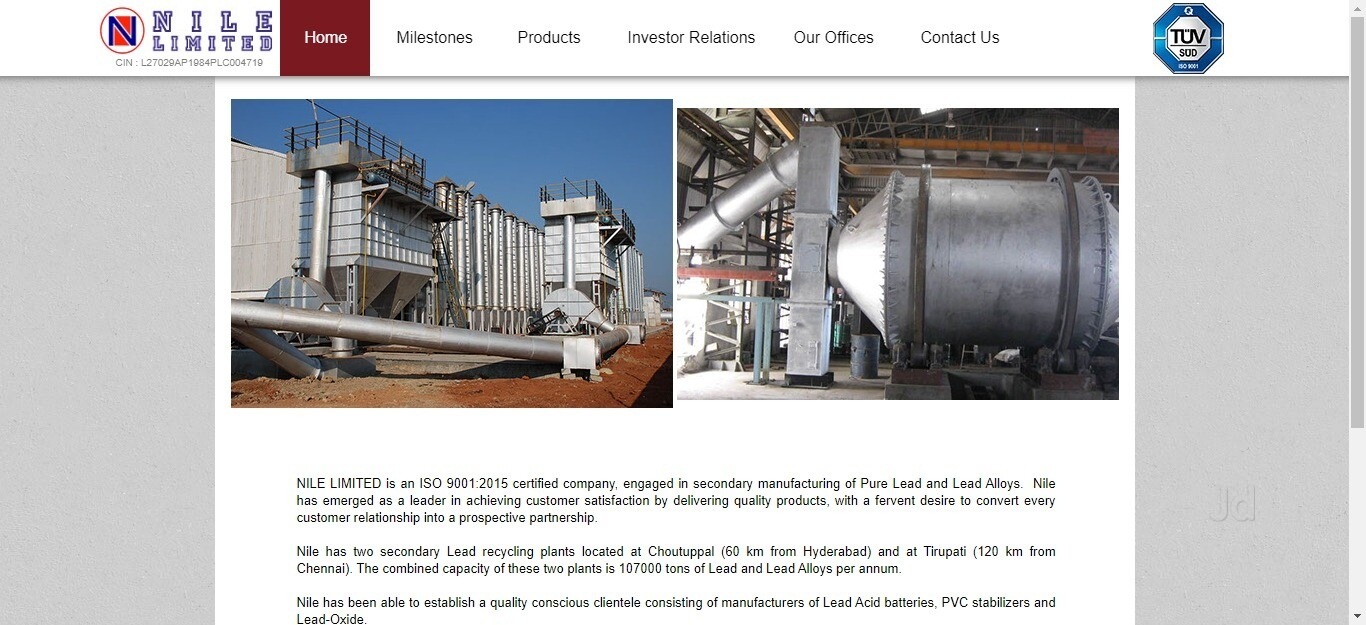
NILE Ltd has spent the last few decades mastering the dark, cyclical, and heavy art of secondary lead manufacturing. Established back in 1984, the company transforms spent lead-acid batteries and industrial scrap into pure lead and specialized alloys. If you drive a vehicle or rely on an inverter in India, chances are a fragment of NILE’s chemical outputs is quietly sitting in your battery hull, keeping the lights on.
For a business that handles hazardous material and operates within the grueling corridors of the commodities market, its balance sheet has retained a remarkably lean profile. Aside from its massive lead recycling plants in Choutuppal and Tirupati, it runs a small, legacy 2MW wind farm in Ramagiri, selling energy to local discoms—a minor green footnote in an otherwise heavy industrial story. The strategic focus today, however, isn’t about wind; it is entirely focused on avoiding a catastrophic client divorce while trying to catch the next technological wave in lithium recycling.
Section 3 — Business Model: WTF Do They Even Do?
To put it bluntly, NILE is a high-volume, low-margin industrial refinery masquerading as a critical technology partner. They purchase spent lead-acid batteries, melt them down under intense regulatory supervision, and produce 99.97% pure lead, alongside antimony, selenium, and calcium alloys. These compounds are then shipped off to battery manufacturers and PVC stabilizer companies.
The core revenue architecture is divided into direct sales of lead products, which bring in roughly 91% of the top line, and raw tolling or “job work” charges, accounting for another 8%. The fundamental catch here is that NILE does not control its destiny. Its pricing is explicitly pegged to the London Metal Exchange (LME) dollar rate plus a rigid smelting premium. When LME lead prices oscillate, NILE’s inventory values ride the exact same rollercoaster. It is a business where you must hold 1.5 times your monthly order volume in raw material just to keep the furnaces running, turning the operating cycle into a perpetual game of dodging global commodity volatility.
Section 4 — Financials Overview
Figures are consolidated, in ₹ crore.
Metric
Latest Quarter (Mar 2026)
YoY
QoQ
Revenue
230.00
-12.47%
-20.96%
EBITDA
17.00
21.43%
-22.73%
PAT
14.00
40.00%
-12.50%
EPS (₹)
45.70
15.58%
-8.31%
The sequential deceleration in the final quarter of FY26 highlights that commodity cycles wait for no one, as revenue contracted by over 20% compared to the preceding December period. However, the dramatic 40% year-on-year net profit expansion in the face of falling quarterly revenue reveals an impressive firming of execution margins. True earnings quality belongs to enterprises that can squeeze higher absolute profitability out of a shrinking top line by optimizing operational yields.
Did Management Walk the Talk?
Reviewing the older credit and operational disclosures from late FY24 and FY25, management explicitly stated that Phase 1 of their lithium-ion recycling subsidiary, Nile Li-Cycle Private Limited, would achieve commercial visibility, followed by an aggressive push into Phase 2 by late 2025. The actual filings validate this trajectory: the subsidiary is fully consolidated, and total capital work-in-progress expanded to ₹25 crore by March 2026, confirming that real capital has effectively hit the ground. Management also noted that their pricing mechanism linked to LME plus fixed premiums would protect them from gross margin collapses during downward price cycles, which is precisely why the PAT margin managed to expand toward the end of the fiscal year.
Section 5 — Valuation Discussion: Fair Value Range Only
To evaluate NILE without losing our sanity, we must run the numbers across multiple conservative financial frameworks, given its massive client concentration risk.
With a current market price of ₹1,810.15 and an annual net profit of ₹55 crore spread across 0.30 crore