1. At a Glance
The entertainment business is built entirely on illusions. You pay for the thrill of a roller coaster under the assumption that the tracks are bolted firmly to the ground. For investors looking at Nicco Parks & Resorts Ltd, however, the ground itself appears to be sliding away. While structural topline figures show historical stability, a granular analysis reveals multiple operational and governance shocks that deserve immediate attention.
The consolidated total income from operations for the full year ended March 31, 2026, contracted sharply to ₹6,634.67 lakhs, down from ₹7,501.67 lakhs in the previous fiscal year. This drop is not an ordinary cyclical dip; it is a major operational slowdown. The company’s primary driver, Park Operations, saw segment revenues fall from ₹6,093.06 lakhs in FY25 to ₹5,692.65 lakhs in FY26.
Even more startling is the near-total elimination of consolidated net profit. The company recorded a staggering consolidated net loss of ₹272.59 lakhs for the full year of FY26, compared to a net profit of ₹2,243.58 lakhs in FY25.
Consolidated Performance Contraction (FY25 vs FY26)

Total Revenue: ₹75.02 cr
₹66.35 cr (-11.6%)
---------------------------------------------------
Net Profit/Loss: ₹22.44 cr
-₹2.73 cr (-112.1%)
A core driver of this structural disruption is an institutional property seizure. On November 8, 2025, the Department of Tourism, Government of West Bengal, unilaterally repossessed 1.46 acres of land previously utilized by the company for its Food & Beverages (F&B) and Other Recreational Facilities segment. This specific plot was a high-margin income source, contributing approximately 9% of total corporate revenues in prior operational cycles.
To compound these complications, the statutory auditors, M/s Lodha & Co LLP, have issued a heavily modified, qualified audit opinion. The auditors openly state that the absolute financial impact of this land repossession remains entirely un-ascertainable at this date, leaving the public to fly blind regarding true asset valuations.
Furthermore, the foundational Joint Sector Agreement that granted the company access to its core amusement park acreage has been declared infructuous and inoperative due to the ongoing liquidation proceedings of its original corporate promoter, Nicco Corporation Limited. The initial 33-year land lease officially expired on February 28, 2023. Though management claims a renewal application is under active consideration, the park has been operating for over three full years without a formalized, legally binding lease agreement.
What happens to an amusement park if its landlord decides the ride has gone on long enough?
2. Introduction
Nicco Parks & Resorts Ltd has operated as a regional entertainment fixture in Eastern India since its incorporation in 1989. Nestled across 40 acres in Salt Lake City, Kolkata, the park was established as a unique public-private joint venture. The company operates through technical advisory collaborations with Blackpool Leisure and Amusement Consultancy Ltd, UK.
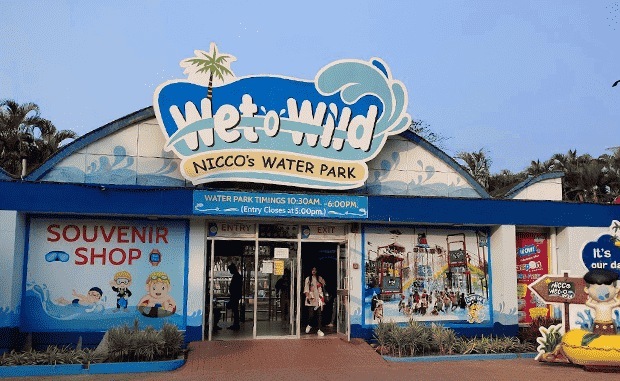
For decades, the company capitalised on its prime urban location, acting as a high-footfall destination for the regional populace. It diversified its portfolio into water parks (Wet-O-Wild), bowling alleys (Nicco Super Bowl), and sports lounges (Bowlers’ Den), alongside a specialized division that manufactures, supplies, and installs rides for external amusement complexes across India and neighbouring countries like Bangladesh.
Yet, structural vulnerabilities are mounting. Footfall data shows a clear downward trend: total standalone visitor footfalls dropped from 14.45 lakh visitors in FY23 down to 12.24 lakhs in FY24, and slid further to just 10.68 lakhs in FY25. This steady loss of real-world traction occurred well before the formal land seizures of late 2025.
Standalone Visitor Footfall Decay (Lakhs)
=========================================
FY23: 14.45
FY24: 12.24
FY25: 10.68
=========================================
The leadership architecture has also seen significant churn. Managing Director and CEO Rajesh Raisinghani retired early on medical grounds in August 2025. The company went months without permanent executive leadership until Rahul Mitra was appointed MD & CEO for a three-year tenure starting January 27, 2026. This leadership gap, alongside delays in state administrative appointments, directly caused the board to fall out of compliance with Regulation 17 of the SEBI Listing Regulations, as it lacked the required ratio of independent directors.
3. Business Model – WTF Do They Even Do?
The business model relies on monetization through high upfront gate access fees and ongoing internal consumption. When a visitor steps inside, the revenue engine triggers multiple touchpoints: entry fees, premium access passes for individual thrill rides, internal arcade tokens, and high-margin hospitality spend across the park’s food courts and kiosks.
Historically, Park Operations formed the bedrock of the firm, generating over 83% of typical top-line volume. Hospitality and F&B segments brought in 16%, while the engineering and consulting wing contributed a minor 1% via external ride manufacturing contracts.
Historical Revenue Structural Split
===================================
Park Access & Rides: 83%
Hospitality & Catering: 16%
Engineering Advisory: 1%
===================================
This model is inherently highly sensitive to fixed costs. Amusement parks require non-stop maintenance, structural integrity testing, specialized insurance, and thousands of kilowatts of electricity to keep massive metal structures spinning. Whether ten thousand people turn up on a rainy Tuesday or just ten, the cost to run a roller coaster remains practically identical.
When footfalls fall or the state government repossesses a portion of the culinary and hospitality real estate, the core operating leverage works against the business. The fixed operational overhead remains completely static while the high-velocity food and ticket cash