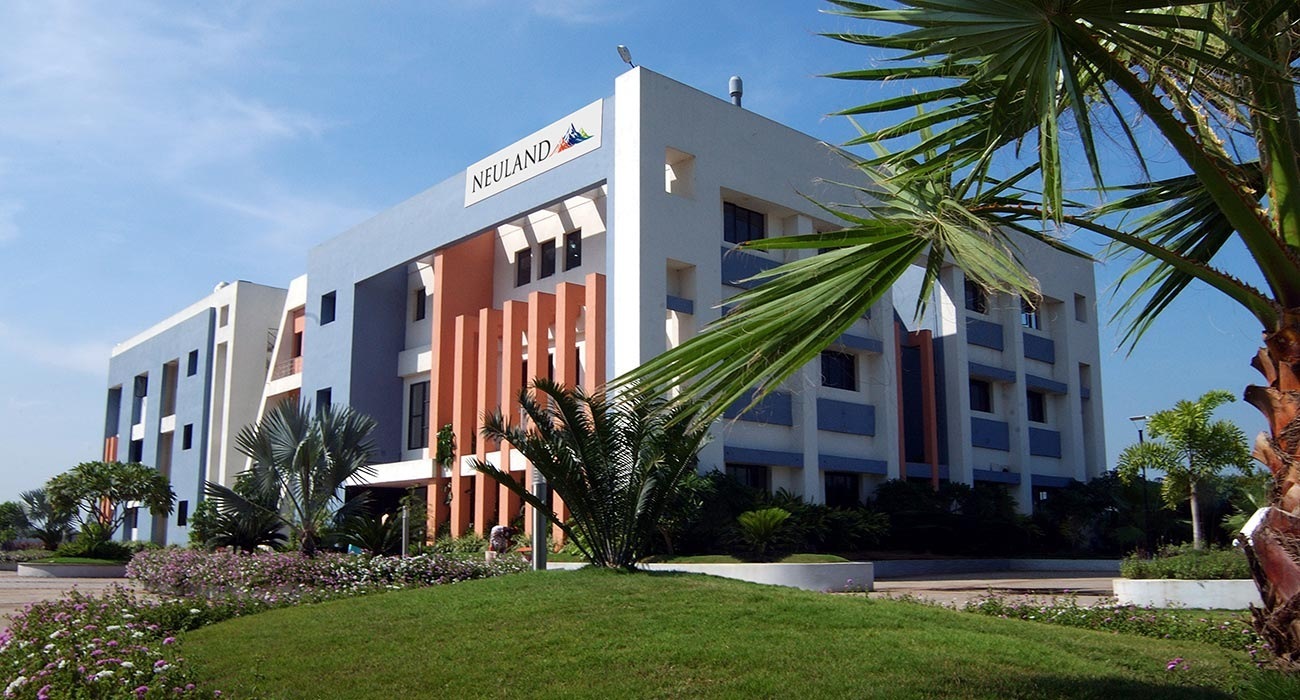
01 — At a Glance
The CDMO Story That’s Built on Volatility
- 52-Week High / Low₹19,748 / ₹10,060
- Q3 FY26 Revenue₹448 Cr
- Q3 FY26 PAT₹41 Cr
- Q3 FY26 EPS₹31.62
- Annualised EPS (Q3×4)₹126.48
- Book Value₹1,263
- Price to Book10.4x
- Dividend Yield0.10%
- Debt / Equity0.16x
- 12-Month Return+12.9%
Auditor’s Opening Rant: Neuland closed Q3 FY26 with ₹448 crore revenue (+11.4% YoY) and ₹41 crore PAT (-27.3% YoY). The stock trades at a 92.9x P/E and has lost -22.1% in three months. EBITDA margin collapsed to 19% from 21% a year ago. And management’s answer? “Q3 was an outlier. Trust us. We’re expanding peptide capacity for molecules that don’t exist yet.” The market, apparently, is listening to the future instead of the quarterly numbers.
02 — Introduction
Once a Bulk Drugs Company. Now a CDMO Casino.
Let’s talk about Neuland Laboratories. Founded in 1984, spent 30 years selling commodity APIs to generics companies. Boring margins, cut-throat competition, race-to-the-bottom pricing. Then somewhere around 2018, management discovered that rich pharma companies and biotech startups would pay premium rates for custom manufacturing — especially for novel molecules under patent protection.
Enter: the CDMO transition. Custom Drug Manufacturing and Services. No longer selling to 50 competitors fighting for each rupee. Now, you’re selling to 1–2 innovator companies per molecule at locked-in, patent-protected pricing. It’s a different beast. Higher margins. Longer customer relationships. Venture-backed biotech customers with serious funding and desperate timelines.
By FY24, this was half the company’s revenue. By Q3 FY26, CMS (the CDMO segment) is >50% of quarterly revenue. Revenue grew from ₹1,191 crore in FY24 to ₹1,477 crore in FY25 (+24%). Profitable. Credible. A genuine strategic pivoting act.
Except one problem: CDMO revenues are lumpy as hell. A single molecule can be ₹50–100 crore per quarter. Shipment delays (like Paliperidone in Q3, stuck due to customer operational issues) crater margins for an entire quarter. Working capital stretches. Inventory builds. Management screams “seasonality” and “ramp-ups.” The market hears “execution risk.”
Meanwhile, the stock is down -22% in three months, trading at 92.9x earnings on annualized Q3 numbers. At that multiple, you’re not buying a CDMO. You’re buying a faith-based initiative.
Concall Note (Feb 2026): CEO explicitly stated growth is “preordained” for the next 2–3 years because products are already in the pipeline. Translation: if execution happens smoothly and shipment timing aligns, we’re golden. If not, margins repeat Q3 performance. No pressure.
03 — Business Model: WTF Do They Even Do?
Turning Lab Chemistry Into Factory Millions
Neuland’s business has three pillars. First: Prime APIs — ~15 large-volume molecules (Levetiracetam, Mirtazapine) sold to generic pharma companies globally. Mature, stable, low-margin, ~24% of revenue. This is the old Neuland.
Second: Specialty/Niche APIs — 25+ complex, low-volume molecules with patent protection or IP-protected processes. Top 5 products = 70% of segment revenue. Margins are higher than prime, ~22% of total revenue.
Third: Custom Manufacturing Solutions (CMS / CDMO) — this is the money maker. Neuland acts as a manufacturing partner to biotech companies and pharma innovators, developing and producing APIs/intermediates for novel molecules. Two sub-buckets: R&D/development stage (lower revenue, builds relationships) and commercial stage (high revenue, patent-protected pricing). As of Q3, CMS was 51% of revenue, growing at double digits, with pipelines of 97 molecules across pre-clinical to commercial phases.
The real magic? The CMS customer concentration. Top 10 customers account for 63% of revenue. Top 5 = 54%. You’re selling to well-funded biotech companies with serious drug development timelines. They can’t afford supply chain failures. Price sensitivity is non-existent. You’re the only manufacturing partner for their NCE (novel chemical entity). Pricing is locked in on multi-year contracts. Margins can reach 40–50%+.
The trap? If one customer delays a shipment (Paliperidone: customer operational issues), or a molecule doesn’t commercialize as expected, that quarter’s financials crater. Neuland’s manufacturing footprint — three facilities in Hyderabad totalling 901 KL capacity — is world-class but built for consistency, not volatility.
CMS Concentration>50%Q3 FY26 Revenue
Regulated Markets90%+US, Europe, Canada
Export Revenue78%FY25 of total
R&D SpendState-of-art360+ scientists
Capex Alert: Neuland has sanctioned ₹342 crores for capacity expansion (Jan 2025 board approval). Unit 3 CMS expansion is complete; ramp-up is “very early.” A new R&D campus at Genome Valley (₹189 crores) approved Nov 2025 will house peptide process development and scale-up. If peptides work, this could be transformational. If not, it’s a ₹500 crore bet on molecules that don’t exist yet.
💬 Drop a comment: Do you think Neuland’s peptide bet is visionary, or just FOMO investing in R&D? And how would you feel about the margin volatility in a CDMO?
04 — Financials Overview
Q3 FY26: The Outlier (Or The New Normal?)
Result type: Quarterly Results | Q3 FY26 EPS: ₹31.62 | Annualised EPS (Q3×4): ₹126.48 | Full-year FY25 EPS: ₹139.62
| Metric (₹ Cr) |
Q3 FY26
Dec 2025 |
Q3 FY25
Dec 2024 |
Q2 FY26
Sep 2025 |
YoY % |
QoQ % |
| Revenue | 448 | 401 | 514 | +11.4% | -12.8% |
| EBITDA | 85 | 87 | 156 | -2.3% | -45.5% |
| EBITDA % | 19% | 22% | 30% | -300 bps | -1,100 bps |
| PAT | 41 | 57 | 97 | -27.3% | -57.7% |
| EPS (₹) | 31.62 | 43.71 | 75.49 | -27.6% | -58.1% |
This Quarter Was Brutal: Revenue grew 11.4% YoY but fell 12.8% QoQ. PAT declined -27.3% YoY and -57.7% QoQ. EBITDA margin crashed from 30% (Q2) to 19% (Q3). Management blames: (1) missing high-margin CMS shipments (one specialty product, Paliperidone, delayed due to customer operational issues — now expected FY27); (2) mix shift towards lower-margin products; (3) one-time ₹10 crore labor code impact. Strip out the labor code, normalized EBITDA margin would be 21%, still a collapse from Q2’s 30%.
But Wait, Says Management: “Q3 is an outlier. We can sustain 25–30% EBITDA margin.” FY24 saw ~30% EBITDA. Q2 FY26 was 30%. So the argument is Q3 is the deviation, not the norm. Problem: investors see three consecutive quarters of volatile profitability (Q1 12%, Q2 30%, Q3 19%). At a 92.9x P/E, you’re pricing in consistency you don’t have.
05 — Valuation Discussion
Is 92.9x P/E A Fire Sale Or A Cautionary Tale?
Join 10,000+ investors who read this every week.