Nahar Industrial Enterprises Ltd FY26: Spinning in Circles
General information and entertainment, not investment advice. The author is not a SEBI-registered adviser or research analyst. No recommendation, no promised returns. Markets carry risk including loss of capital. Figures may not be current. Consult a registered adviser before acting.
1. At a Glance
The company reported consolidated net profit of ₹51.3 Cr for FY26, a 164% jump from ₹19.4 Cr in FY25—but revenue slipped 8% to ₹1,408 Cr. The lift came from one-time land sales and lower losses at the Bhiwadi spinning unit before its closure.
Operating margins compressed to 4.3% from 5.4%, the latest chapter in a 10-year decline.
Textile revenue fell 10% despite a cotton-buyer’s advantage that once moved millions of bales annually. The sugar unit delivered ₹216 Cr (15% of revenue) but couldn’t offset spindle-slow momentum in the core.
Debt rose to ₹682 Cr from ₹622 Cr, a capex-on-warehouses story that will define the next three years. The market prices the stock at 9.7x FY26 earnings against a peer median of 24x—a gap that reflects something. What, is the question.
2. Introduction
Nahar Industrial Enterprises Ltd (NIEL) was incorporated in 1983 and is part of the Nahar group, a conglomerate spanning textiles, sugar, real estate and hospitality. Chairman Jawaharlal Oswal has family investment entities holding 71% of the company.
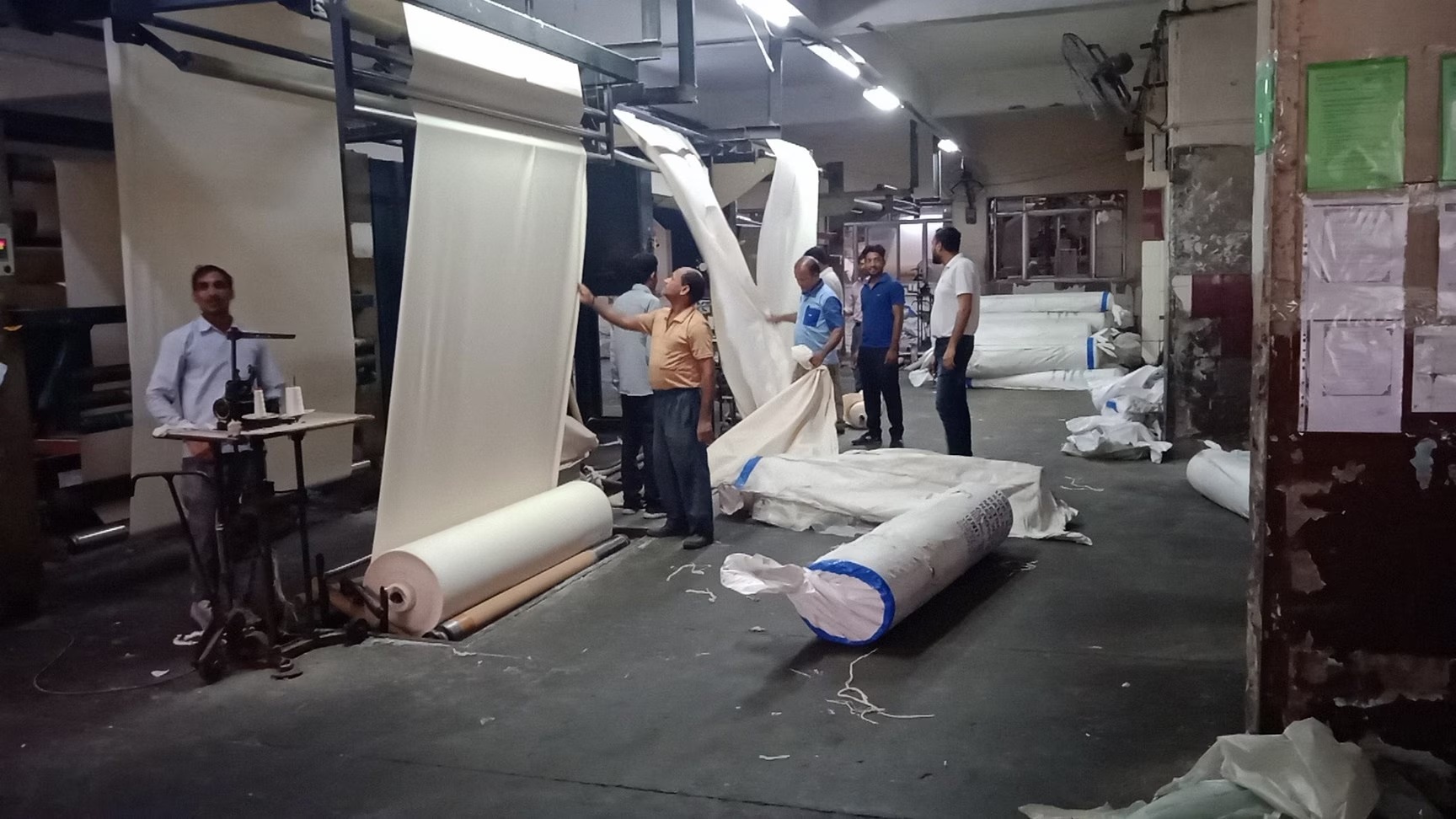
The core textile business is vertically integrated: spinning ₹2.2 lakh spindles, weaving ₹515 looms, processing fabric at 584 lakh meter capacity per annum. A sugar mill crushes 4,000 tonnes of cane daily in Amloh, Punjab.
NIEL consumes 300,000+ bales of cotton annually—scale that once gave it leverage in procurement. Major clients include GAP, Tommy Hilfiger, Marks & Spencer, Target and Zara.
In November 2025, the board closed Arham Spinning Mills, which contributed ₹239 Cr revenue (15.6% of group sales) but ran at losses. In May 2026, a fire damaged the raw cotton godown at Lalru, Mohali—no lives lost, facilities insured, production unaffected.
CRISIL reaffirmed the long-term credit rating at A-/Stable and short-term at A2+ on June 2, 2026.
3. Business Model: WTF Do They Even Do?
Three engines, one sputtering.
Textiles (85% of revenue): Yarn, fabric, processing. The company buys cotton when global prices are low, processes it into yarn and finished fabric for export and domestic wear. Clients are high-frequency buyers—Gap and Zara rotate stock weekly. Competition is ferocious: K.P.R. Mill does 44x earnings, Vardhman does 24x. NIEL’s spread per metre compresses in every downturn.
Sugar (15%): Four thousand tonnes of cane per day becomes ₹216 Cr revenue and operating profit swings of ±₹1,000 Cr depending on crushing recovery and cane prices. Hedging is minimal. Recovery rates hover around 9.8–10.2%. An excellent year buoys the whole; a poor one masks textile gains.
Real Estate & Warehouses (emerging): The company owns logistic parks at Ludhiana and Kolkata, leasing to Amazon, Instakart, Zomato. Rental income hit ₹45.1 Cr in FY26 from ₹28.3 Cr in FY25. Warehousing is predictable cash, not dependent on cotton prices. CRISIL expects rentals to reach ₹60–70 Cr within three years as new space gets occupied. The Kolkata facility is still under construction.
The model is: absorb commodity cycles in textiles, stabilise with sugar and real estate, sell land plots over 3–5 years at ₹50 Cr/year to fund capex. It’s a holding company dressed as a mill.
4. Financials Overview
Figures are consolidated, in ₹ crore.
Metric
FY26
FY25
Change
Revenue
1,408
1,530
-8%
EBITDA
110
117
-6%
Operating Profit
61
70
-13%
PAT
51
18
+164%
EPS (₹)
11.88
4.28
+177%
The 164% jump in net profit is a mirage. CRISIL notes that ₹46.5 Cr came from sale of property and investment gains—items that don’t recur. Underlying operations earned ₹5–6 Cr. Operating margins fell to 4.3% from 5.4%, driven by the loss-making Bhiwadi unit before closure and unfavourable yarn spreads.
CRISIL expects FY27 revenue to moderate another 5–6% and operating margins to hold at 3–4%. The warehousing rental uplift is the one bright spot.
5. Market Expectations & Historical Multiples
This section describes how the market is currently pricing the company and how that compares with its own history and peer group. It is descriptive, not predictive.
Metric
Current
5-Year Average
Peer Median
P/E
9.69x
10.9x
24.35x
EV/EBITDA
7.18x
—
8.2x
P/B
0.49x
—
1.77x
ROE
5.11%
6.02%
7.3%
ROCE
6.63%
—
9.01%
The market currently pays 9.7x earnings here versus a peer median of 24x. The company trades at 0.49x book value against a peer median of 1.77x. This gulf exists because NIEL’s return on equity has trended downward: 6.02% over five years, 2.37% over three years,