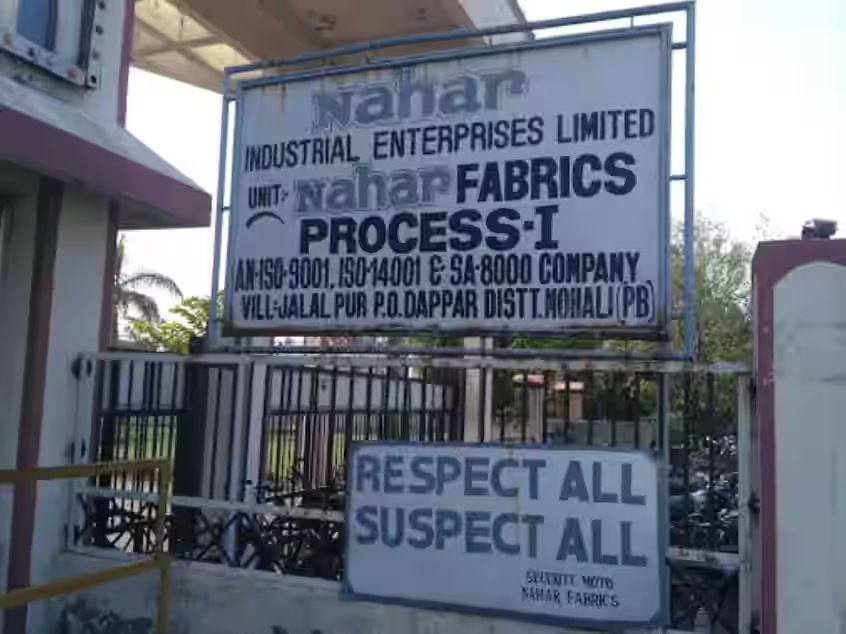
1. At a Glance – The Textile Dinosaur That Refuses to Go Extinct
There are companies that grow like startups… and then there are companies like Nahar Industrial Enterprises — a business that feels like it’s been stuck in buffering mode since the days when Nokia ruled India.
Here’s the paradox: A ₹422 crore market cap company sitting on a ₹1,701 crore balance sheet, trading at just 0.42x book value, with ₹1,459 crore annual revenue — sounds like a classic “hidden gem,” right?
But wait.
Margins are thinner than hostel dal. ROE is a tragic 1.11%. Sales growth? Basically flatlining for 5 years. And oh, ₹93.6 crore “other income” quietly helping profits like a side character doing all the heavy lifting.
Now add this twist: They are shutting spinning units, selling assets, entering real estate, warehousing, hospitality… basically doing everything except focusing on core textile growth.
So what is this company?
A value stock? A turnaround story? Or a confused conglomerate trying to escape textile hell?
Because right now, it feels like your uncle who started as a textile trader… and now runs a logistics park, owns land, invests in startups, and still says “beta asli paisa kapde mein hai.”
Let’s dig deeper.
2. Introduction – Welcome to the Multi-Business Identity Crisis
Nahar Industrial Enterprises is part of the larger Nahar/Oswal group — a legacy textile empire that has seen cycles come and go.
The company operates across:
Textiles (yarn + fabric = 88% revenue)
Sugar (~12%)
And now suddenly… real estate, warehousing, hospitality
Yes, because when textile margins collapse, the natural instinct is: “Let’s build a logistics park.”
Classic Indian promoter playbook.
And to be fair — the textile business itself is no joke:
2.2 lakh spindles
515 looms
584 lakh meters processing capacity
This is not a small player. This is industrial-scale textile manufacturing.
But here’s the catch:
Scale ≠ Profitability
Despite being one of India’s largest cotton buyers (4 lakh bales annually), margins are stuck at 4–5%.
And management itself admits:
Textile performance has been “moderate”
Operating margins are expected around 4–5% going forward
So basically — no structural improvement expected.
Let me ask you:
If a business has scale, brand, integration… but still earns 4% margins — is that a good business or just a busy one?
3. Business Model – WTF Do They Even Do?
Let’s simplify this chaos.
Core Business: Textile Manufacturing
They do everything:
Spin yarn
Weave fabric
Dye and process
This vertical integration should ideally give them:
Cost advantage
Better margins
Control over value chain
But reality check:
Margins still suck.
Why?
Because textile is a commodity business.
You don’t control pricing. Global cotton prices do.
Side Hustle #1: Sugar Business
4,000 TCD sugar mill
14.5 MW power plant
Translation: A cyclical business inside another cyclical business.
Brilliant.
Side Hustle #2: Real Estate + Warehousing
Now THIS is interesting.
Warehousing expanding to 2.4 million sq ft
Rental income expected to grow from ₹35–40 Cr to ₹65–70 Cr
Clients include:
Amazon
Zomato
Instakart
Finally — a business with:
Stable cash flows
Better margins
Predictability
Side Hustle #3: Hospitality + Land Monetization
Selling plots → ₹50 Cr annual inflow expected
New subsidiary for hotels
At this point, this company is:
Textile + Sugar + Real Estate + Logistics + Hospitality
Bro, pick a lane.
4. Financials Overview – Numbers Don’t Lie, But They Do Confuse
Quarterly Performance (₹ Crores)
Metric
Dec 2025
Dec 2024
Sep 2025
YoY %
QoQ %
Revenue
340.20
429.66
340.24
-20.82%
~0%
EBITDA (Op Profit)
15.24
15.80
-3.32
-3.5%
Turnaround
PAT
5.79
4.63
16.49
+25%
-65%
EPS (₹)
1.34
1.07
3.82
—
—
Annualised EPS
Since this is Quarterly Results (Q3):
Average EPS (Q1+Q2+Q3 approx) ≈ low volatile, but TTM EPS = ₹9.85