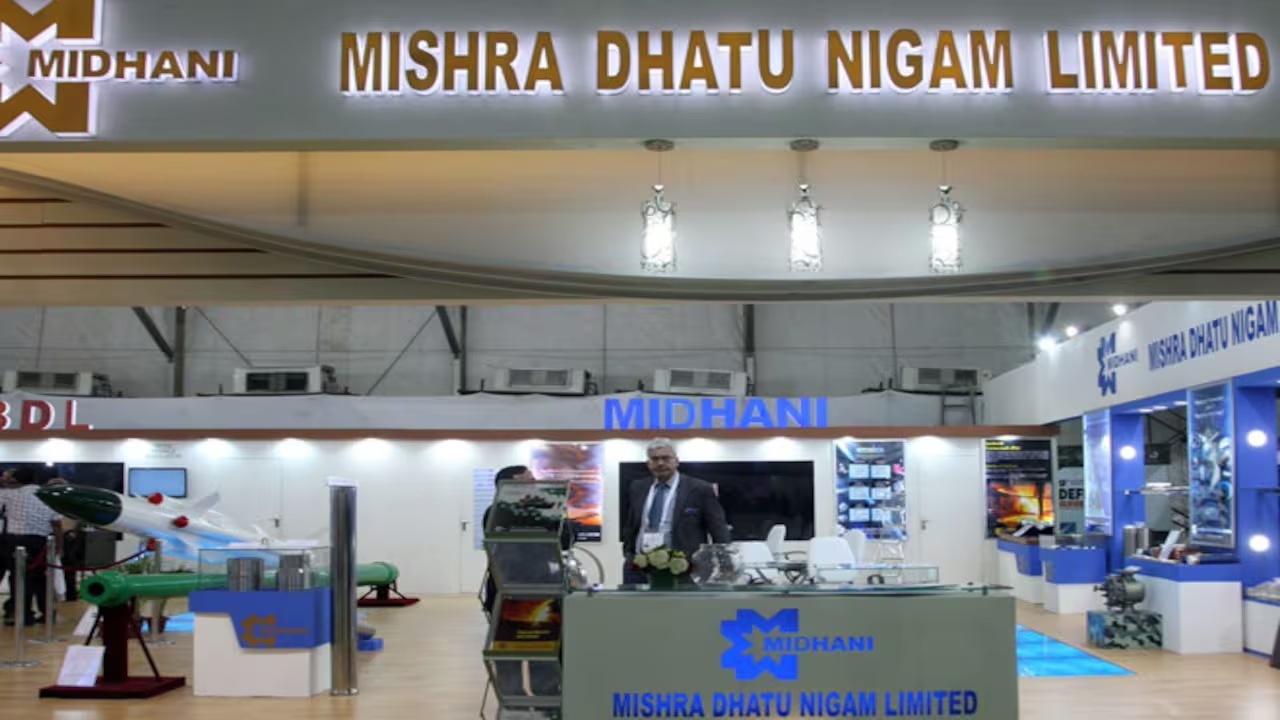
Mishra Dhatu Nigam: Record Turnover, 62× P/E, and the Working Capital Trap
General information and entertainment, not investment advice. The author is not a SEBI-registered adviser or research analyst. No recommendation, no promised returns. Markets carry risk including loss of capital. Figures may not be current. Consult a registered adviser before acting.
MIDHANI hit a record ₹1,209 crore revenue in FY26, up 12.5% YoY. Profit surged 18.8%, but the multiple sits at 62× earnings—the company pays for the 11% ROCE it earned, not the momentum it claims.
The balance sheet has ₹407 crore debt, manageable against ₹1,343 crore reserves. Order book stands at ₹2,290 crore, about 1.9× annual revenue, stretching across 15–18 months of work. So far, so strategic—a Government CPSE playing defence, space, and exotica.
The catch: inventory stands at 1,333 crore, debtors at 554 crore. Cash conversion has improved, but working capital remains brutal. The company is burning cash to fill shelves, and that tail of unsold metal is the real constraint on growth.
Reader question: Can a 15% annual growth target stick if working capital keeps tying up cash faster than operating profits release it?
2. Introduction
Mishra Dhatu Nigam Limited (MIDHANI), incorporated in 1973, began as a Government of India enterprise under the Ministry of Defence. The state still owns 74% after the 2018 IPO—no change from last year.
The company makes superalloys, titanium (it’s India’s only manufacturer), special steels, and controlled-expansion alloys. Targets are defence platforms (jets, missiles), space missions (ISRO, Chandrayaan, Aditya-L1), energy, and aerospace OEMs.
Recent moves: A new fastener plant started producing in FY26, targeting ₹20–30 crore orders near-term. An aerospace-grade facility for ring-rolled rings for aero engines closed Q4 with over 700 units shipped. Management is piloting a “metal bank”—a buffer inventory of critical raw materials (nickel, cobalt, molybdenum)—to de-risk sanctions and supply shocks. A capex cycle of ₹1,000 crore over three years is being firmed up, aimed at automation and downstream efficiency, not just capacity.
Crisil reaffirmed AA- (Long-term) and A1+ (Short-term) in January 2026, citing strategic importance, strong market position, and a healthy order book. The rating flagged working capital intensity and forex volatility as persistent weaknesses.
3. Business Model: WTF Do They Even Do?
MIDHANI is a metallurgist’s casino. It smelts, forges, rolls, draws, and casts superalloys and titanium into shapes that go into gas turbines (engines), airframes, and missiles. The work is bespoke—customers provide specs, MIDHANI engineers the alloy chemistry and process to hit them.
Products by revenue (FY26 mix): Maraging Steel (34%), Special Steels (27%), Superalloys (20%), Titanium Alloys (9%), Others (10%). Maraging and special steels are higher-margin on volume; titanium and superalloys are boutique and price-volatile because raw material moves.
Segments (FY26): Defence (~43%), Space (~40%), PSUs (~18%), Energy (negligible), Exports (6.5%). Defence and space together are ~83% of revenue. This concentration is a feature to the government (strategic) and a risk to the company (customer concentration).
Geographies: Hyderabad (headquarters, primary fabrication), Rohtak (Haryana, armor products). Exports go to four countries; management expects ₹100 crore in FY27.
Capabilities: Two vacuum induction furnaces, a vacuum arc remelting furnace (new), forging and rolling mills, wire drawing, investment casting, and quality labs. A 300 kg VAR furnace commissioned in FY23 enabled titanium scaling. The company also developed single-crystal superalloy blade material for aero engines—described as “highest level of metallurgical competitiveness”—a brute-force advantage against imports.
The catch: Raw materials (50–60% of COGS) are imported—nickel, cobalt, molybdenum, vanadium, tungsten. India has none of these. When raw material prices jump (as they did in FY24), or shipping jams, the company chokes. The metal bank is a bet that this squeeze won’t last; the numbers suggest the cash strain will.
4. Financials Overview
Figures are consolidated, in ₹ crore.
Metric
FY24
FY25
FY26
YoY (FY26)
2-Yr Trend
Revenue
1,073
1,074
1,209
+12.5%
Flat to +6.4% CAGR
EBITDA
235
282
281
-0.4%
+9.4% CAGR
PAT
91
110
131
+18.8%
+20.0% CAGR
EPS (₹)
4.87
5.88
6.98
+18.7%
Matches PAT
Q4 FY26 (Jan–Mar 2026): Revenue ₹553 crore (highest quarterly ever, +34.6% YoY vs Q4 FY25 at ₹411 crore). PAT ₹78 crore (+38.5% YoY). The back-half loaded as always: Q4 is ~22% of FY revenue. Value of production hit ₹392 crore in Q4, and management flagged that “conversion” (turning production into sales) became seamless by March.
Operating margin: 21% in FY26, up from 20% in FY25. Half-year FY26 margin was 17.6%; full-year guidance calls for 21–22%, stable on “continued cost control” and higher-margin defence order mix.
Concall colour: CFO noted margins could tick toward 23–25% as the product mix tilts titanium and maraging (both higher-margin), though raw material price and energy constraints remain. Interest costs fell to ₹25 crore (from ₹30 crore in FY25) as debt repayment continued.
5. Market Expectations & Historical Multiples
This section describes how the market is currently pricing the company and how that compares with its own history