General information and entertainment, not investment advice. The author is not a SEBI-registered adviser or research analyst. No recommendation, no promised returns. Markets carry risk including loss of capital. Figures may not be current. Consult a registered adviser before acting.
1. At a Glance
Merritronix just listed on BSE SME in June 2026. The freshly minted public company posted a ₹156 Cr revenue — up 37% year-on-year — and a PAT of ₹16.1 Cr, up 86% from ₹8.66 Cr in FY25.
That earnings jump landed the current price at a P/E of 37.4x, against the peer median of 30.5x. The company raises eyebrows for one reason: the PAT margin jumped to 10.3% in FY26, from 7.6% in FY25 and 3.6% in FY24. That’s either operational excellence, or a one-time gift from shrinking material costs.
The balance sheet glows. Net cash stands at negative ₹17.5 Cr (borrowings of ₹43.2 Cr, cash of ₹25.7 Cr). The debt-to-equity sits at 0.81x, which is manageable. The real tension lies here: debtor days are now 85.6 days, up from 48 in FY24. Working capital days hit 226, a tripwire for a company that’s supposed to be scaling. That cash tied up will chase the company harder than the order book.
Installed capacity is 17.85 lakh units per annum, scaled for defence and aerospace. The top 10 customers account for 98% of revenue. One customer yawns, and the model gasps.
2. Introduction
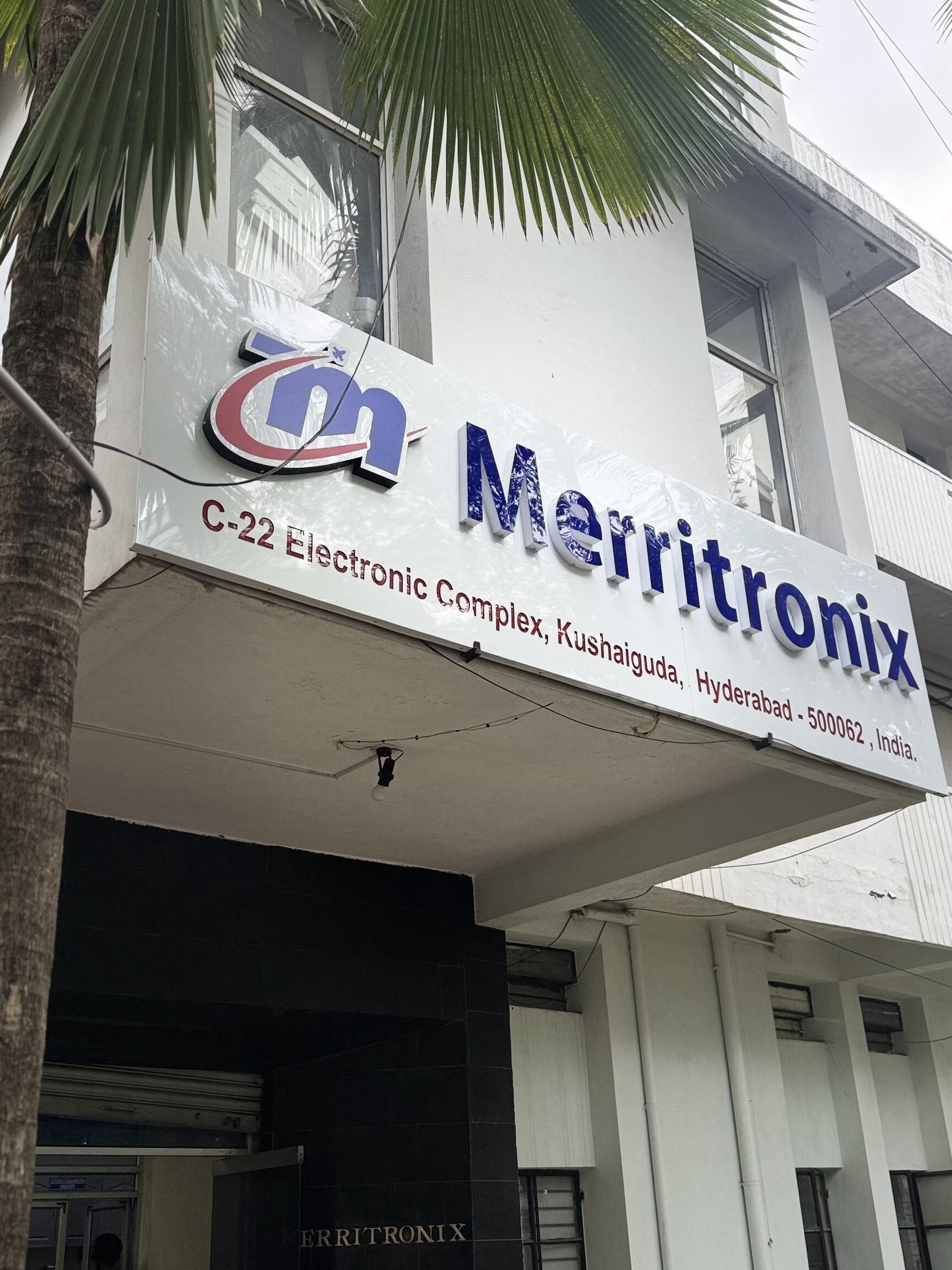
Incorporated in 1988, Merritronix is a 38-year-old Electronics Systems Design and Manufacturing (ESDM) company. For most of that history it was private — first as a telecom component supplier, then as a defence electronics vendor. The June 2026 IPO raised ₹70.03 Cr (fresh capital only), priced at ₹149 per share.
The company IPO’d on June 8, 2026, opening at ₹283.10 against the issue price of ₹149 — a listing gain of 90%. Three trading days later, the stock rests at ₹344.05. Price-referenced are not live; they are closing prices as of June 11, 2026.
Three decades of the Dovari family running the show — Yesudas, Amarnath, and two others holding the largest blocks. Amarnath Dovari, the CEO, oversees daily operations. The promoters pocketed ₹14 Cr via the IPO’s stake sale (10.5%), which diluted their hold from 85% to 62%.
The IPO prospectus spoke of upgrade plans: new SMT equipment, automated material handling, expanded testing. The company received EN 9100:2018 certification for aerospace and defence (equivalent to AS 9100D), plus ISO 9001:2015. Both matter in mission-critical environments where “quality” isn’t marketing speak.
3. Business Model: WTF Do They Even Do?
Merritronix assembles printed circuit boards (PCBs) and systems for defence, aerospace, telecom, and industrial electronics. It does not design weapons or sell consumer widgets. It is a B2B contract manufacturer of high-reliability electronics.
By sector: Aerospace & Defence, 98%. Complex PCBA & NPI, 2%. By customer type: Non-Government (private industry), 93%. Government entities, 7%. Geography: Telangana dominates at 98%, with scraps in UP, Haryana, and 1% exports.
The company boasts 86% repeat customer ratio in FY26 (68 of 79 active customers came back). Top 10 customers account for 98% of revenue. Translate that: if Hindustan Aeronautics, Apollo Micro, or Bit Mapper sneezes, the company catches the flu.
Installed capacity: 7.65 lakh SMT assembly boards, 6 lakh through-hole (THT) boards, 4.2 lakh box-build units — 17.85 lakh units total per annum. The company is at the mercy of material supply chains, labour hiring, and customer throughput. Advanced components like Ball Grid Array (BGA) and micro-BGA are part of the toolkit, aimed at miniaturized aerospace systems.
The company outsources mechanical enclosure fabrication to third parties but controls the full integration. Customers get one throat to choke if something goes wrong.
4. Financials Overview
Figures are consolidated, in ₹ crore.
Metric
FY24
FY25
FY26
YoY Growth (FY25 to FY26)
2-Year CAGR
Sales
85.7
113.56
155.9
37.3%
34.8%
EBITDA
6.73
15.18
27.22
79.5%
101.2%
PAT
3.05
8.66
16.1
85.9%
129.3%
EPS (₹)
2.10
5.96
12.59
111.3%
—
The trailing EPS (TTM) from the Screener data shows ₹12.59. The current stock price is ₹344.05, so the market P/E is 344.05 ÷ 12.59 = 27.3x on trailing earnings. The reported FY26 annualized P/E (using full-year EPS of 12.59) is 27.3x.
Operating margin (OPM) improved to 17.5% in FY26 (from 13.3% in FY25 and 7.8% in FY24). The company achieved EBITDA of ₹27.22 Cr, marking a 79.5% jump. The improvement reflects (a) better material sourcing under volume, (b) operating leverage as the facility ramps, and (c) possibly one-time tailwinds from raw material deflation. That last variable is not a moat; it’s a renter’s benefit.
Depreciation is low (₹0.47 Cr), which suggests the asset base is small and/or new plants haven’t been fully capitalized yet. Interest cost climbed to ₹4.08 Cr (from ₹2.83 Cr), a 44% jump driven by higher borrowing balances.
5. Market Expectations & Historical Multiples
This section describes how the market is currently pricing the company and how