Mercantile Ventures Ltd — FY2026: ₹93 Cr Revenue, 3.7% EBITDA Margin, and a Security Arm Quietly Running the Show
Spotted a factual error — a wrong number, date, or fact? Tell us and we will check the source.
General information and entertainment, not investment advice. The author is not a SEBI-registered adviser or research analyst. No recommendation, no promised returns. Markets carry risk including loss of capital. Figures may not be current. Consult a registered adviser before acting.
1 — At a Glance
Mercantile Ventures Ltd ended FY2026 with consolidated revenue of ₹93.34 crore — up 29.3% year-on-year — but EBITDA of just ₹3.45 crore, a margin of 3.7%. Profit after tax landed at ₹6.90 crore, against ₹16.23 crore the prior year, a compression of 57.5%. On the surface: revenue growing, earnings retreating. That tension runs through the whole year.
The market pays 40.7x earnings on this result. The industry median sits at 18.53x, per the peer table. At a market cap of ₹282.59 crore and a book value of ₹272.64 crore, the price-to-book registers 1.04x — the company is trading essentially at net worth, which is itself a number anchored by ₹149.51 crore in investments and ₹93.71 crore in fixed assets.
There is one number that deserves a double-take: other income of ₹3.01 crore accounts for 43.6% of the reported ₹6.90 crore PAT. Strip it out and the operating business is carrying very thin water. ROCE stands at 0.82%, ROE at 2.29%.
Meanwhile, security services — a segment that didn’t exist prominently five years ago — now generates 52.2% of consolidated revenue. The original property leasing business contributes 8.2%. The company that says “leasing and manpower” on the tin has quietly pivoted its engine.
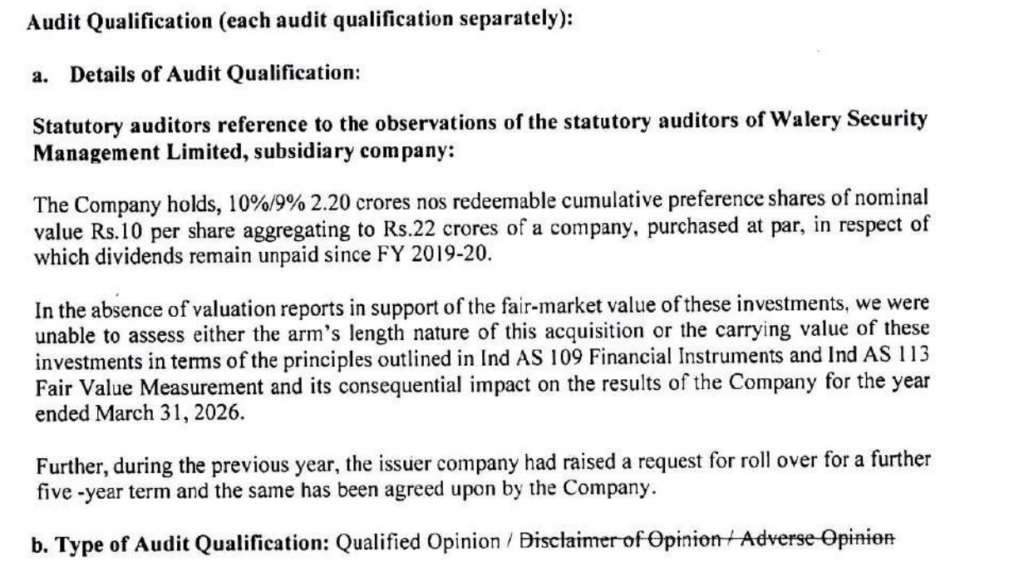
The auditors issued a qualified opinion on the consolidated accounts — flagging unverifiable fair-market value on ₹22 crore of preference shares held by subsidiary Walery Security Management Limited, dividends on which have been unpaid since FY2019-20.
Revenue is doing the right thing. Everything downstream of it is asking harder questions.
2 — Introduction
Mercantile Ventures Limited (MVL) was incorporated in 1985, originally as a non-banking financial company. It subsequently pivoted to leasing immovable properties, acquiring them for rental income or resale — a model that has itself been gradually supplemented by facility management and manpower services. The registered office sits at 88 Mount Road, Guindy, Chennai.
The FY2026 story is partly MVL-standalone and partly a group result that now encompasses three subsidiaries: i3 Security Private Limited, India Radiators Limited, and Walery Security Management Limited. Of these, Walery runs the security services business that now dominates consolidated revenue, and i3 Security carries a pending merger into the parent.
On the corporate actions front, the year saw meaningful movement. Equity shareholders approved the amalgamation of India Radiators Limited into Mercantile Ventures at a meeting on March 13, 2026, with 99.999% votes in favour, per the announcement. A second motion petition was subsequently filed with the NCLT Chennai bench on March 23, 2026. The merger is in progress.
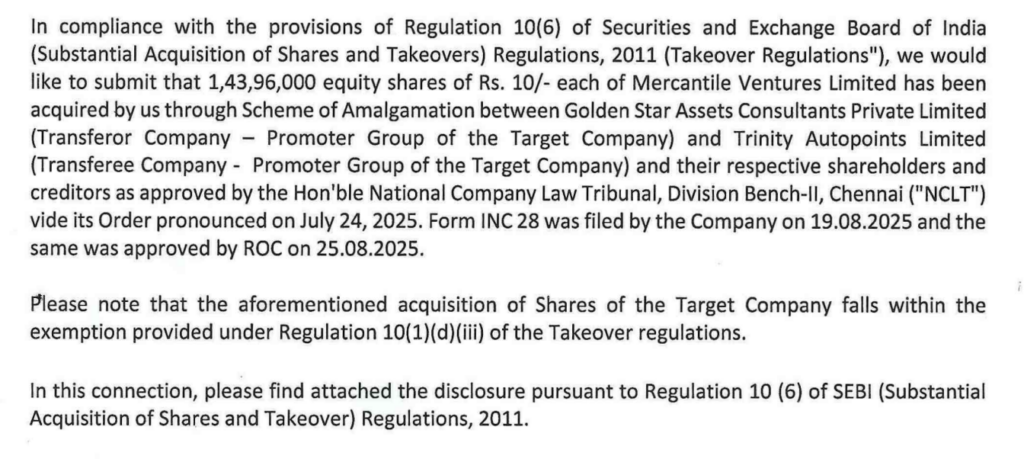
Promoter shareholding stood unchanged at 72.76% throughout the year. Trinity Auto Points Limited, one of the promoter entities, increased its stake from 18.72% to 31.59% in September 2025 following an NCLT-ordered acquisition of 1,43,96,000 shares.
N. Umasankar was appointed Whole-time Director (Finance) and CFO from October 27, 2025, per the announcement filed that date. The company continues to be led by Whole-time Director E. N. Rangaswami.
The audited results were approved by the board on May 27, 2026. Statutory auditors are Venkatesh & Co., Chartered Accountants. The standalone audit opinion was unmodified; the consolidated audit opinion was qualified — a distinction that matters and is addressed in Section 13.
3 — Business Model: WTF Do They Even Do?
Mercantile Ventures’ official description — “leasing of properties and manpower supply services” — reads like a business card that hasn’t been updated since the last decade. The actual revenue breakdown for FY2026 tells a more complicated story.
Security services, operated through subsidiary Walery Security Management Limited, generated 52.2% of consolidated revenue — ₹50.34 crore of the total ₹96.35 crore (per the consolidated segment figures in the filing, which include investment income in the denominator). Manpower services contributed 36.5% (₹35.14 crore). The property leasing that the company is still nominally known for? 8.2% (₹7.85 crore). Investment activities produced ₹3.01 crore, which is 3.1%.
The property business works as follows: MVL acquires immovable properties — a mix of commercial real estate — and leases them out, earning rent and maintenance income. The segment is stable but not a growth driver. Segment profit before tax for rent and maintenance was ₹3.89 crore in FY2026, down from ₹4.08 crore in FY2025, per the consolidated segment results in the filing.
The manpower business supplies workers to clients, primarily including SPIC (Southern Petrochemical Industries Corporation), which has historically been both a major customer and a significant public shareholder holding 13.43%. The concentration in a single client group and the related-party texture of the revenue are structural features of this segment, not incidental ones.
The security services segment, via Walery, is where the volume is. Segment revenue grew from ₹35.56 crore in FY2025 to ₹50.34 crore in FY2026 — 41.5% growth in a single year. Segment profit before tax also grew, from ₹1.38 crore to ₹2.43 crore. This is a labour-intensive business with thin margins by design; the question is whether operating leverage eventually follows volume.
The balance sheet carries ₹149.51 crore in investments — 48.9% of total assets — which is a reminder that MVL’s lineage as an NBFC never entirely disappeared. These investments generate the “investment income” that keeps showing up in other income lines and, sometimes, accounting complications.
Does a ₹283 crore company with three distinct businesses — property, manpower, security — and 48.9% of its balance sheet in financial investments have a coherent capital allocation framework, or is it an accumulation of adjacencies? The filings don’t settle this.
4 — Financials Overview
Figures are consolidated, in ₹ crore.
Quarterly Results — Latest Quarter (Mar 2026)
Metric
Mar 2026
YoY (vs Mar 2025)
QoQ (vs Dec 2025)
Revenue
23.67
+22.9%
-5.6%
Operating Profit
-0.23
vs +0.05
vs +0.44
PAT
3.51
-61.4%
+22.7%
EPS (not annualised)
₹0.31
vs ₹0.81
vs ₹0.26
Revenue in the March 2026 quarter grew 22.9% year-on-year, maintaining the double-digit top-line trajectory visible across the past several quarters. Operating profit turned negative at -₹0.23 crore (OPM: -0.97%), against +₹0.05 crore in the prior-year quarter. The PAT decline of 61.4% against March 2025 traces to Q4 FY2025’s deferred tax credit of ₹5.26 crore — by the arithmetic in the quarterly data, that credit accounts for most of the prior-year quarter’s reported profit — which the March 2026 quarter did not repeat. Other income of ₹2.09 crore carried a meaningful share of Q4 FY2026 profitability.
No concall is available in the dump; management commentary is therefore limited to what the filings state.
5 — Market Expectations & Historical Multiples
This section describes how the market is currently pricing the company and how that compares with its own history and peer group. It is descriptive, not predictive.
Company with the market cap for only 281 crs. ( Currently reverse merger going to happen with india radiators ). Company has given corporate guarantee of rupees 30000 crs


One Response
Company with the market cap for only 281 crs. ( Currently reverse merger going to happen with india radiators ). Company has given corporate guarantee of rupees 30000 crs