01 — At a Glance
The Pharmacy Chain That Makes No Money But Costs Everything
- 52-Week High / Low₹1,052 / ₹603
- Q3 FY26 Revenue₹1,806 Cr
- Q3 FY26 PAT₹57.8 Cr
- Q3 FY26 EPS₹4.82
- Annualised EPS (Q3×4)₹19.28
- Book Value₹154
- Price to Book5.46x
- Dividend Yield0.00%
- Debt / Equity0.65x
- Store Count (Q3)5,112
Auditor’s Reality Check: Medplus ended Q3 FY26 with 5,112 stores, ₹1,806 crore quarterly revenue (+15.7% YoY), ₹57.8 crore net profit (+26% YoY), and an insane P/E of 48.9x. The stock is at ₹840. Annualised EPS from Q3 would be ₹19.28, meaning the valuation is even spicier. No dividend, 0.65x debt-to-equity (not catastrophic but not trivial), and a promoter pledge that’s climbing faster than the store count. The company is expanding like a startup but valued like it’s already the Walmart of India.
02 — Introduction
A Pharmacy Retail Romance Novel Written By A Spreadsheet
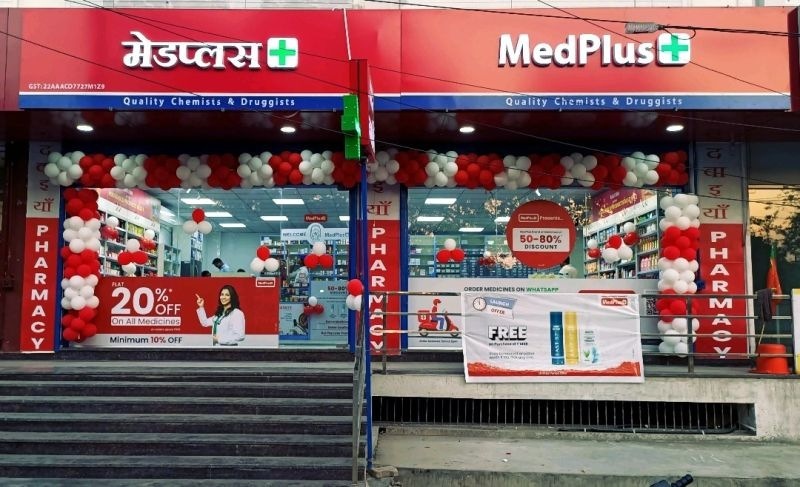
Medplus Health is India’s second-largest pharmacy chain. Let that sink in. The. Second. Largest. Not fourth. Not “competitive.” Second. With 5,112 stores across 13 states and 1 union territory, it’s serving over 750 cities and growing at 15%+ revenue CAGR. The company moved from one city (Telangana) to being a national beast in less than a decade.
But here’s where the romance novel turns into a financial thriller: the stock is trading at 48.9x P/E. For context, Nifty trades at ~28x. Medplus is trading at nearly 2x the market multiple despite having a single-digit ROE of 8.8% and zero dividend. It’s as if the entire market agreed that someday, somehow, this company will become ridiculously profitable. Maybe. Hopefully. We’ll see.
Q3 FY26 delivered the goods: ₹1,806 crore in quarterly revenue (up 15.7% YoY), net profit of ₹57.8 crore (up 26% YoY), and a 5.4% operating margin after swallowing a ₹70.59 crore labour code bill. But here’s the kicker—mature stores (>12 months old) are already generating 12.4% store-level EBITDA margins. That’s real. The problem? You have 23% of stores that are less than 2 years old, still burning capital and dragging overall returns like an anchor.
Welcome to the Medplus paradox: a company growing explosively, making decent profits at store level, but losing money on working capital, leverage, and the classic startup sin of expansion before profitability. Let’s dissect this pharmacy romance and see if it’s a love story or a cautionary tale.
Concall Highlight (Feb 2026): “At least for the next 1 quarter, I have a very clear visibility [on SSSG],” said management. Translation: Q4 comparisons are weak, and SSSG will look good. After that? *shrugs in finance*
03 — Business Model: It’s Just A Store. What’s The Mystery?
Retail Pharmacy: Buy Branded Drugs, Sell Them, Pray For Volume
The business model is delightfully simple. Medplus buys medicines—branded and generic—from pharma companies at wholesale rates, stocks them in 5,112 stores, and sells them to customers at retail prices. It also sells FMCG products (soap, shampoo, bandages, etc.) and now offers diagnostics. The mix is roughly: Branded Pharma (64.4%), Branded FMCG (9%), Private Label Pharma (12.1%), Private Label FMCG (9.6%), and Others (4.9%).
Gross margins are the real story. Branded pharma (~13–14%), private label pharma (~65–70%), and private label FMCG (~25–28%) show a massive arbitrage. Private label is the golden goose—nearly 5x the margin of branded. But here’s the strategist’s dilemma: push private label too hard and you risk alienating customers who came for the branded security. So Medplus has redesigned incentives. Previously, staff got bonuses for private label sales only. Now it’s blended: hit total sales targets or the private label commission suffers. It’s genius if it works.
The distribution network is 95% company-owned stores (leased real estate), meaning capital-intensive expansion. Each store requires ~₹15–18 lakhs in inventory alone. They’re now testing a franchisee model to lighten the load—sell inventory on day-one, reduce working capital. Early signals show some withdrawals, but the concept is sound.
Pharma Gross Margin13-14%Branded Pharma
PL Pharma Margin65-70%Private Label
PL FMCG Margin25-28%Non-pharma
Metro Concentration47%of Revenue
The Private Label Pivot: Medplus launched its own branded pharmaceutical products in FY25 Q1. Private label pharma penetration grew from 7.9% to 18.9% (GMV basis) in less than a year. But watch the realization metrics: pharma PL net realization fell from ₹83 to ₹45–46. That’s aggressive pricing, not margin magic. It’s a volume play masquerading as a margin story.
💬 Question for you: When a company opens a store every single day, which costs capital and takes 12-24 months to break even, does that sound like a path to profitability or a path to raising more money from the market?
04 — Financials Overview
Q3 FY26: The Numbers That Made The Stock Soar
Continue reading with a premium membership.