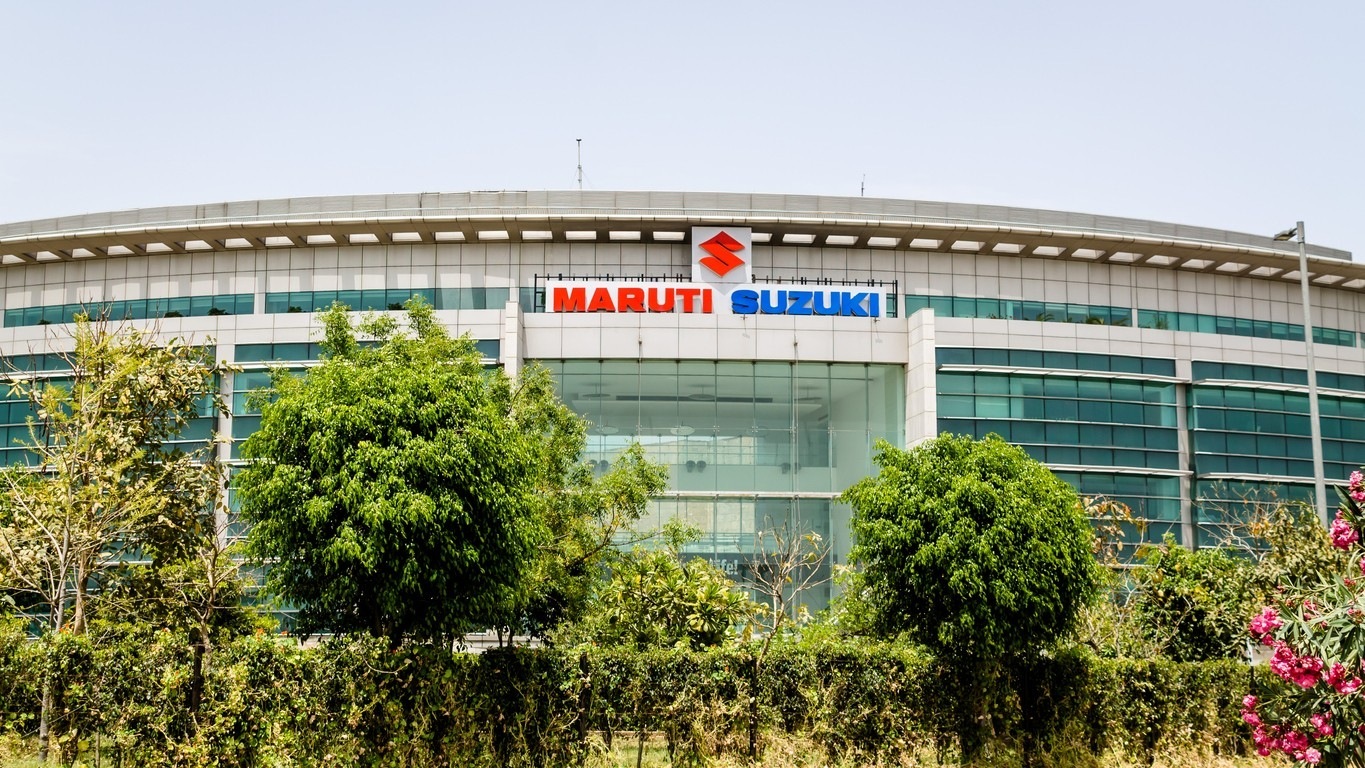
Maruti Suzuki:
₹49,904 Cr Quarterly Sales. Record High. GST Reform Saved The Day.
Domestic market exploded 22% in Q3 after a historic 5–10% GST cut in September. Maruti just kept selling cars while demand crushed supply constraints. Highest quarterly revenue ever. Next question: is this sustainable?
The Maruti Show: Where Small Cars Meet a Tax Windfall
- 52-Week High / Low₹17,372 / ₹11,059
- Q3 FY26 Revenue₹49,904 Cr
- Q3 FY26 PAT₹3,879 Cr
- Q3 FY26 EPS₹123.38
- 9M FY26 PAT₹10,862 Cr
- Book Value₹3,172
- Price to Book4.46x
- Dividend Yield0.95%
- Debt / Equity0.00x
- Interest Coverage90.6x
Maruti Suzuki: The Market Leader That GST Just Rewarded
Maruti Suzuki is India’s largest passenger vehicle manufacturer. Since 1981. Market share: ~39% (domestic), ~46% (exports). Suzuki Motor Corporation (SMC) owns 58.28%. The company makes cars. Small cars, utility vehicles, some sedans. CNG cars. Electric cars now. That’s it. No fintech play. No electric unicorn. Just the dull, reliable, cash-generating business of moving Indians from point A to point B.
And yet — in the fiscal year ending March 2025, Maruti generated ₹1,52,913 crore in revenue and ₹14,500 crore in net profit. Operating margin at a respectable 13%. Return on equity: 15.9%. A ROCE of 21.7% — better than 80% of Nifty 500 companies. Debt basically non-existent: ₹99.9 crore against a ₹4,45,121 crore market cap.
Then, on September 22, 2025, the Government of India cut GST on small cars from 28% to 18% — a straight 10-percentage-point reduction. GST on sub-4-meter utility vehicles also fell to 18%. For cars priced below ₹12 lakhs, the tax hit went from roughly 28% to 18%. Customers saved 5–10% on sticker price overnight. Demand… erupted. Domestic volumes in Q3 FY26 climbed 22% YoY. Production running at 90% capacity. Supply chain on life support. And Maruti, as market leader, captured the bulk of the windfall.
This is the story: a market leader riding a one-time tax shock that may or may not last. Let’s dig in.
They Build Cars. A Lot. Sell Them Cheaper. Repeat.
Maruti Suzuki’s business is refreshingly simple. Buy components (95% from India-based suppliers), assemble them across four plants (Gurgaon, Manesar, Kharkhoda, Gujarat), slap a Maruti badge on, sell through ~1,500 dealerships and 4,000 service touchpoints. The company sells in the sub-₹20 lakh sweetspot where 70% of India’s passenger vehicle market lives. Small cars (Alto, S-Presso) account for ~28% of revenue. UVs (Brezza, Grand Vitara, Fronx, VICTORIS) — the hot segment — drive another large slice. CNG powertrain variants: 35% of FY25 volumes. Electric: just started with the e VITARA.
Capacity: currently ~2.6 million units per annum across all four plants. Utilization: ~90% as of Dec 2025. Two fresh 250,000-unit-per-annum plants coming online in quick succession (Kharkhoda Phase 2 in April 2026, Gujarat D-line “soon after”). A brand-new greenfield facility planned in Gujarat. By FY2030-31, Maruti targets 4 million units per annum capacity. That’s a 54% capacity expansion in 5 years.
Profitability margins: typically 12–14% operating margin, 9–10% net margin. In Q3, OPM was 11.2% due to commodity inflation, rare earth supply disruptions, and price cuts on a few models — headwinds that partially offset the operating leverage from surging volumes. But the company’s confidence is evident: they’re building capacity ahead of demand, borrowing nothing, and burning through cash like a dividend machine.
Q3 FY26: The Record That Came With Asterisks
Result type: Quarterly Results | Q3 FY26 EPS: ₹123.38 | Annualised EPS (Q3×4): ₹493.52 | Full-year FY25 EPS: ₹429.01
Source table
| Metric (₹ Cr) | Q3 FY26 Dec 2025 |
Q3 FY25 Dec 2024 |
Q2 FY26 Sep 2025 |
YoY % | QoQ % |
|---|---|---|---|---|---|
| Revenue | 49,904 | 38,764 | 42,344 | +28.7% | +17.9% |
| Operating Profit | 5,573 | 5,076 | 5,086 | +9.8% | +9.6% |
| OPM % | 11.2% | 13.1% | 12.0% | -190 bps | +20 bps |
| PAT | 3,879 | 3,727 | 3,349 | +4.1% | +15.8% |
| EPS (₹) | 123.38 | 118.54 | 106.52 | +4.1% | +15.8% |
Is 29.8x P/E Really Justified?
Method 1: P/E Based
Annualised EPS (Q3×4) = ₹493.52. TTM EPS (as of March 2025) = ₹429.01. Using a blended normalized EPS of ₹460: Sector median P/E = 29.9x. Maruti’s justified premium (market leader, ROCE 21.7%, FCF strong): 0.90x–1.05x sector. Fair P/E band: 27x–31x.
Range: ₹12,420 – ₹14,260
Method 2: EV/EBITDA Based
TTM EBITDA (FY25 + Q3 FY26 incremental) ≈ ₹25,800 Cr. Current EV = ₹4,44,552 Cr. EV/EBITDA = 17.2x. Auto OEM comps trade at 13x–18x depending on cycle. Maruti’s strong FCF and market position justify 16x–17.5x range.
EV range (16x–17.5x): ₹4,12,800 Cr – ₹4,51,500 Cr → Per share (31.4 Cr shares):
Range: ₹13,140 – ₹14,380
Method 3: DCF Based
FCF FY25: ~₹16,136 Cr. Growth assumptions: 12–14% revenue CAGR for 5 years (post-GST normalization, capacity expansion). Terminal growth: 4%. WACC: 10%.
→ Terminal Value (4% perpetual growth, 6% cap rate): ~₹3,85,000 Cr
→ Total EV: ~₹4,60,000 Cr
Range: ₹14,620
The Plot Thickens: GST Demand vs Sustainable Growth
🔴 The GST Shock: A One-Time Tailwind or Structural Inflection?
On September 22, 2025, India’s government reduced GST on automobiles — small cars from 28% to 18%, compact SUVs to 18%. A straight 5–10% price cut for customers. Demand surged 20.5% YoY for the industry in Q3; Maruti’s domestic volumes jumped 22%. But here’s the tension: management explicitly stated on the concall, “What is the sustainable level of demand after the euphoria is over?” They suspect Q3 saw both “postponed demand and preponed demand” — people rushing to buy before prices stabilize, plus folks who delayed purchases now buying early to lock in the lower tax rate. The real test comes in Q4 and beyond. Consensus industry growth expectations: ~7% sustainable CAGR post-GST. Maruti is betting on 12–14%, driven by capacity additions and EV adoption. The delta will determine whether this is a 5-year compounding story or a 1-2 year boom followed by normalization.
✅ Capacity Blitz: Building Ahead of Demand
- • Kharkhoda Phase 2 (250k/yr): April 2026 target
- • Gujarat D-line (250k/yr): “Soon after” Kharkhoda
- • New Gujarat greenfield: Strategic reserve planned
- • Total capex run-rate: ₹10,000–₹12,000 Cr/yr
- • Target capacity by FY30-31: 4 million units/yr
⚠️ Margin Pressure & Commodity Headwinds
- • PGM (platinum, palladium, rhodium) inflation: 60 bps impact in Q3
- • Rare earth element supply: 20 bps cost in Q3
- • Price cuts on select models: 70 bps impact
- • Labour Code provision: 125 bps one-time hit
- • FX headwinds: 15 bps; ongoing exposure
✅ EV Launch & Export Growth
- • e VITARA: 5-star Bharat NCAP safety rating
- • Exports by Dec 2025: 13,000 units to 29 countries
- • Domestic launch: “Very soon now” (likely Jan/Feb 2026)
- • Charging ecosystem: 2,000 exclusive points; 13 CPO partnerships
- • FY26 export target: 400,000 units (on track)
⚠️ Regulatory & Trade Headwinds
- • South Africa tariff threat: “Media coverage” stage; exposure risk on exports
- • Tax assessments pending: FY2010-11 to FY2012-13 orders, under appeal
- • CCI antitrust case: NCLAT hearing Feb 2026; outcome uncertain
- • Rare earth supply dependency: China-sourced, geopolitical risk
Net Worth Paradox: Growing Despite Massive Payouts
Source table
| Item (₹ Cr) | Sep 2025 | Jun 2025 | Mar 2025 | Change (9M) |
|---|---|---|---|---|
| Total Assets | 138,453 | 133,180 | 131,971 | +6,482 |
| Equity + Reserves | 99,587 | 97,654 | 96,083 | +3,504 |
| Borrowings | 100 | 99 | 87 | +13 |
| Other Liabilities | 38,609 | 35,525 | 35,644 | +2,965 |
| Total Liabilities | 138,453 | 133,180 | 131,971 | +6,482 |
Borrowings ₹100 Cr. Interest coverage: 90.6x. The company earns ₹90 for every rupee of interest it owes. Imagine having a ₹25 lakh home loan that you could pay off with 2 weeks of salary.
9M FY26 net profit: ₹10,862 Cr. 9M capex: likely ₹8,500–₹9,000 Cr (annualized). Leftover cash: ₹1,500–₹2,000 Cr gets paid as dividends or sits on the balance sheet.
Days payable (70) > inventory days (23) + receivable days (16). Maruti collects cash from customers before paying suppliers — a 31-day cash-flow holiday. Classic market-leader advantage.
Sab Number Game Hai: The FCF Machine
Source table
| Cash Flow (₹ Cr) | FY25 | FY24 | FY23 |
|---|---|---|---|
| Operating CF | +16,136 | +16,801 | +9,251 |
| Investing CF | -14,456 | -11,865 | -8,036 |
| Financing CF | -4,155 | -4,062 | -1,213 |
| Free Cash Flow | +1,680 | +4,936 | +1,215 |
The Numbers That Matter Most
Show Me the Money: Revenue, Margins, Profit
Source table
| Metric (₹ Cr) | FY25 | FY24 | FY23 |
|---|---|---|---|
| Revenue | 152,913 | 141,858 | 117,571 |
| Operating Profit | 20,224 | 18,626 | 11,029 |
| OPM % | 13.2% | 13.1% | 9.4% |
| PAT | 14,500 | 13,488 | 8,211 |
| EPS (₹) | 461.20 | 429.01 | 271.82 |
Revenue growing at 14% CAGR, but profit growing at 33% — that’s leverage. In good years, Maruti extracts margin expansion. In commodity-inflationary years (like Q3), those gains evaporate. The recent GST cut is a margin tailwind that might not last. Investors should distinguish between cycle-adjusted profit and actual reported profit.
The Competitive Gauntlet: Who’s Left Standing
Source table
| Company | Qtr Revenue (₹ Cr) | Qtr PAT (₹ Cr) | P/E | ROCE % | Market Share |
|---|---|---|---|---|---|
| Maruti Suzuki | 49,904 | 3,879 | 29.8x | 21.7% | ~39% (Dom) |
| M&M | 52,099 | 5,021 | 25.9x | 13.9% | ~15% (Dom) |
| Hyundai Motor | 17,452 | 1,194 | 29.9x | 54.2% | ~11% (Dom) |
| Tata Motors (PV) | 70,108 | -2,073 | 21.5x | 20% | ~10% (Dom) |
| Force Motors | 2,128 | 254 | 29.3x | 30% | Niche |
Maruti dominates market share and ROCE, but M&M is catching up in volume. Hyundai’s ROCE is an outlier (likely cyclical euphoria). Tata Motors’ PV division is struggling. Force Motors is profitable but tiny. The duopoly is Maruti + M&M at 54% combined market share. Everyone else is playing for scraps.
Who Owns This Market Leader?
Shareholding (Dec 2025)
- Suzuki Motor Corp (Promoter)58.28%
- FIIs15.76%
- DIIs22.84%
- Public3.04%
- Government0.08%
Strategic Context
SMC is Maruti’s parent and super-majority shareholder. Control firmly in Japan. No hostile takeover risk. FIIs own ~16%, DIIs (including ICICI funds, SBI funds, LIC) ~23%. Retail public: tiny 3% stake. The company has never paid a dividend over 30.5% payout ratio despite generating excess cash — suggests conservative capital allocation to fund capex. 0% pledge on SMC’s stake.
Auditors, Boards, Compliance: All Green
✅ Strong Governance Posture
- ✓ Crisil AAA/Stable rating (Nov 2025, reaffirmed)
- ✓ 36% independent directors on board
- ✓ 27% women board representation
- ✓ 100% investor complaint resolution rate
- ✓ Clean audit history; no material qualifications
- ✓ 0% pledge on promoter stake (SMC)
- ✓ Related-party transactions disclosed
⚠️ Regulatory Headwinds
- ⚠ CCI antitrust case: Dealers complaint under appeal (NCLAT, Feb 2026 hearing)
- ⚠ Tax assessments: FY2010-11–FY2012-13 under ITAT appeal
- ⚠ Grand Vitara recall: 39,506 units (fuel gauge fault, Nov 2025)
- ⚠ South Africa trade risk: Tariff threats on automotive imports
- ⚠ Capital markets scrutiny: High valuation under watch
The Indian Auto Market: Consolidation Underway
India’s passenger vehicle market is ~43 lakh units annually. Maruti captures 39%. M&M captures 15%. Hyundai: 11%. Tata Motors (PV): 10%. Everyone else splits the remaining 25%. It’s a duopoly with extras. Maruti’s dominance is built on: (1) first-mover advantage in small cars, (2) cheapest cost base in India, (3) unmatched distribution network, (4) CNG powertrain expertise, (5) Suzuki’s global tech partnerships.
🟢 Structural Tailwinds: Vehicle Parc Growth
India adds ~15 million vehicles annually to its parc. Currently, the installed base sits at ~200 million vehicles. Penetration is 8–9 per 100 people, vs 50+ in developed markets. Decades of volume growth ahead. Even in a 3–4% per annum demand growth scenario, Maruti’s capacity expansion to 4 million units by FY30-31 won’t oversupply the market.
🔵 EV Transition: Gradual, Not Cliff
India’s EV penetration in new PV sales: ~6% (Dec 2025). Even optimistic scenarios put it at 20–25% by 2030. The ICE vehicle parc will need oil, service, spares for 15+ years. Maruti’s service network (4,000 touchpoints) is a moat. e VITARA launch domestic targeting “very soon” — but EV is a multi-year ramp, not a cliff event. The bigger threat is competition from EV-native makers (BYD, Tesla, Nio). Maruti’s brand equity helps here.
🟡 The GST Shock: One-Time Demand Boost?
September 2025’s GST cut to 18% was unprecedented in magnitude. Savings of ₹1–₹2 lakhs per small car suddenly materialized. Demand surged. But the sustainability question looms. If consumers front-loaded purchases, Q4 and Q1 FY27 will see normalization. Maruti is betting that the lower GST is permanent (it is) and that it drives structural demand uplift. That’s plausible, but it’s not guaranteed. Market consensus needs to reset if Q4 volume growth drops below 5–10% YoY.
🔴 Geopolitics & Supply Chains: Rare Earth Risk
Maruti sources rare earth elements (for EV magnets) globally; China exposure is material. The concall mentioned a 20 bps margin hit in Q3 due to “rare earth supply issues” and resultant air freight. If geopolitical tensions escalate, supply chain snafus could hurt margins. The mitigation: India’s government is incentivizing local rare-earth magnet manufacturing. But timelines are uncertain. Short-term (1–2 years), this remains a headwind.
Competitive intensity: M&M is launching aggressive UV products. Hyundai and Kia have moved up-market. Tata Motors (EV focus) is losing PV share. Chinese OEMs (BYD, Great Wall) are eyeing India. Maruti’s 39% share is enviable but not permanent. To hold it, product refresh cycles and EV credibility are non-negotiable.
The Maruti Paradox
Maruti Suzuki is India’s auto leader by a crushing margin. 39% market share. 21.7% ROCE. Near-zero debt. ₹16k crore annual FCF. It’s the kind of business that financial theorists dream about. And yet the stock trades at 29.8x P/E — barely below sector median — suggesting the market has already priced the entire GST-shock rally and post-GST capacity story.
Q3 Execution: Record quarterly revenue of ₹49,904 crore. Volume growth of 22% YoY (domestic). Management operating at 90% capacity, working weekends, racing to commission Kharkhoda Phase 2 by April 2026 and Gujarat D-line “soon after.” The infrastructure bet is real. The capacity is being built. But timing risk exists: if GST-fueled demand normalizes faster than expected, you’re left with excess capacity and subdued margins.
Margin Reality Check: Q3 operating margin compressed from 13.1% (Q3 FY25) to 11.2% (Q3 FY26) despite 28.7% revenue growth. Commodity inflation (PGM, rare earth), supply disruptions, labour cost provisions, and strategic price cuts ate into the upside. Management says the Labour Code hit was one-time, but commodity cycles are structural. Investors should expect 11–12% OPM as normalized, not the 13–14% peak seen in benign commodity years.
Historical Context: Maruti’s stock has delivered 15% annualized returns over 10 years, 14% over 5 years, 18% over 3 years. That’s respectable, not spectacular. The FY26 rally (+21.4% in one year) has caught many investors’ attention, but it’s largely driven by GST sentiment, not fundamental re-rating. Forward returns will depend on: (1) industry demand growth post-GST normalization, (2) execution on 4-million-unit capacity plan, (3) EV adoption rates and profitability, (4) commodity price trajectory.
Capital Allocation Philosophy: Management returns 30–35% of earnings as dividends while reinvesting the rest into capex. This is disciplined and shareholder-friendly. But it also signals management expects ROI on incremental capex to be lower than cost of equity — hence the modest dividend yield (0.95%) and large equity base needed for future growth.
✓ Strengths
- 39% market share; unmatched scale in small cars
- 21.7% ROCE; best-in-class capital efficiency
- ₹16k Cr annual FCF; self-funding capex
- 1,500 dealerships + 4,000 service touchpoints
- CNG powertrain leadership (35% of volumes)
- Suzuki’s global tech partnership (EV, hybrids, autonomous)
✗ Weaknesses
- Operating margin volatile; exposed to commodity cycles
- Small cars segment shrinking as % of market
- EV profitability not yet visible (e VITARA just launched)
- Rare earth supply dependency; geopolitical risk
- Execution risk on 4-million-unit capacity plan
- P/E valuation at sector median; limited re-rating upside
→ Opportunities
- EV adoption secular tailwind (2030+ inflection)
- CNG powertrain expansion in CV/LCV segments
- Export growth (46% share; 400k target FY26)
- Mid-premium UV segment (VICTORIS, Grand Vitara scaling)
- Rural vehicle penetration still low; expansion runway
- Used car market (True Value) monetization upside
⚡ Threats
- GST demand shock normalization risk (Q4 FY26 data critical)
- M&M UV competition intensifying; share loss in UV segment
- Rare earth supply disruptions; geopolitical escalation
- Trade tariff threats (South Africa, global protectionism)
- CCI antitrust case (NCLAT hearing Feb 2026); potential penalties
- EV-native competitors entering India; BYD, Tesla, Nio threat
Maruti Suzuki is a best-in-class business trading at fair-value pricing.
The GST shock was real and Q3 execution was flawless. Capacity expansion is underway at scale. EV positioning is credible. But the stock has already rewarded most of the good news. At P/E 29.8x, the market is assuming: (1) GST demand boost sustains, (2) capacity additions hit target timelines, (3) margins normalize to 12–13%, (4) ROI on new capex justifies the reinvestment. Any one of these assumptions breaking — GST demand softer, capex delays, margin compression, or execution stumbles — and the stock becomes expensive.
For long-term equity investors with 5–7 year horizons, Maruti is a quality compounding story. For traders betting on a post-GST boom, valuation is already pricing the bloom. The fair value range (₹12,400–₹14,800) suggests CMP sits at the high end of fair value. Downside protection is limited below ₹12,000 given execution risks.