Manaksia Steels FY26: Revenue Nearly Doubles, Margins Triple — A Haldia Story Finally Finds Its Second Act
Spotted a factual error — a wrong number, date, or fact? Tell us and we will check the source.
General information and entertainment, not investment advice. The author is not a SEBI-registered adviser or research analyst. No recommendation, no promised returns. Markets carry risk including loss of capital. Figures may not be current. Consult a registered adviser before acting.
1 — At a Glance
Manaksia Steels is a ₹465 Cr market cap coated-steel company operating out of Haldia, West Bengal. In FY26, the company posted standalone revenue of ₹1,053 Cr — up 80% year-on-year — against ₹584 Cr in FY25. PAT jumped from ₹12 Cr to ₹38 Cr, a 226% rise. EPS on a full-year basis came in at ₹5.82. The market pays 12.2x those earnings, against a peer median closer to 18x.
The numbers carry a structural story: FY25 was a year of compressed realisations — Chinese steel flooding regional markets knocked margins to 2% operating — while FY26 saw the combination of safeguard duties on flat steel imports, improved realisations, a new Aluzinc (galvalume) plant commissioned in June 2025, and Q4 delivering an EBITDA margin of 11.27% on standalone figures. ROCE moved from 4% in FY25 to 13.4% in FY26.
The tension worth watching: the company operates at roughly 46% capacity utilisation on its existing lines. The galvalume plant is running at ~85% utilisation per management, but the older galvanising and cold-rolling lines remain underloaded. Two more expansion projects — a new colour-coating line and a ₹100 Cr cold-rolling mill — are in various stages of commissioning and planning. A cyclical steel company adding capacity as margins are recovering is either excellent timing or excellent optimism. The record doesn’t settle which.
2 — Introduction
Manaksia Steels was incorporated in 2001 in Kolkata by Suresh Kumar Agrawal and family, though it sat dormant until 2013, when the steel division of Manaksia Limited was demerged into it. The Manaksia Group operates across flat and long metal products, aluminium, kraft paper, and engineered closures, with plants in India, Nigeria, and Ghana.
MSL itself is the India-listed steel processing arm, operating a single manufacturing facility at Haldia, West Bengal. The Haldia location is not accidental — proximity to Haldia port reduces logistics costs on both the import of raw materials (primarily HR coils from Japan) and the export of finished goods. In FY25, ~75% of raw material purchases were imported, per the CARE rating report.
FY25 was a difficult year: revenues fell to ₹584 Cr from ₹632 Cr in FY24, per CARE, because realisation per tonne dropped sharply on account of cheap imports from China and neighbouring countries. Sales volumes actually grew 21% that year — the company was selling more and getting paid less for it, per the filing.
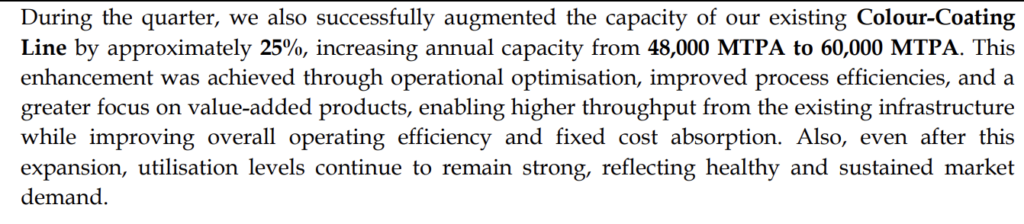
FY26’s recovery came from multiple directions: the June 2025 commissioning of the 110,200 MTPA Aluzinc plant (funded entirely from internal accruals at a total cost of ₹85 Cr), improved realisations after safeguard duties were implemented on flat steel imports, expansion of the existing colour-coating line capacity by 25% (from 48,000 to 60,000 MTPA) through process optimisation, and what management described as a sharp rise in steel pricing in Q4 driven by supply-side constraints from power and fuel shortages. MD Varun Agrawal, in the FY26 results announcement, attributed the Q4 improvement specifically to these pricing dynamics and to higher stocking demand from dealers.
3 — Business Model: WTF Do They Even Do?
Manaksia Steels is, in the most stripped-down description, a steel processor. The company does not make steel. It buys hot-rolled (HR) coils — mostly from Japan — cold-rolls them to tighter tolerances, then applies coatings of various kinds and sells the finished product to builders, appliance manufacturers, and whoever needs metal that won’t rust embarrassingly fast.
The product cascade works like this: HR coils go through the cold rolling mill to become cold-rolled (CR) coils. Those CR coils then go through one of three coating processes — hot-dip galvanising (zinc), Aluzinc/galvalume (aluminium-zinc-silicon), or colour-coating (paint on top of a zinc or galvalume base). Each step adds margin. Each step also adds a facility, capital, and a new way to get the economics wrong if input prices and realisation prices move out of sync.
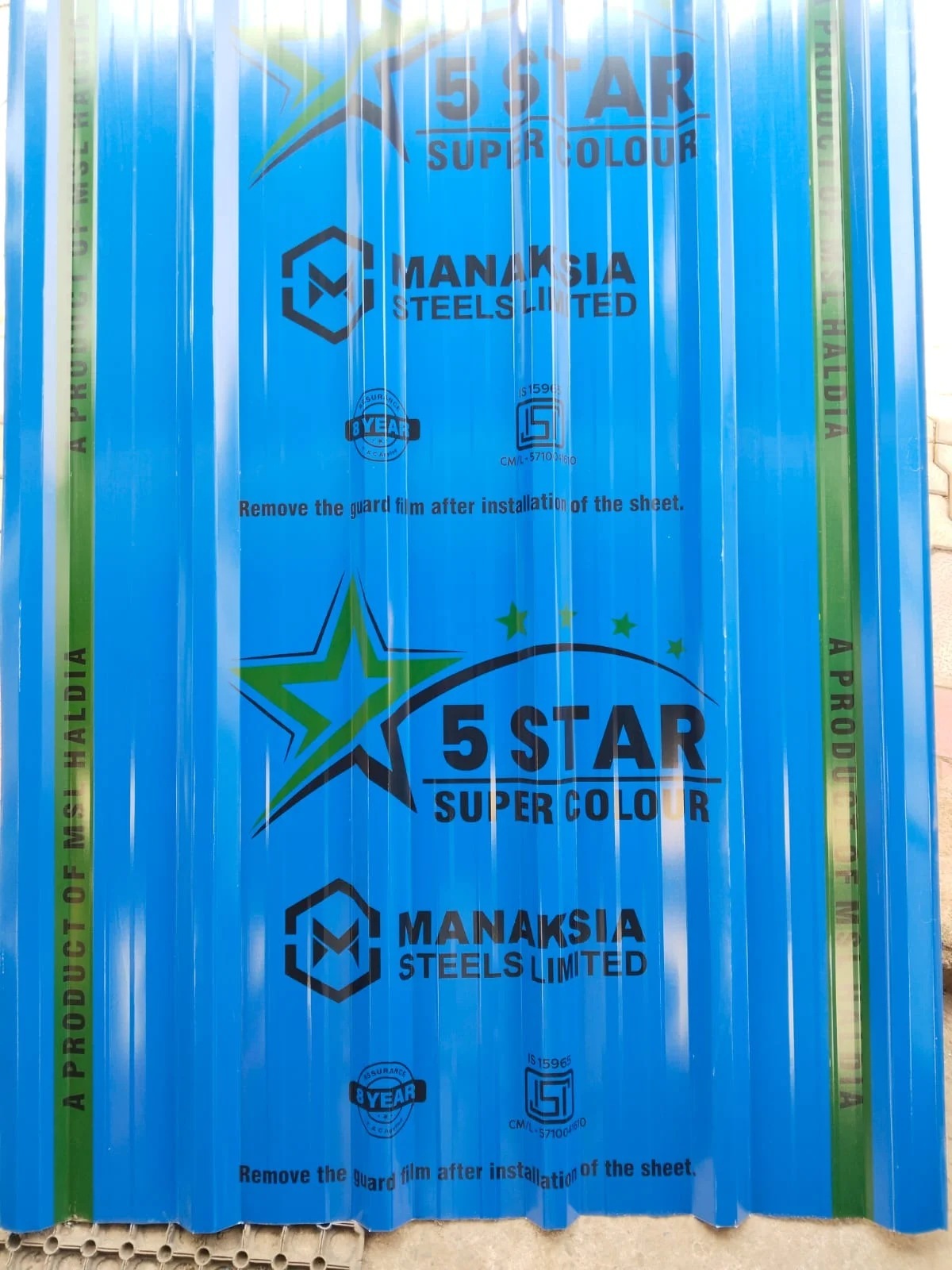
The branded product portfolio: 5 Star Super Shakti (galvanised sheets for roofing and cladding), 5 Star Superlume (Aluzinc/galvalume, high corrosion resistance), 5 Star Super Colour (pre-painted coated sheets), and Austrang (colour-coated with enhanced UV protection). The brands sit in the “new-age building materials” category — construction, solar, warehousing, home appliances — sectors that are, structurally speaking, not going anywhere.
The geography split in FY25 was roughly 77% domestic (with ~67% of that from Eastern India alone) and 23% exports. The company has flagged Europe and Africa as newer target markets; trial supplies to European and African customers commenced in Q3 FY26, per the announcement. The Nigerian subsidiary, Federated Steel Mills Ltd (FSML), recorded ~45% year-on-year revenue growth in Naira terms in FY26, management stated.
The concentration risk is real: top 10 customers contribute over 52% of sales, per CARE. And roughly 18% of FY25 sales involved supplying HR coils and aluminium sheets to group companies in Nigeria — related-party revenues that sit in the revenue line.
The market share figures the company cites — 15% in hot-dipped galvanised sheets, ~31% in pre-painted galvanised, ~29% in pre-painted Aluzinc, among secondary flat steel manufacturers in operating regions — deserve the qualifier “in operating regions.” Eastern India is not the national market. A 31% share of a regional niche is worth knowing, but not confusing for something larger.
What this model needs to work: stable HR coil import costs, decent realisation on coated products, and enough utilisation to absorb the fixed costs. When Chinese steel is cheap and flooding the market, two of those three break simultaneously.
4 — Financials Overview
Figures are standalone, in ₹ crore. This is a Yearly result for FY26 (year ended March 31, 2026).
Metric
FY26
FY25
YoY Change
Revenue
1,053
584
+80.3%
EBITDA
72
12
+500%
PAT
38
12
+226%
EPS (₹)
5.82
1.79
+225%
Q4 FY26 (standalone):
Metric
Q4 FY26
Q4 FY25
YoY
Revenue
310
191
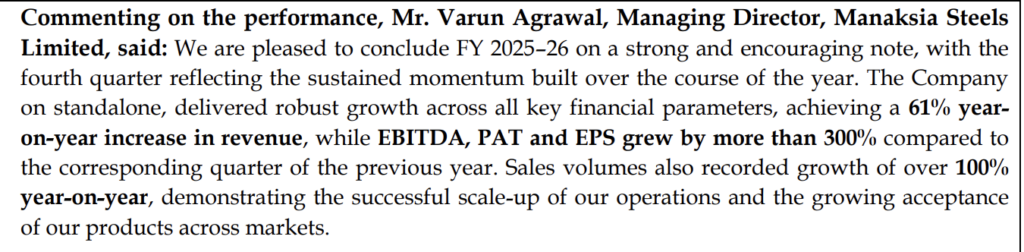
+61.4%
EBITDA
34.7
8.6
+306%
PAT
18.7
4.3
+332%
EPS (₹)
2.86
0.66
+332%
Q4 alone accounted for ₹18.7 Cr of the full-year ₹38 Cr PAT — so roughly half the year’s profits arrived in the final quarter.
Management attributed the Q4 performance to a sharp rise in steel pricing driven by supply-side constraints from power and fuel shortages, which led to increased dealer stocking. The Aluzinc line operated at approximately 85% capacity utilisation and drove higher demand for downstream colour-coating capacity, which ran near-full utilisation. Management noted that the existing colour-coating line capacity was increased by 25% through process optimisation during the quarter. On the outlook, management flagged that energy, consumable, and packing costs have increased in Q1 FY27 due to geopolitical tensions in the Middle East.
5 — Market Expectations & Historical Multiples
This section describes how the market is currently pricing the company and how that compares with its own history and peer group. It is descriptive, not predictive.