Madhav Infra FY26: Revenue Fell 18%, Profit Rose 6%, and the Company Secretary Quit Over Her Salary
Spotted a factual error — a wrong number, date, or fact? Tell us and we will check the source.
General information and entertainment, not investment advice. The author is not a SEBI-registered adviser or research analyst. No recommendation, no promised returns. Markets carry risk including loss of capital. Figures may not be current. Consult a registered adviser before acting.
1 — At a Glance
Madhav Infra Projects closed FY26 with revenue of ₹502 crore, down 17.7% from the prior year’s ₹610 crore. Profit after tax moved the other way, rising 6% to ₹27.4 crore. A company that sells less and earns more in the same year is worth reading carefully, because the story usually lives in the mix, not the headline.
The operating margin firmed from 11% to 13%, and the reported EPS ticked up to ₹1.02 from ₹0.96. The market prices all of this at 8.5x earnings against an industry multiple of 17.5x and a peer median near 17.6x — a company sitting at roughly half the group’s multiple.
Underneath the numbers sit some things a reader notices at a second glance: contingent liabilities of ₹306 crore against a net worth of ₹240 crore, an order book concentrated in two states, a Company Secretary who resigned in May 2026 over deducted salary, and a secretarial report flagging website and insider-trading compliance gaps. A construction firm’s profit is a story about working capital, and working capital is a story about who is minding the books. The rest of this entry follows both threads.
2 — Introduction
Madhav Infra Projects is a Vadodara-based engineering, procurement and construction (EPC) contractor, incorporated in 2010 and the in-house EPC arm of the Madhav group. It builds roads, bridges, railway overbridges and elevated corridors, largely across Madhya Pradesh and Gujarat, and it develops and operates solar power projects. The promoters, Ashok Khurana and his son Amit Khurana, were the erstwhile promoters of MSK Projects India, later taken over by the Welspun group.
The recent years read as a pivot toward solar EPC. Per CARE’s rating report, FY25 revenue jumped ~60% on the back of high-value solar EPC execution, though those projects carry thinner margins than the group’s road work. FY26 then gave the revenue back — down to ₹502 crore — while profit held and margins recovered.
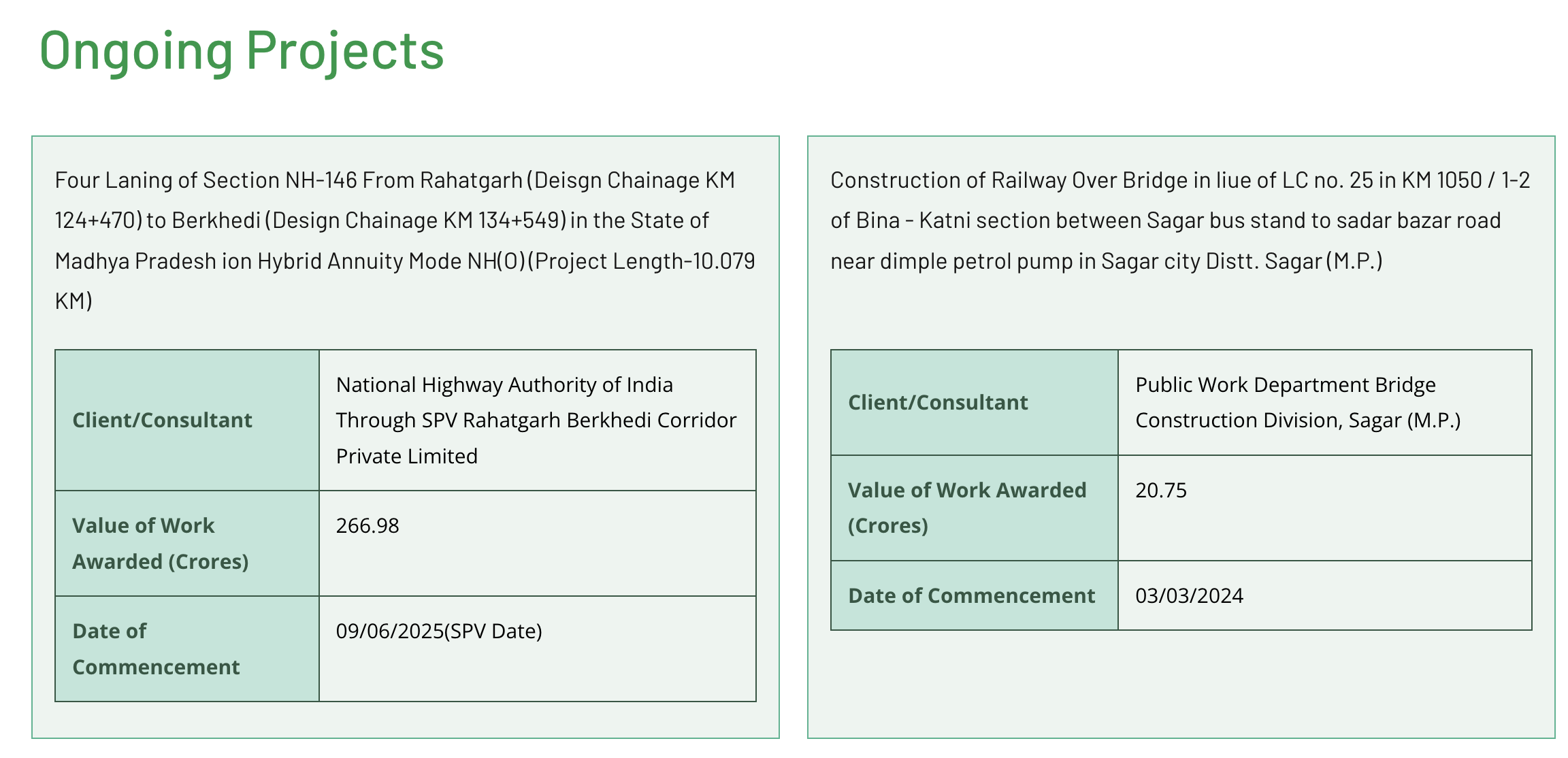
Recent moves cluster around solar. In April 2025 the company received a National Highways Authority letter of award for the NH-146 project worth ₹323.82 crore, and separately announced the acquisition of a 100% stake in MSK Projects. Through late 2025 and early 2026 it stacked up solar mandates from Madhya Pradesh government entities, incorporated nine wholly-owned SPVs in January 2026, and in April 2026 executed nine power purchase agreements for 73.15 MW of solar capacity.
3 — Business Model: WTF Do They Even Do?
Two segments, wildly lopsided. Infrastructure is essentially the whole company — 99% of revenue in FY24 versus 97% in FY22 — and energy (solar and hydro) is the rounding error that keeps growing anyway. The company itself notes power generation revenue runs under 10% of the main segment, which is why it treats the whole operation as a single reporting segment.
The infrastructure work is the classic government-contractor arrangement: win a tender, build a road or a railway overbridge, either directly or through a special-purpose vehicle under a concession agreement, then move to the next bid. The energy side offers solar as a service — viability studies, execution, supply, commissioning, and O&M — plus a modest solar EPC and O&M portfolio of around 119 MW across Karnataka, Punjab, Gujarat and Madhya Pradesh, and two hydropower projects totalling 6.8 MW.
The structural feature worth naming: this is a working-capital-intensive business bidding in what CARE describes as an intensely competitive and fragmented construction industry, where projects go to the most attractive bid price. That combination — aggressive bidding to win, then a long cash cycle to execute — is the entire margin puzzle of the sector. It also explains why a firm doing half a billion rupees in revenue holds receivables of ₹109 crore and inventory of ₹72 crore at year-end. The business doesn’t sell products; it finances them until the government pays.
The consolidated entity spans fifteen subsidiaries, one associate, and six joint ventures. For a ₹233 crore company, that is a lot of legal boxes to keep in a row.
Does a firm that pivoted into low-margin solar to grow revenue, then shed that revenue to protect margin, know which lever it wants to pull?
4 — Financials Overview
Figures are consolidated, in ₹ crore.
Metric
FY26
YoY
FY25
Revenue
502
−17.7%
610
Operating Profit
66
−1.5%
67
PAT
27.4
+6.0%
25.9
EPS (₹)
1.02
+6.3%
0.96
The headline tension is right here: revenue dropped a fifth, operating profit barely moved, and profit rose.