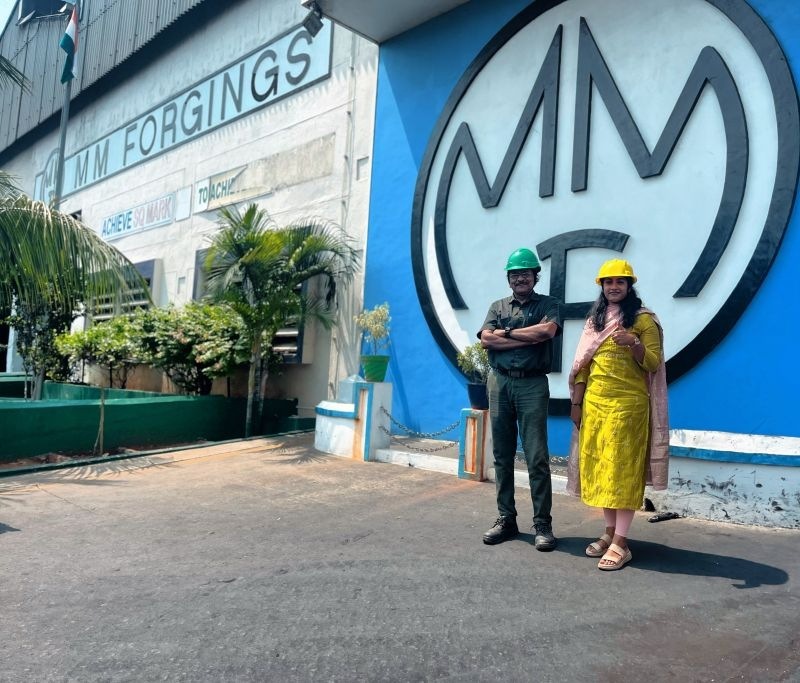
M M Forgings FY26: The Forging Business Hits a Flat Note While Debt Stays Put
General information and entertainment, not investment advice. The author is not a SEBI-registered adviser or research analyst. No recommendation, no promised returns. Markets carry risk including loss of capital. Figures may not be current. Consult a registered adviser before acting.
1. At a Glance
Revenue flatlined. FY26 sales of ₹1,545 Cr landed virtually unchanged against FY25’s ₹1,477 Cr—a gain of just 4.6% that management had hoped would be “a little bit of growth.” The US market turned hostile; domestic held steady. Net profit dropped 16.8% to ₹113.31 Cr, driven not by operations but by interest costs ballooning to ₹78.2 Cr (from ₹61.29 Cr prior year). A multi-year capex cycle—₹850 Cr over three years, mostly debt-funded—remains undigested: return on capital employed slouches to 10% (FY25: 15%), dragging ROCE below the company’s own stated targets. Meanwhile, the balance sheet swelled with debt near ₹1,100 Cr and the market prices the stock at 19.2x earnings, above its five-year median of 18.7x. Three questions loom: Does rising interest costs mark a peak, or the shape of things to come? Can the new 16,500-ton press, now commissioning, pull utilization from 70,000–75,000 tons (FY26) up toward management’s 90,000–100,000 ton target? And will the US market’s promised recovery materialize as quickly as management expects, or does tariff uncertainty keep the brakes on?
2. Introduction
M M Forgings traces its roots to 1946, when it peddled imported Royal Enfield motorcycles. In 1974, it pivoted to steel forgings and never looked back. By 1990, it scrapped the bike business entirely. Today it’s a ₹2,175 Cr market cap manufacturer of closed-die hot forgings—carbon, alloy, micro-alloy, and stainless steel—supplying Tier-1 auto suppliers across commercial vehicles, passenger vehicles, and agricultural components. It operates 10 plants across Tamil Nadu, Uttarkhand, and Uttar Pradesh with a stated capacity of 130,000 MTPA (metric tonnes per annum).
The company is controlled by the Vidyashankar-Krishnan promoter clan. Vidyashankar Krishnan, the second-generation MD, holds an engineering postgrad from IIT Madras and 25+ years in forgings. He sits on a 56.3% stake. The board includes a mix of promoter family, institutional directors, and independent faces. In late March 2026, shareholders approved a ₹600 Cr fundraising plan via QIP, signalling appetite for more leverage ahead.
FY26 marked a transition year. Order books swelled domestically; exports cratered. A CFO departed in April 2026; his successor stepped in the same month, a routine rhythm in mid-cap auto-supplier land.
3. Business Model: WTF Do They Even Do?
The business model is capital-intensive and cyclical. M M Forgings takes raw steel billets, heats them, forges them in massive presses (the new 16,500-ton press can shape 110+ kilo forgings), then half-finishes or fully machines them to customer spec. The trick is in the die work—custom dies for custom parts—and the metallurgical chops to hold tolerances.
Revenue splits roughly 76% commercial vehicle (CV), 8% passenger vehicle (PV), 15% agri/off-highway, and 1% other (9MFY26 mix). Within that, 61% comes from India; 39% from exports (mostly US 16%, Europe 12%, South America 4%, rest 1%). The domestic market is recovering—truck sales have picked up. Exports? Management says US Class 8 truck orders “shot through the roof in February,” but the FY26 numbers show US revenue compressed to just 9% of total (from 16–17% prior), a “huge reduction” management’s own words.
The product mix is shifting—toward heavier, machined forgings with higher value add. Machined parts (forged + machined) were 54% of sales in FY26, up from 42% in FY25. The company talks of “A for axle arm, B for beam, C for crankshaft.” Heaviest by volume is connecting rods—thousands of light parts. Axles and beams are fewer, heavier, higher-margin. The play is to move the mix up the scale.
Capacity sits at 130,000 MTPA. Actual utilization in FY26? A meagre 70,000–75,000 tons—half the nameplate. Management blames customer project delays (“many projects got delayed by more than a year at customer end”) and internal execution hiccups (one plant “was almost dictating terms of the customer,” delivery lags). Both are now supposedly behind them.
4. Financials Overview
Figures are consolidated, in ₹ crore.
Metric
FY26
FY25
YoY Growth
Revenue
1,545
1,477
+4.6%
EBITDA
300
323
-7.1%
PAT
113
136
-16.8%
EPS (annualized)
23.5
28.2
-16.8%
Q4 FY26 Snapshot (Standalone): Revenue ₹413 Cr (vs Q4 FY25: ₹355 Cr, a 16.3% jump). PAT ₹48.06 Cr (vs ₹36.24 Cr, a 32.5% leap). EPS ₹9.96. The quarter was strong, masking a lumpy year—Q2 and Q3 FY26 were dragged by US tariff fears and geopolitical chop.
From Management (Mar 2026 Concall):
Management expects FY26 final outcome to land near FY25, with “marginal growth of one or two percentage points.” They think FY27 will see “easily do 20% growth” driven by US Class 8 recovery, healthy India truck markets, and multi-year capex tailwind. They’ve invested “up to ₹1,000 Cr consistently over the last 5 years.” The catch? “Geopolitical tensions…throwing a spender in the works.” The US tariff is currently ~27.2% (Section 232 + base); management hears it could drop to ~18% but awaits fine print. Crucially: “Customers are paying the tariffs. Tariffs are not our responsibility.”
Management also flagged EPA norms driving potential pre-buy demand from “rest of 2026, up to second half of 2027.” They see US Class 8 production moving from ~150,000–180,000 trucks per annum toward 250,000.
5. Valuation Discussion: Fair Value Range (Educational Only)
What follows is a walkthrough of how three valuation methods work, using this company’s numbers as the example—not a target, not a forecast, not advice.
Method 1 (P/E multiple): Annualised EPS ₹23.5 × peer band 19.2–27.3x produces ₹451–641 per share.