Lux Industries FY26: The Squeeze Between Stardust and Subcontracting
Section 1 — At a Glance
A multi-year evaluation reveals a striking divergence between top-line expansion and capital efficiency. Lux Industries Limited crossed a historic milestone in the financial year ended March 31, 2026, delivering its highest-ever consolidated sales from operations of ₹2,929 crore, representing a robust 13.38% growth year-over-year. This acceleration was driven primarily by premiumization initiatives and the successful rollout of new sub-brands across its expanded apparel lines.
However, beneath this record-breaking top-line momentum lies a far more sobering reality for minority shareholders. The company’s consolidated net profit plummeted to ₹101.45 crore in FY26, a sharp 38.92% contraction from the ₹166.09 crore posted in the previous fiscal period. This structural compression was engineered by a deliberate, front-loaded corporate strategy: management elected to expense massive product development, celebrity brand endorsements, and subcontracting costs entirely within the current financial year instead of capitalizing or amortizing them over time.
Concurrently, the operational framework became increasingly capital-intensive. Working capital requirements expanded significantly, with inventory building up around new mid-premium product launches. This balance sheet stretching forced a heavy reliance on short-term bank borrowings, which more than doubled over the past twelve months. Consequently, finance costs spiked, driving the company’s return on capital employed (ROCE) down to a multi-year low of 7.84%.
High top-line growth achieved at the expense of collapsing capital efficiency frequently signals a business that is buying market share rather than earning it.
While asset-light digital tools and retail expansions via franchise networks offer viable structural pathways for forward optimization, the immediate horizon remains strictly tethered to how quickly these heavy marketing investments translate into high-margin organic pull.
Section 2 — Introduction
Lux Industries Limited, established in 1995, has grown from a traditional innerwear manufacturer into one of India’s largest hosiery giants. The company accounts for approximately 15% of the country’s organized men’s innerwear market, anchoring its corporate footprint around deep-rooted legacy brands.
The operational landscape for the company in FY26 was defined by a massive structural transformation. Management actively initiated a transition away from being a pure-play men’s innerwear vendor toward functioning as a comprehensive apparel house, aggressively entering segments like women’s outerwear, kids’ casuals, athleisure, and specialized winter and rain gear. This commercial pivot required heavy initial outlays, a broader SKU architecture, and complex manufacturing and supply line recalibrations. In an era where consumer preferences are moving rapidly toward premium alternatives, the corporate focus shifted toward creating permanent consumer demand via an intensive omni-channel retail rollout and heavy celebrity engagement.
Section 3 — Business Model: WTF Do They Even Do?
At its core, Lux operates a giant manufacturing and distribution engine designed to turn raw yarn into high-volume consumer apparel. The company maintains an extensive catalog of over 5,000 SKUs, managing a dual-track operational model that splits production between nine in-house automated facilities and heavily supervised third-party job workers.
To logically manage this sprawling assortment, the enterprise segments its commercial activities into three corporate verticals:
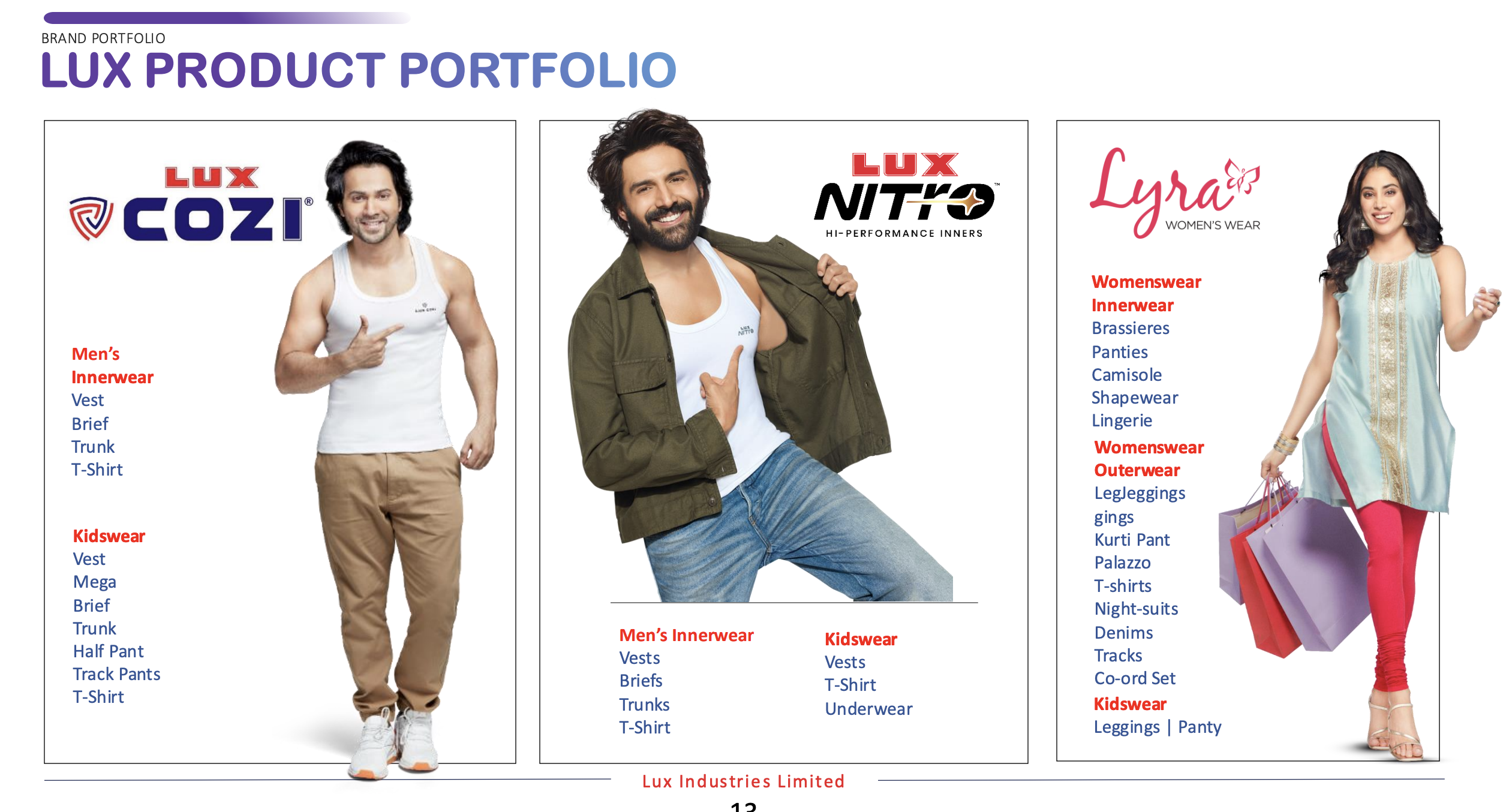
Vertical A (The Stardust Division): Houses premium and mid-premium pillars like Lux Cozi and ONN. This division drives 47% of revenue and absorbs a massive portion of the company’s multi-million-rupee celebrity endorsement outlays.
Vertical B (The Utility Crew): Commands 43% of the top-line, grouping budget-friendly workhorses like Lux Venus and Lyra women’s bottom-wear with niche launches like seasonal rainwear.
Vertical C (The Emerging Outliers): Captures the remaining 10% of sales through structural brands like GenX, Lux Classic, and Lux Champion.
The underlying business logic relies on a massive “push-to-pull” marketing loop. Lux spends an average of 8% of its revenue on high-voltage branding campaigns, hiring an army of Bollywood and sports superstars to convince consumers that hosiery is an lifestyle statement. These products are then fed into a traditional multi-tiered wholesale network spanning over 1,170 dealers and 2 lakh retail counters. While this structure guarantees massive volume scale, it leaves the company structurally vulnerable to volatile raw material shifts, long distribution credit cycles, and high inventory storage costs.
Section 4 — Financials Overview
Figures are consolidated, in ₹ crore.
Quarterly and Annual Performance Trend
Metric
Latest Quarter (Q4 FY26)
YoY Change (Q4)
QoQ Change
Full Year FY26
Full Year FY25
YoY Change (FY)
Revenue
₹881.25
+7.58%
+31.04%
₹2,937.11
₹2,578.50
+13.91%
EBITDA
₹64.11
-15.81%
+77.30%
₹198.35
₹264.77
-25.09%
PAT
₹40.37
-27.85%
+203.08%
₹101.45
₹166.09
-38.92%
Reported EPS
₹13.42
-27.89%
+202.93%
₹33.74
₹55.23
-38.91%
(Note: Annualized and quarterly numbers are compiled directly from the foundational financial accounts. Full-year operational revenue reported via corporate presentations stands at ₹2,928.74 crore).
Did Management Walk the Talk?
Reviewing archival commentary against actual financial realization highlights a major strategy execution gap. In previous conversations, management aggressively committed to defending double-digit operating margins while pursuing top-line growth. Instead, the full-year EBITDA margin collapsed from 10.27% to 6.75%.