01 — At a Glance
The Eyewear Startup That IPO’d Into the Stratosphere
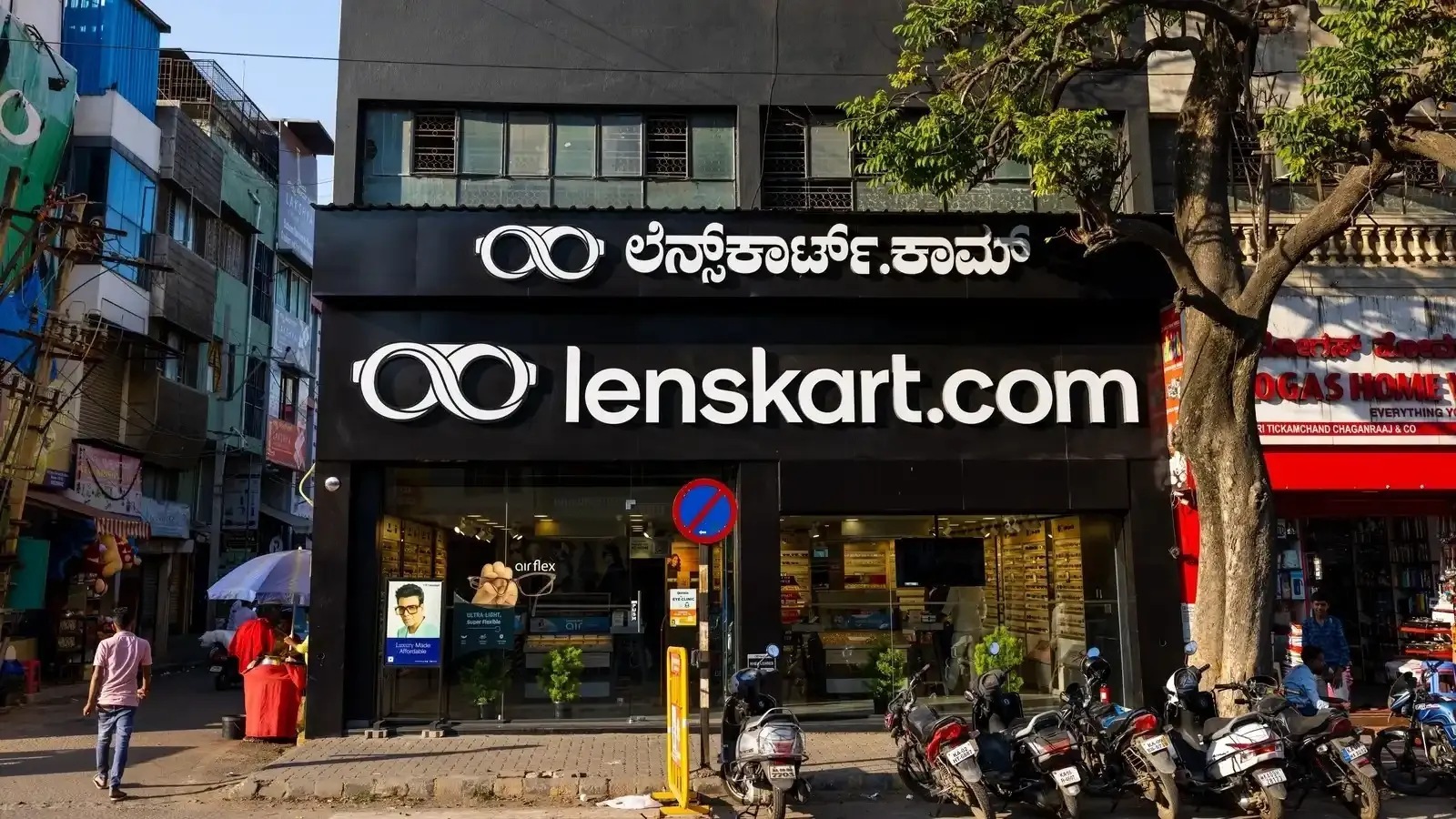
Lenskart is India’s largest organised retailer of prescription eyewear—a market leader with 4–6% of the ₹79,000 crore domestic market. The company went public in November 2025, raised ₹7,278 crore, and immediately became a market darling. Six weeks later, it posted Q3 FY26 numbers that made believers believe even harder. Revenue jumped 37% YoY to ₹2,308 crore. EBITDA (before Ind-AS 116) surged 90% to ₹462 crore. PAT exploded 7,141% YoY to ₹133 crore (off a tiny Q3 FY25 base). The stock is up 24.7% in three months. Market cap? ₹90,311 crore. P/E ratio? 238x. For context, that’s the kind of multiple you see on companies that just invented smartphones, not eyewear retailers. But the story is compelling—eye tests up 54% YoY, 49% of them first-timers, and management claims it’s in a “compounding phase.” Whether that’s genius-level capital allocation or just very expensive eyewear ambition is what we’re here to figure out.
IPO Play Recap: Lenskart raised ₹2,150 crore fresh issue at ₹720/share. IPO priced at Nov 10, 2025. Current trading at ₹520 (vs IPO ₹720). Down 27.8% from listing but still up massively from pre-IPO valuations. Welcome to the world of post-IPO volatility, where your gains are someone else’s buying opportunity and vice versa.
02 — Introduction
From “Fixing Glasses” to “Fixing Your Eyesight Narrative”
Lenskart began in 2008 as a D2C (direct-to-consumer) online eyewear startup. Peyush Bansal and Amit Chaudhary saw a gap: Indians buying expensive spectacles from shady optics shops where the markup was 300–400%. They said, “Let’s blow that up.” And they did—by bundling optometry, manufacturing, and retail under one roof.
Over 16 years, Lenskart became India’s #1 organised eyewear player. They own and operate multiple brands: Lenskart (mass market), Owndays (acquired premium), John Jacobs (style), Vincent Chase (mid-range), Hustlr (budget). They run 2,067 stores in India and 656 internationally. They manufacture frames and lenses in-house at four plants (Gurgaon, Bhiwadi, Singapore, UAE). They have 6.77 million active Gold members and a loyalty retention rate that makes Starbucks jealous (98% repeat rate within 2 years).
But here’s where the story shifts: Lenskart just stopped being a “retail startup” and started being an “AI-powered demand-creation machine.” Management now talks about eye tests (6.3 million globally in Q3) as the real business—not eyewear sales. The pitch is TAM expansion, not market share grabbing. And suddenly, a company selling ₹3,000 spectacles is trading at ₹90,000 crore market cap. Is this visionary capital deployment or a mirage? Let’s see.
Founder Holding Alert: Promoters hold only 17.57% post-IPO. That’s weak founder conviction relative to IPO proceeds. The largest individual shareholder is SVF II Lightbulb (Cayman) Limited at 13.14%, indicating Softbank’s still-dominant voting power. This matters when analysing capital allocation decisions.
03 — Business Model: More Than Just 20/20 Vision
They Don’t Sell Eyewear. They Sell Confidence.
EduInvesting runs entirely on reader support — ₹360 a year keeps the lights on.