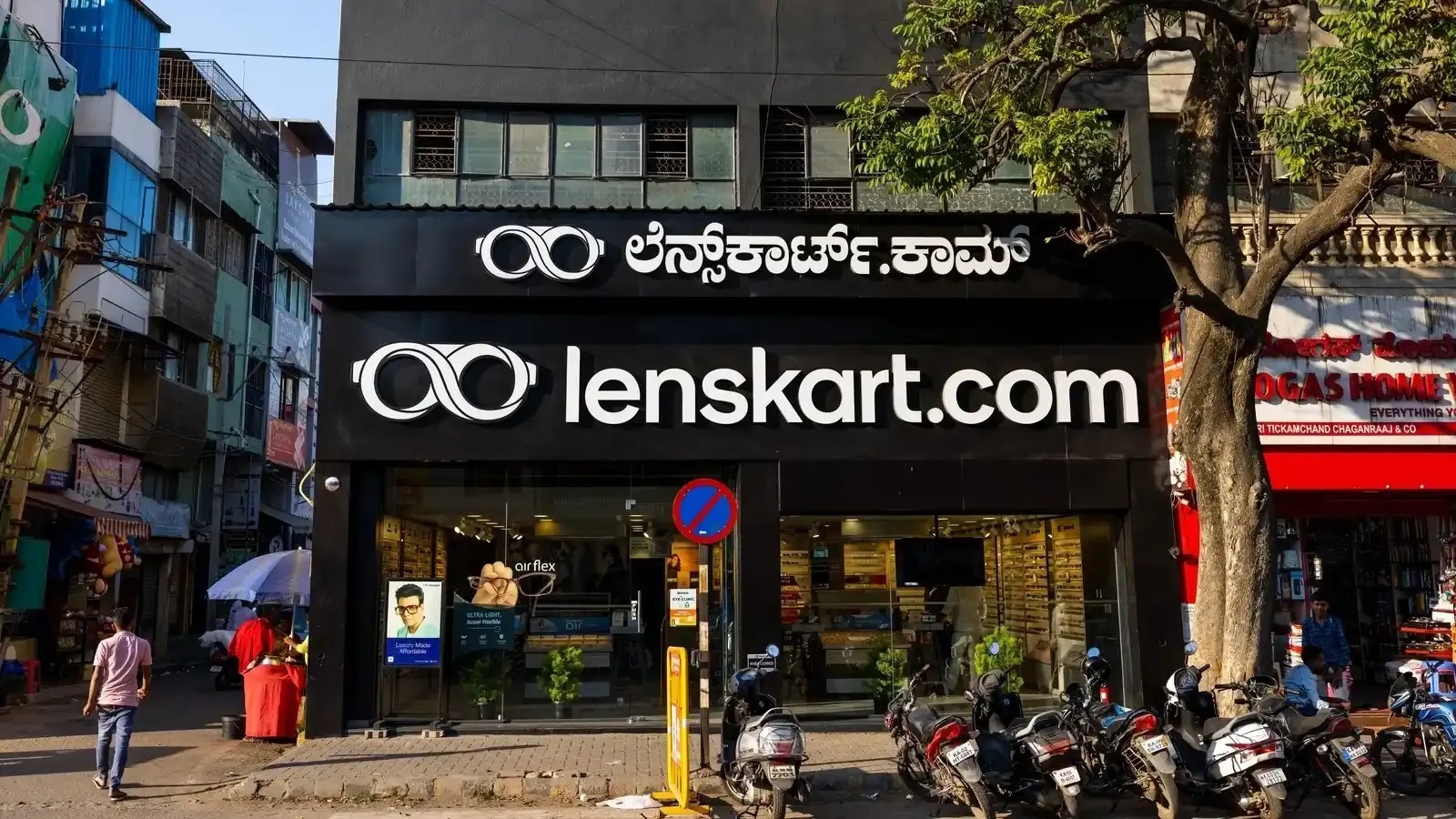
Lenskart Solutions IPO Q2FY26 – ₹69,727 Cr Vision Revolution: India’s Favorite Eyewear Unicorn Hits Dalal Street With a 285x P/E and More Drama Than a Netflix Docuseries
1. At a Glance
Hold your lenses tight, folks — Lenskart Solutions Ltd is not just coming to the markets; it’s coming wearing titanium frames, AI-powered optics, and a valuation so high that even your optometrist would squint.
This ₹7,278 crore IPO is split into two parts: a fresh issue worth ₹2,150 crore (new cash for growth) and a monster OFS worth ₹5,128 crore (old investors cashing out). The price band is ₹382–₹402 per share — the kind of range where you start questioning your own financial eyesight.
The market cap post-listing? ₹69,726 crore, putting it in the same valuation glasses as Titan’s eyewear division — except Titan actually makes jewellery, watches, and profits.
Retail investors will need ₹14,874 for one lot of 37 shares — or roughly the cost of two pairs of premium Lenskart Air frames.
The IPO opens Oct 31, 2025, closes Nov 4, and lists Nov 10 — right after Diwali, so you can either shine bright or burn your fingers like leftover crackers.
2. Introduction – From Startup Darlings to Stock Market Spectacle
It started in 2008, when Peyush Bansal, the soft-spoken Shark Tank hero, decided India needed affordable eyewear. Today, Lenskart is India’s largest omni-channel eyewear company with 2,723 stores, a tech team that could rival SaaS firms, and a marketing budget that could probably buy half of Gurugram.
After raising billions from Temasek, SoftBank, and Abu Dhabi Investment Authority, the company now wants to raise ₹7,278 crore from you — because every Indian should see the world clearly, including its IPO filings.
But let’s be clear — this IPO is less about vision correction and more about valuation correction. With a P/E of 285x, it’s priced like an AI company disguised as a retail chain.
Still, Lenskart has one thing even analysts agree on: execution brilliance. They turned a boring category into an experience-driven business — from 3D try-ons to 24-hour lens delivery.
And for a generation that spends more time staring at screens than road signs, eyewear demand is practically recession-proof.
3. Business Model – WTF Do They Even Do?
Lenskart operates a direct-to-consumer model blending online agility with offline presence. Think of it as the “OYO of optics” but with fewer scandals.
They design, manufacture, and sell:
Prescription glasses – their bread and butter.
Sunglasses – fashion with UV defense.
Contact lenses & accessories – because Gen Z loves convenience.
Franchised Stores: 310 of them, because not every city can afford a fully owned outlet.
Online Channels: Website, app (100M downloads), and quick-delivery services.
Their ecosystem spans manufacturing units in Bhiwadi, Gurugram, Singapore, and UAE, ensuring one-day delivery in 40 cities and three-day delivery in 69 others.
Tech Differentiation: AI-driven frame recommendations, cloud inventory, 3D try-on, and computer-vision-based virtual fitting — the kind of stuff that makes you forget you’re just buying glasses.
It’s not just an eyewear company — it’s an eyewear tech company. Or as Peyush would put it, “We’re fixing vision problems at scale… and maybe profitability next year.”
Even giving Lenskart a “premium for vision clarity” at 100–140x → Fair Value = ₹141 – ₹197 per share.
Method 2: EV/EBITDA Method
FY25 EBITDA = ₹971 Cr
EV ≈ ₹69,727 Cr → EV/EBITDA = 71.8x
Industry median for retail-tech = 30–45x → Fair Value ≈ ₹405 – ₹485/share only if FY27 EBITDA doubles.
Method 3: DCF (Optimistic Growth) Assuming 25% CAGR for next 5 years, WACC 10%, terminal 4%, Fair Value ≈ ₹300–₹360 per share.
🎯 Fair Value Range: ₹300 – ₹400 per share
Disclaimer: This fair value range is for educational purposes only and is not investment advice.
6. What’s Cooking – News, Triggers, Drama
Fresh Issue (₹2,150 Cr): For CoCo store expansion (₹272 Cr), leases (₹591 Cr), tech upgrades (₹213 Cr), and marketing (₹320 Cr). Basically, the company plans to open more stores and buy more ads featuring Peyush smiling at you.
OFS (₹5,128 Cr): Existing investors including SoftBank and TPG are partially exiting. Because unicorn investors need liquidity more than vision sometimes.
Profit Turnaround: From ₹(-10 Cr) in FY24 to ₹297 Cr in FY25 — that’s not turnaround, that’s Shark Tank redemption arc.
Telangana Manufacturing Plant: A new “smart facility” in the works to handle 20 million lenses annually — a key capex growth driver.
Question: Will they produce profits faster than spectacles?