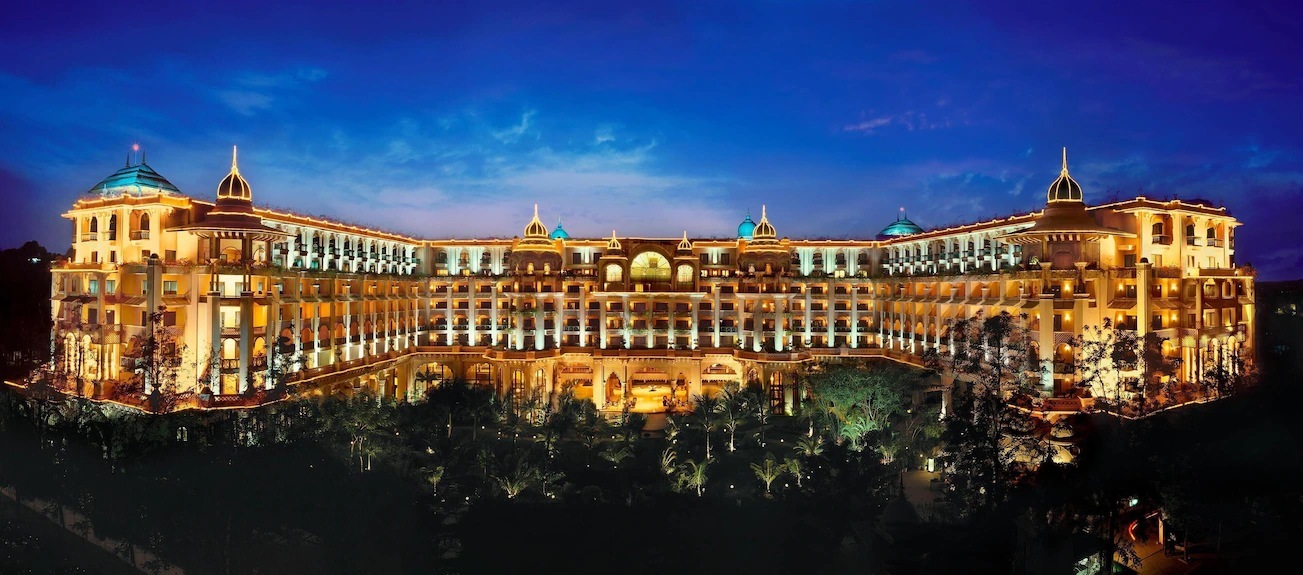
(Pure-play luxury hospitality is rare in Indian markets. Even rarer is one where the room rates feel royal and the balance sheet has recently stopped behaving like a stressed real estate developer.)
1. At a Glance
There are hotel companies, and then there are companies monetizing aspiration.
Leela Palaces Hotels & Resorts is trying to become less “hotel owner” and more “luxury platform.” That distinction matters.
Q4 FY26 was not just another quarter. It was the quarter where multiple threads came together:
- FY26 operating revenue rose 15% to ₹15,273 million (₹1,527 crore)
- Operating EBITDA rose 19% to ₹7,429 million with 49% margin
- PAT surged 8.5x to ₹4,030 million
- Net debt/EBITDA dropped from 3.7x to 1.6x after IPO-led deleveraging
- 4 hotels added in a year, the fastest expansion pace in company history.
This is not typical Indian hospitality behavior.
Usually hotel stories swing between:
- “Occupancy is improving.”
- “Debt is a concern.”
- “Capex cycle may create value in 2037.”
Leela is trying to write a different script.
And the unusual thing? Management seems to be walking the talk.
In Jan 2026 concall, management guided:
- high-teens EBITDA growth
- PAT above ₹4 billion
- double-digit RevPAR growth
- continued margin expansion
They delivered.
That matters.
Because in markets, forecasts are cheap. Delivery is expensive.
Even more interesting is what is driving growth.
This is not occupancy-led growth alone.
This is pricing power.
ADR hit ₹25,375 in FY26, up 13%. RevPAR rose 14%. RevPAR premium sits at 2.3x industry growth.
That is luxury moat behavior.
Question for readers:
Is this becoming India’s closest listed analogue to global luxury asset-light brands, or still largely a premium real estate wrapper with hotel earnings?
That question matters enormously for valuation.
2. Introduction
Most hospitality companies sell rooms.
Leela increasingly sells scarcity.
That sounds philosophical until you see numbers.
71% occupancy with ₹30,337 ADR in Q3.
Q4 ADR ₹32,059.
These are not “rooms,” these are pricing signals.
Supply in luxury hospitality is constrained.
Demand—especially upper-end discretionary demand—is growing.
Management repeatedly hammered this on concall:
“Luxury consumption is relatively inelastic.”
Dangerous statement if false.
Powerful statement if true.
Current thesis seems built on 4 engines:
Engine 1 — Premium owned assets
Delhi, Bengaluru, Chennai, Udaipur.
These are crown jewels.
Engine 2 — Asset-light HMA growth
Dubai. Jaisalmer. Sikkim. Waterstone.
Fee income without matching capex.
That changes economics.
Engine 3 — Asset monetization
Retail. Wellness. Clubs. F&B.
Hotel room becomes ecosystem.
Engine 4 — Selective trophy acquisitions
Coorg.
Brookfield seems willing to buy