01 — At a Glance
The Chemical Company That Forgot to Make Money
- 52-Week High / Low₹241 / ₹110
- CMP₹120
- Q3 FY26 Revenue₹719 Cr
- Q3 FY26 PAT₹25.4 Cr
- Annualised EPS (Q3×4)₹3.68
- Book Value₹69.6
- Price to Book1.72x
- Dividend Yield0.42%
- Debt / Equity0.17x
- Full-Year FY25 PAT₹114 Cr
The Audit Trail Speaks: Laxmi Organic just dropped a -34% stock return bomb in 52 weeks. Q3 revenue tumbled 9% YoY while margins got skinned alive. Two gigantic factories (Dahej & Lote) are in their infant stages, bleeding standalone cash, and management keeps saying “Don’t worry, FY28 is when we party.” That’s two fiscal years away. Your portfolio, however, is partying much sooner — but on the roof, in a thunderstorm.
02 — Introduction
The Chemistry of Catastrophe: A Masterclass in Patience No One Asked For
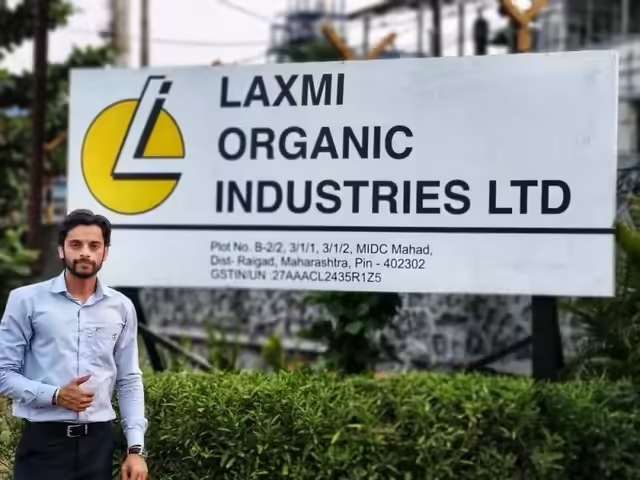
Laxmi Organic Industries is a specialty chemicals company founded in 1989 by the Goenka family — think solvents, acetic acid derivatives, and complex fluorochemicals. If you’ve ever bought anything in a plastic bottle, used a pharmaceutical, or painted a wall in your home, you’ve probably touched a Laxmi product. Silently. Without acknowledgement. Like a good Indian housekeeping staff.
They make three things: Essentials (Ethyl Acetate, Acetic Anhydride — 65–70% of revenue), Specialties (Diketene Derivatives, Fluorochemicals — 30–35% of revenue), and they serve 750+ customers across 55+ countries. They’re ranked globally top 3 in Essentials (outside China) and top 5 in Specialties. It’s genuinely impressive portfolio construction.
Then comes the fun part. In 2024–25, they bet the farm on a ₹1,100 crore capex program to double Specialties revenue by FY28. Two massive factories went live: Dahej (Phase I done, Phase II by Q4) and Lote (Fluorochemicals). These facilities are eating cash, missing volumes, and dragging margins. Meanwhile, global feedstock prices (acetic acid, ethanol) crashed like an INR against the dollar post-budget announcements. And their biggest customer segment, pharma, decided to optimize costs instead of ordering more chemicals.
The stock was at ₹241 just 12 months ago. Today it sits at ₹120. Down 50%. ROCE fell from 9% to 8.56%. Margins were cleaved from double digits to single-digit purgatory. Rating agencies downgraded them in November and March. And management’s answer to all this? “Q1 next year is hard. Q2 is uncertain. Q3 onwards, maybe things stabilize. FY27 is qualification. FY28 is when the money prints.”
That’s corporate Hindi for: “Arre yaar, patience karo. Abhi toh construction chal raha hai.”
From the Concall (Jan 2026): “Revenue from top 10 customers reduced from 41% in FY22 to 25% in 9M FY25 to further 20% in 9M FY26.” Translation: Diversification is real, but so is the fact that nobody’s ordering much anymore.
03 — Business Model: WTF Do They Even Do?
Specialty Chemicals For People Who Don’t Know What Specialty Chemicals Are
Imagine you’re making a pharmaceutical tablet. You need a solvent to dissolve your active ingredient. Enter Ethyl Acetate. Or you’re coating a paper with pigment for printing. You need acetic anhydride. Or you’re formulating a pesticide. You need diketene derivatives. Laxmi supplies all three. To 750+ customers. In 55+ countries. At global prices. With zero pricing power because it’s a commodity business pretending to be specialty.
Revenue split: 68% from India, 32% from exports (36% to Europe, 23% to America, 16% to Middle East). Customer split: 34% pharma, 31% printing/packaging, 17% pigments, 7% agro. No single customer is >10% of revenue. Capacity: 232,000 MTPA of Ethyl Acetate. That’s enough to supply ~35% of India’s total demand. They’re the Ethyl Acetate guy in India. If Ethyl Acetate was a celebrity, Laxmi would be its paparazzi.
The Essentials business is scale-dependent and margin-compression-prone because acetic acid (their main input) is priced globally and imported. When acetic acid was at $450/tonne in 2024, Laxmi’s margins were juicy. When it crashed to $320/tonne by mid-2025, margins got liquidised. The Specialties business is higher-margin but exposed to cyclical pharma/agro spending. And the new Fluorochemicals division? Still in “sampling and customer qualification” mode — which is boardroom-speak for “we’re not making money yet.”
India Market Share35%Ethyl Acetate
Domestic Demand Met55%Diketene Derivatives
Specialties EBITDA %13%Down from 24% YoY
Active Customers750+Diversified, Good Sign
Concall Highlight (Jan 2026): When asked about recovering to 20–25% Specialties margins, the CEO said: “We’ve delivered that in the past.” He didn’t say: “We’ll deliver it again soon.” That pause is deafening.
💬 Drop a comment: If you were betting on chemicals, would you wait 2 years for factories to ramp, or deploy elsewhere? Be honest.
04 — Financials Overview
Q3 FY26: The Reckoning
Result type: Quarterly Results | Q3 FY26 EPS: ₹0.92 | Annualised EPS (Q3×4): ₹3.68 | Full-year FY25 EPS: ₹4.10
| Metric (₹ Cr) |
Q3 FY26
Dec 2025 |
Q3 FY25
Dec 2024 |
Q2 FY26
Sep 2025 |
YoY % |
QoQ % |
| Revenue | 719 | 786 | 700 | -8.6% | +2.7% |
| Operating Profit | 50 | 75 | 37 | -33.3% | +35.1% |
| OPM % | 7% | 10% | 5% | -300 bps | +200 bps |
| PAT | 25.4 | 29.3 | 10.8 | -13.3% | +135.2% |
| EPS (₹) | 0.92 | 1.06 | 0.40 | -13.2% | +130.0% |
The Fine Print That Kills: Q3 PAT of ₹25.4 Cr looks okay until you realize it includes a ₹36.7 Cr one-time gain from an MERC ruling (Maharashtra power transmission wheeling charges). Strip that out, adjusted PAT is negative. Margins compressed because Specialties revenue fell 30% YoY (mix shift + price erosion + agrochemical intermediate phase-out). Essentials volumes were flat but realization fell due to acetic acid price crashes. Two new factories (Dahej & Lote) are now a drag on standalone cash flow — Dahej Phase 2 won’t be complete until end-Q4, Lote is only now “meeting first-year objectives.” The concall made it clear: FY27 is sampling/qualification. FY28 is when margins recover. That’s 18 months of pain.
05 — Valuation Discussion
Fair Value Range: Where the Money Goes To Die