General information and education, not investment advice. The author is not a SEBI-registered adviser or research analyst. No recommendation, no promised returns. Markets carry risk including loss of capital. Figures may not be current. Always consult a SEBI-registered adviser.
1. At a Glance
The company was incorporated in 1988 and spent thirty-eight years making cable in West Bengal. Then came the busiest twelve months of its corporate life. An 8-for-1 bonus issue came first, meaning eight new shares for every one held. The face value was cut from ₹100 to ₹5, and the constitution changed from private limited to public limited. A ₹742 crore initial public offering followed, with listing on 16 July 2026. The three months to June 2026 are the first quarter it has had to explain to strangers.
Revenue from operations was ₹522 crore, against ₹454 crore in the June 2025 quarter. That is a rise of 14.8%. Operating profit was ₹66 crore against ₹52 crore. Net profit was ₹21 crore against ₹49 crore. Management stated that the prior-year consolidated figure carried a one-time extraordinary profit of about ₹32 crore. The consolidated filing shows that exceptional item at ₹32.79 crore, sitting in the June 2025 column.
Finance costs for the quarter were ₹36 crore. Management noted these took roughly 55% of quarterly EBITDA, which is operating profit before interest, tax and depreciation. Management also noted that the quarter closed on 30 June while the offering completed in July. The money raised to repay debt arrived after the scoreboard had been photographed.
The order book stood at ₹2,788 crore as of June 2026. It splits into ₹1,433 crore of manufacturing and ₹1,356 crore of project work. Revenue for the year to March 2026 was ₹2,326 crore, against ₹2,570 crore the year before. Operating profit across those same two years rose from ₹250 crore to ₹301 crore.
2. Introduction
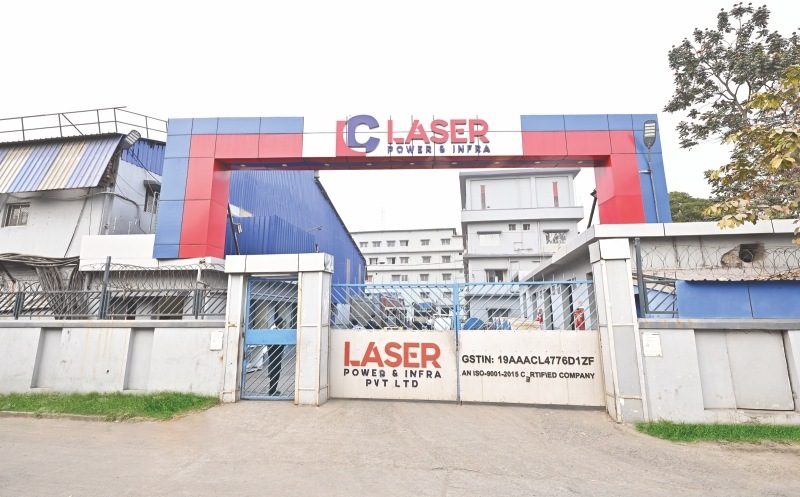
The company was incorporated in 1988 and is headquartered in Kolkata. Its registered offices are on Pollock Street, with a corporate office nineteen floors up in Salt Lake. The business is power cables, conductors and specialty products for the transmission and distribution industry. That is the physical wire carrying electricity from where it is made to where someone boils a kettle.
The milestone list reads like a company that adds one thing per era and throws nothing out. Manufacturing Unit I opened at Dhulagarh in 2006, and Unit II followed in 2009. An aluminium rod rolling mill sits inside Unit II, alongside a CCV line making cable rated up to 66 kilovolts. In 2010 came a first international order for AAAC conductors, for the Ethiopian Electric Power Corporation. In 2015 the company entered EPC work, meaning engineering, procurement and construction: building the network rather than only supplying parts for it. A first international EPC project followed in 2018, distributing electricity across six cities in the Republic of Togo. In 2021 an undertaking of Bhuvee Stenovate Pvt Ltd merged in under NCLT orders, becoming Unit III at Kharagpur. In 2025 the company signed a licensed stranding partnership with the US-based TS Conductor Corp.
Then two financial years arrived at once. In September 2025 the constitution changed from private limited to public limited. A draft red herring prospectus, which is the offer document filed ahead of an IPO, went to SEBI. Final approval came on 2 February 2026. Acuité, a credit-rating agency, noted in May 2026 that the issue had not yet launched owing to prevailing market conditions. That is the corporate-filing way of saying the room was cold.
The offer comprised 3,46,72,895 equity shares. A fresh issue of 2,53,27,102 shares raised ₹542 crore. An offer for sale of 93,45,793 shares raised ₹200 crore. Listing followed on 16 July 2026. Between board resolution and listing, the share count changed shape entirely. Before, there were 6,39,118 shares of ₹100 face value. After, there were 14,03,68,342 shares of ₹5 each. Per-share figures either side of that line describe two differently sliced companies.
US
Now live
US Stocks terminal is live
13,000+ US tickers · EDGAR fundamentals · screener and filings feed — the same terminal, for American markets.
Explore →
3. Business Model: WTF Do They Even Do?
They make the wire, then they install the wire, and the wire they install is frequently their own.
The manufacturing half runs three integrated units in West Bengal, two at Dhulagarh and one at Kharagpur, across 40.39 acres. Combined installed capacity was 85,448 tonnes as of March 2026. Units I and II hold 50,380 tonnes, while Unit III holds 35,068 tonnes. Capacity rose about 37.8% between the years to March 2024 and March 2026. Production in the year to March 2026 was 52,629 tonnes, against 55,724 tonnes the year before. Utilisation was reported at 61.6%.
The product list is where a cable company reveals its personality, and this one is a maximalist. There are low voltage, medium voltage and high tension power cables. There are aerial bunched cables, with bare or insulated messenger wire, in low and high tension versions. There are control cables, quad cables, railway signalling cables and concentric communication cables. The conductor range covers ACSR, AAC, AAAC and AL-59. It also covers ACSS, Eco Conductors and medium voltage covered conductors. Gap-type GTACSR and GZTACSR sit alongside AECC conductors made through the TS Conductor partnership. Somewhere in the middle of that alphabet is a marketing department that let engineering name things.
Backward integration means aluminium wire rods, aluminium alloy rods, PVC compounds and XLPE compounds are made in-house. The company mixes its own plastic before it wraps its own metal. Scrap PVC and XLPE are recycled and reprocessed. In-house testing laboratories, accredited by NABL, check the result.
The EPC half began in 2015 and has completed more than 43 projects, with 34 ongoing. It has installed over 85,191 circuit kilometres of distribution lines and commissioned more than 113 substations. The work runs under government schemes named RDSS, DDUGJY, IPDS and Saubhagya. Management stated that EPC is effectively 100% government and utility-led, and that the company does not subcontract. Management also stated that manufacturing runs roughly half