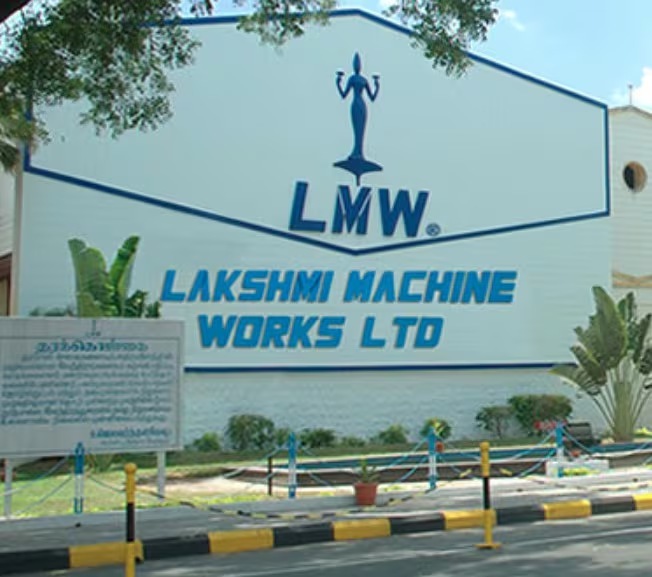
Lakshmi Machine Works Ltd Q2 FY26 (Sep 2025) – ₹822 Cr Quarterly Revenue, EPS ₹38.3, Order Book ₹3,300 Cr: Legacy Giant or Capital Goods Midlife Crisis?
1. At a Glance – When Heritage Meets Headwinds
Lakshmi Machine Works Ltd, or LMW for those who don’t have time to pronounce full South Indian surnames, is currently a ₹15,130 Cr market-cap capital goods company trading around ₹14,163. In the last three months, the stock politely disappointed investors with a return of -8.78%, and over six months it extended the pain to -12.9%—basically the stock equivalent of “still buffering.” The headline numbers from the latest quarterly results (Sep 2025) show revenue of ₹822 Cr and PAT of ₹40.9 Cr, translating into a quarterly EPS of ₹38.30. Annualised (because yes, these are Quarterly Results), that EPS lands at roughly ₹153, while the market is valuing the business at a reported trailing P/E north of 120x. ROCE is sitting at 4.48% and ROE at 3.04%, which is not exactly screaming “capital efficiency,” more like whispering “legacy balance sheet.” And yet—despite the muted ratios—the company is debt free, sits on a chunky order book of ₹3,300 Cr, and still commands enormous respect in textile machinery circles. So is this a cyclical lull, or is LMW becoming that legendary uncle who peaked in the 90s but still gets invited to every family function? Let’s dig.
2. Introduction – The Weight of Being LMW
LMW is not just a company; it’s an institution. Founded in Coimbatore—India’s unofficial capital of spinning frames—it has powered textile mills for decades. If Indian textiles had a soundtrack, LMW machines would be the background score humming 24×7. But markets don’t pay nostalgia dividends. They pay for growth, margins, and capital efficiency. And right now, LMW is stuck in an awkward phase where revenue exists, order book exists, reputation exists—but profitability metrics look like they took an extended sabbatical.
The company is diversified across Textile Machinery, Machine Tools, Foundry, and an aspirational Advanced Technology Centre (ATC) for aerospace. On paper, this diversification should smooth cycles. In reality, it has also diluted margin focus. The textile cycle has been soft globally, capex decisions by mills are cautious, and machine tools are fighting a crowded competitive landscape. Add to that a large base of other income, and suddenly operating leverage doesn’t look as impressive as one would expect from a company of this pedigree.
So the real question is not “Is LMW a good company?”—that debate ended decades ago. The real question is: At this valuation and return profile, is LMW behaving like a premium capital goods compounder or a very expensive bond with mood swings?
3. Business Model – WTF Do They Even Do?
Imagine explaining LMW to a lazy but smart investor over filter coffee. You’d say: “They make the machines that make the yarn that makes your T-shirt. Also, when they get bored, they make CNC machines and aerospace components.”
Textile Machinery Division (TMD)
This is the heart and soul of LMW, contributing 73.6% of FY24 revenue. The division sells spinning machinery with automation and digital features, exported globally. In FY24, 4,455 machines were sold. Capacity utilisation in H1 FY25 was 45–50%, which tells you demand is present but not roaring. This division is cyclical and heavily dependent on global textile capex sentiment.
Machine Tool Division (MTD)
Contributing 17.8% of revenue, this division manufactures CNC turning centres and machining centres. FY24 unit sales were 3,684 machines, with ~70% capacity utilisation in H1 FY25. This business is more diversified across industries but also brutally competitive.
Foundry Division (FDY)
At 2.3% of revenue, this division supports internal requirements and select external clients. FY24 production volume stood at 5,022 tonnes, with 70% utilisation in H1 FY25. It’s not glamorous, but it keeps internal supply chains stable.
Advanced Technology Centre (ATC)
The most exciting slide in the investor presentation—and only 3.4% of revenue. ATC supplies high-precision components to aerospace and defence clients, including ISRO. The margins could be attractive, but scale is still small. This is the “optional future” investors love to talk about.
Now ask yourself: can ATC and MTD eventually compensate for textile cyclicality? Or will textiles always remain the emotional and financial anchor?
4. Financials Overview – The Quarterly Reality Check
Result Type Locked: Quarterly Results (Sep 2025) Annualised EPS = ₹38.30 × 4
Metric
Latest Qtr (Sep 25)
Same Qtr LY (Sep 24)
Prev Qtr (Jun 25)
YoY %
QoQ %
Revenue (₹ Cr)
822
769
694
6.9%
18.4%
EBITDA (₹ Cr)
44
32
14
37.5%
214%
PAT (₹ Cr)
41
24
11
67.3%
272%
EPS (₹)
38.30
22.90
10.74
67.3%
256%
Yes, growth looks dramatic—but only because the base was depressed. The EBITDA margin is still hovering around 5%, which is low for a precision engineering company. The jump is more “recovery bounce” than “structural rerating.” Question for you: Is this the start of a margin upcycle, or just a one-quarter caffeine shot?
5. Valuation Discussion – Numbers Without Romance
P/E Method
Annualised EPS ≈ ₹153. At industry-average multiples of 30–40x, fair value lands in the ₹4,600–6,100 range. At premium capital goods multiples of 50–60x, you reach ₹7,600–9,200.
EV/EBITDA
EV ≈ ₹13,721 Cr. Annualised EBITDA (using Sep 25 run-rate) ≈ ₹176 Cr. That’s an EV/EBITDA of ~78x, which is… ambitious.
DCF (High-Level)
Assuming mid-single-digit revenue growth and gradual