Krsnaa Diagnostics Mar 2026: The 163-Day Waiting Game
Date of Publishing -
Spotted a factual error — a wrong number, date, or fact? Tell us and we will check the source.
Section 1 — At a Glance
The FY26 numbers for Krsnaa Diagnostics paint a picture of undeniable operational scale colliding with the hard realities of public-private partnerships. The company reported a topline of ₹690.95 Cr for the full year, a modest uptick from the previous year, while expanding its bottom line to ₹102.68 Cr. Krsnaa has firmly established itself as a volume powerhouse, processing nearly 60 million tests and serving over 20 million patients across 18 states. The underlying asset base is vast: 190 CT/MRI centres and a sprawling network of over 4,700 collection centres.
However, the rapid geographical expansion and heavy upfront capital requirements are leaving deep footprints on the balance sheet. Borrowings have more than doubled year-over-year, jumping from ₹201.62 Cr to ₹531.14 Cr, largely to fund aggressive rollouts like the highly anticipated Rajasthan pathology project. More pressing is the working capital cycle. Receivables have ballooned to ₹308.27 Cr, pushing debtor days to a staggering 163. Earnings on an income statement are just polite suggestions until they arrive in the bank. While management points to a history of zero bad debts with government partners, the sheer delay in cash realization is forcing the company to lean heavily on external debt, including a recent ₹430 Cr issuance of non-convertible debentures.
With significant operational capacity coming online in FY27, Krsnaa is standing on the edge of a massive operating leverage play—if the government payment cycles don’t break the cash flow first.
Section 2 — Introduction
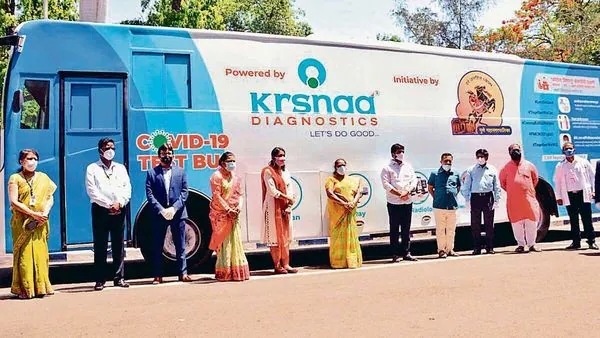
Krsnaa Diagnostics occupies a highly specific, moat-heavy corner of the Indian healthcare ecosystem. While premium diagnostic chains battle for walk-in patients in affluent metro neighborhoods, Krsnaa has built a pan-India empire by setting up shop inside government hospitals. Through the Public-Private Partnership (PPP) model, Krsnaa provides technology-enabled diagnostic services—ranging from routine blood tests to complex MRI scans—across tier-2, tier-3, and rural markets.
The strategy is straightforward: win a state tender, move expensive machinery into government-provided real estate, and handle the captive patient flow at deeply discounted rates. It is an infrastructure-heavy, operationally complex model that deters casual competitors. Recently, the company has also started pivoting toward retail diagnostics to diversify its revenue streams and cash flows, attempting to prove that its backend lab network can serve private consumers just as effectively as public ones.
Section 3 — Business Model: WTF Do They Even Do?
If you strip away the corporate gloss, Krsnaa Diagnostics is essentially a massive equipment financing and logistics operation disguised as a healthcare provider. The government has patients but no money to buy or maintain ₹8-crore MRI machines. Krsnaa buys the machines, puts them in the government hospitals, and runs them 24/7.
Their revenue mix is split down the middle: 50% from radiology (CT/MRI/X-rays) and 50% from pathology (blood and urine). The pricing is where the model gets wild. Krsnaa’s tests are typically priced 60% to 80% lower than prevailing market rates. A CBC test that costs ₹250 elsewhere is billed at ₹37. An MRI brain scan priced at ₹8,000 in a private clinic costs ₹1,340 here. It is a pure, unadulterated volume game. Krsnaa’s prices are a fantastic deal for the patient, and an absolute test of endurance for the company’s working capital. Because while the volume is guaranteed, the government’s speed in clearing invoices is, to put it mildly, leisurely.
Section 4 — Financials Overview
Figures are consolidated, in ₹ crore.
Metric
Latest Quarter
YoY
QoQ
Revenue
173.02
8.6%
8.5%
EBITDA / Operating Profit
88.24
52.7%
71.4%
PAT
43.38
105.8%
163.0%
EPS
31.69
–
–
(Note: EPS is the full FY26 figure. Q4 PAT includes a ₹22.17 Cr fair valuation gain from their Apulki Healthcare investment, reflected in higher other income and EBITDA).
What is Management Promising in the Coming Quarters?
The recent concall was a masterclass in defending a structurally slow cash cycle. Management reiterated that their massive ₹430 Cr debt raise is just a bridge for expansion, while proudly stating they have seen “14 years, virtually 0 bad debt.” The delays in states like Himachal Pradesh and Karnataka were characterized as strictly “administrative… not a credit risk issue.”
Management called the target of bringing debtor days down to sub-120 a realistic goal, subtly backing away from earlier aspirations of 100 days. Acknowledging reality is the first step to fixing it, even if the reality requires a ₹430 Cr bond to tide you over. They also promised that the massive Rajasthan rollout will start contributing to revenue in Q1 FY27, though they conservatively guided for ₹100–150 crore for the year, significantly walking back the street’s hyper-optimistic expectations of ₹300 crore.
Section 5 — Valuation Discussion: Fair Value Range Only