General information and education, not investment advice. The author is not a SEBI-registered adviser or research analyst. No recommendation, no promised returns. Markets carry risk including loss of capital. Figures may not be current. Always consult a SEBI-registered adviser.
1. At a Glance
Kriti Nutrients crushes soybeans at Dewas in Madhya Pradesh and sells refined cooking oil under its own brand.
Revenue for the three months to June 2026 came in at ₹247.08 crore. Operating profit was ₹11.81 crore and net profit ₹9.06 crore. Revenue rose 7.88% against the same three months a year earlier. That earlier quarter brought in ₹229.04 crore of revenue and ₹9.21 crore of profit. Net profit is therefore 1.63% lower, a movement small enough to round away.
The sequential comparison is the livelier one. The three months to March 2026 produced the highest revenue in the visible series, ₹255.23 crore. Its operating margin was one of the thinner ones, at 3.65%. The June quarter sold about ₹8 crore less and earned ₹2.49 crore more at the operating line. Its operating margin was 4.78%. The quarter with the larger sales carried the smaller margin.
The full year to March 2026 was the bigger number story. Sales reached ₹921.51 crore against ₹734.34 crore the year before, a rise of 25.5%. Operating profit across those two years moved from ₹48 crore to ₹43 crore. Sales grew by ₹187 crore and operating profit fell by ₹5 crore.
Cash and bank balances stood at ₹59.19 crore at March 2026, against borrowings of ₹9.10 crore. The dividend payout ratio, meaning the share of yearly profit handed to shareholders, was 49% for the year to March 2026. The figure for the year before was 4%. The 30th annual general meeting passed all eight resolutions on 14 August 2026.
2. Introduction
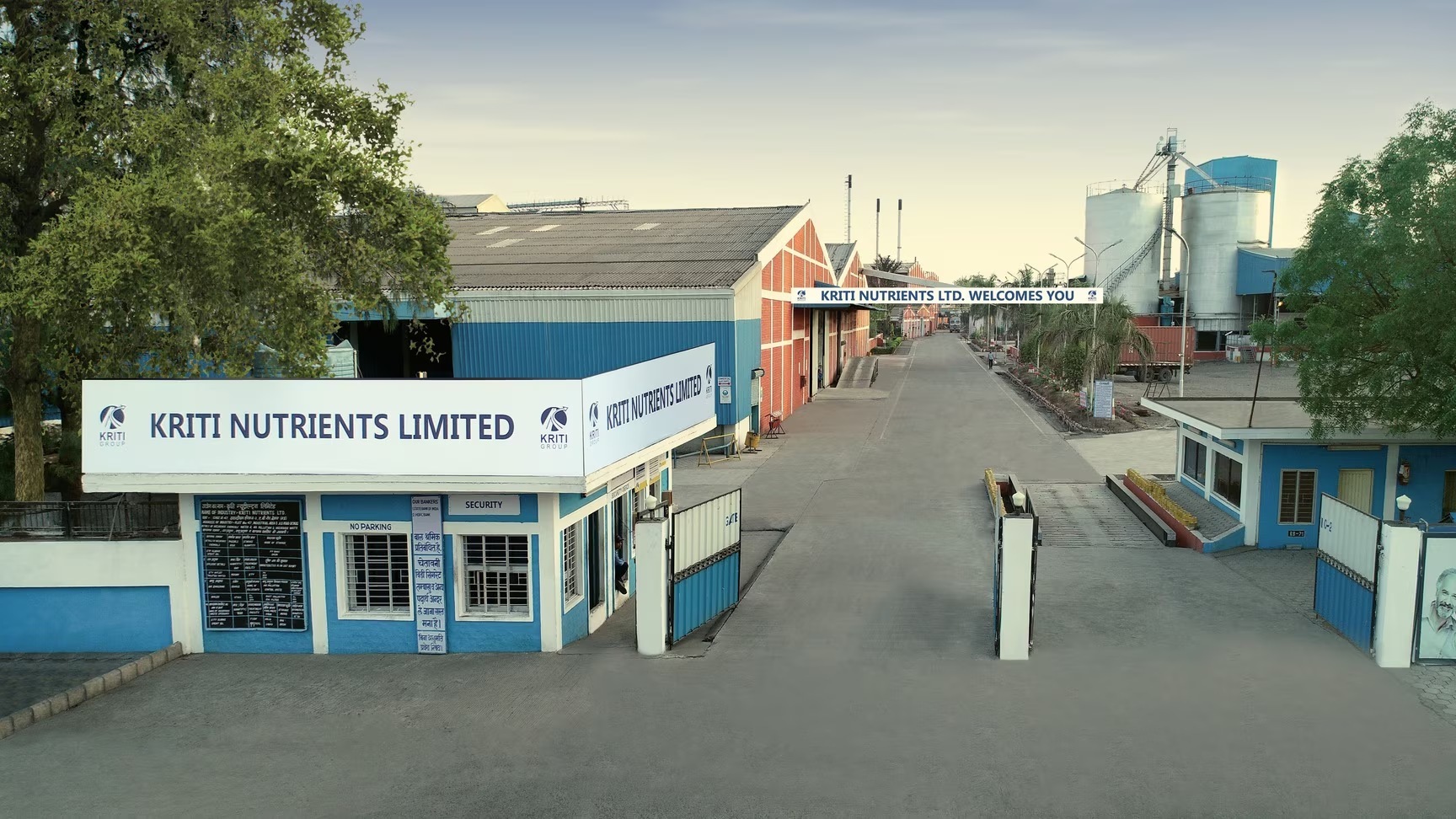
Kriti Nutrients was incorporated in 1992 and works in soya seed extraction and cooking oil. It sits inside the Kriti Group, which is headquartered in Indore. The factory is at Dewas, in the same state. The brand on the oil is also the name of the group and of the company, which presumably settles most questions at the front desk.
Per a September 2025 press release from CARE Ratings, a credit-rating agency, the company was demerged from Kriti Industries (India) Limited in January 2010. Before that split, one entity held both the edible oil business and plastic fittings. The plastics stayed with Kriti Industries. The soya came here.
The two companies remain connected. In June 2024 the company acquired 30,92,480 convertible warrants in Kriti Industries, instruments that can later be turned into shares. CARE records loans and advances of ₹24.35 crore to that company as on 30 June 2025. It also records investments in its equity and convertible warrants of ₹51.52 crore on the same date. CARE puts that exposure at about 35% of net worth then, against about 27% at 31 March 2025.
The consolidated results for the June 2026 quarter treat Kriti Industries as an associate. Under the equity method, a share of the associate’s profit or loss is booked here. That share was a loss of ₹0.14 crore for the quarter. Consolidated profit came to ₹8.92 crore, against a standalone ₹9.06 crore.
Recent corporate activity has been procedural rather than dramatic. An extraordinary general meeting in March 2026 approved a new Clause 35A in the memorandum, the document setting out what a company may do. The clause adds power generation, and thermal, nuclear and solar activities, to the objects. A soya refiner’s founding document now formally contemplates nuclear power.
In November 2025 the board approved an interim dividend of ₹3 per share on 5,01,03,520 shares. The record date was 13 November 2025. In August 2026 the 30th annual general meeting reappointed M. Mehta & Co. as auditors for five years, and reappointed two directors from 2026-27. The statutory auditors gave an unmodified opinion on the results for the year to March 2026. Their limited review of the June 2026 quarter, a lighter check than a full audit, reported nothing that caused them to doubt the statement.
US
Now live
US Stocks terminal is live
13,000+ US tickers · EDGAR fundamentals · screener and filings feed — the same terminal, for American markets.
Explore →
3. Business Model: WTF Do They Even Do?
They take a soybean apart and sell every piece of it.
The Dewas plant is an integrated soybean processing site. Its solvent extraction unit crushes up to 700 tonnes a day, and the refinery handles 225 tonnes. Solvent extraction is the process that pulls the last oil out of crushed bean flakes. The site also makes lecithin and runs effluent treatment, water purification and packaging. Capacity utilisation for the year to March 2026 was 72%.
Out of the bean come refined oil, soya meal, lecithin and acid oil. Defatted flakes, hulls and chunks follow, the chunks being soya badi to most of India. They are made from non-GMO soy flour and carry 52% protein. Lecithin is an emulsifier drawn from the bean, used to hold fat and