01 — At a Glance
The Compressor Company That Keeps Promising Next Quarter
- 52-Week High / Low₹1,550 / ₹955
- Q3 FY26 Revenue (Qtr)₹404 Cr
- Q3 FY26 PAT (Qtr)₹43.2 Cr
- Q3 FY26 EPS (₹)₹6.64
- Annualised EPS (Q3×4)₹26.56
- Book Value₹176
- Price to Book6.14x
- Dividend Yield0.93%
- Debt / Equity0.00x
- Order Book (Jan 2026)₹1,939 Cr
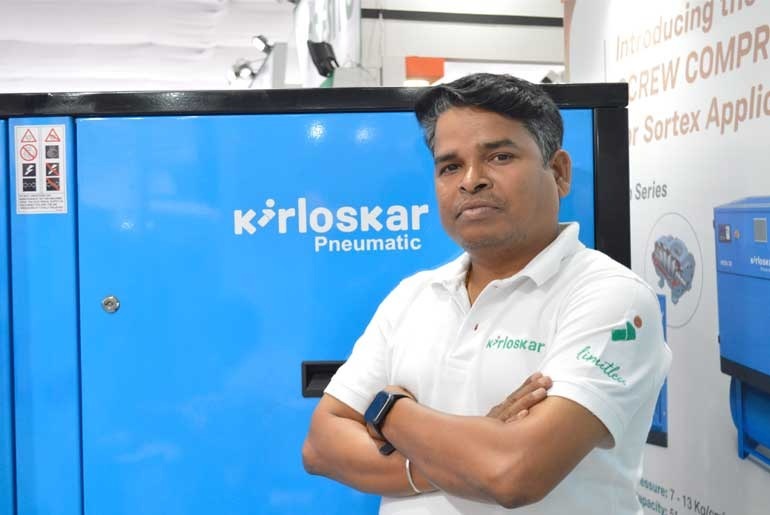
The Setup: Kirloskar Pneumatic (KPCL) is the world’s largest manufacturer of industrial gas compressors and commands 60%+ market share in both CNG systems and oil-and-gas refrigeration in India. FY25 revenue: ₹1,629 Cr (+23%). Q3 FY26 showed +18.7% sales growth YoY and +53.3% profit growth YoY—except the company shipped less than it made because two major customers said “thanks, but not today” on dispatch clearances. Result: inventory bloat, revenue deferred by ~₹180 crores. They now guide for ₹1,800–1,850 Cr full-year FY26 revenue (12–14% growth). Management says it’s a timing issue. Investors say it’s anxiety-inducing theatre.
02 — Introduction
The Only Industrial Compressor Maker Who Makes You Wait For Delivery News
Kirloskar Pneumatic has been in the compressor game since 1958. They’re not household names like Bajaj or TCS — because they don’t make motorcycles or write software code. They make the machines that compress air, refrigerate gas, and power refrigeration systems for cold storage, dairies, and oil rigs. Boring? Absolutely. Recession-proof? Also absolutely.
The company operates through three divisions: air compressors (steady), refrigeration systems (booming), and transmission products (the sleepy cousin nobody talks about). They own three manufacturing facilities near Pune and have embedded foundries and forging plants. Full vertical integration. They like to remind people they’re “world’s largest” in industrial gas compressors — which is technically correct, though nobody asks for superlatives in the compressor aisle.
But here’s the thing: Q3 FY26 results came out on January 23, 2026. Revenue was ₹404 Cr (up 18.7% YoY). Profit surged 53.3% YoY. The stock went down anyway. Why? Because management admitted in the concall that they’d manufactured enough stuff to sell ₹180+ crores more but couldn’t recognize it as revenue because two big customers hadn’t cleared the packages for dispatch. In corporate terms, this is called “lumpy” execution. In investor terms, it’s called “sleep-loss inducement.”
The order book of ₹1,939 crores is strong. The margins look decent. The ROCE is 28.3% (top-tier). But management also said FY26 will grow at 12–14% — “below our run rate of the last 5 years” — and the large package business is cooling faster than a compressor after a 12-hour shift. Welcome to industrial compressor investing, where every quarter feels like your mechanic telling you “the parts are on order.”
Concall Clarity (Jan 23, 2026): “If dispatch had happened, the sale in the quarter would have gone up by more than ₹150 crores, about 180.” — Management. Translation: We have the revenue. We’re just not allowed to show you. Yet.
03 — Business Model: WTF Do They Even Do?
They Compress Air. And Refrigerate Gas. And Make Gearboxes. Riveting.
Industrial compressors are among the most boring and essential products in existence. A refrigeration plant needs them. An oil rig needs them. A pharmaceutical facility needs them. A data centre soon will need them. Nobody gets excited about buying a compressor — but everyone who needs one will pay money. Lots of money. Again and again. For 20–30 years.
Kirloskar has three operating divisions. The first: Air Compressors — rotary screw, centrifugal, reciprocating. Simple. They sell to factories, workshops, and heavy industry. Second: Refrigeration & Gas Compressors — ammonia-based, hydrocarbon-based, CNG. These go into cold chains, dairies, gas stations, oil & gas operations. They command 70% market share in ammonia refrigeration and 50%+ in CNG. The third: Transmission Products — gearboxes, couplings. Forgettable revenue (~10%), but profitable margin (~22%).
Revenue mix is ~90% compression systems, 10% others. Domestic is 92% of revenue; exports are 8% and growing, particularly into MENA (Middle East and North Africa). They manufacture at three facilities: Nasik (foundry + assembly), Hadapsar (machining + assembly), and Saswad (small-frame compressors + testing). All within 50 km of Pune. Full vertical integration means they control iron-to-delivery supply chain.
The order book dynamic is where things get spicy. Large packages (oil & gas, refinery, big petrochemical) take 8–12 months to deliver and often 3–18 months from order to project commissioning. Equipment orders (standard compressors) execute in 12–16 weeks. The problem: management keeps saying “the large package business is weak” — which means revenue visibility just got murky.
CNG Market Share50%+Gas Stations
Ammonia Refrigeration70%Market Share
Oil & Gas Refrigeration60%+Market Share
Capex Cycle8–12 MonthsLarge Packages
The Lumpy Business Problem: When a customer orders a compressor package for ₹50–100 crore oil & gas project, KPCL manufactures it over 12 months. But revenue is recognized only when the equipment is dispatched and accepted—which depends on whether the customer’s site is ready, their engineering team is available, and their CFO hasn’t decided to put the project on hold. Result: You can have ₹400 Cr in sales one quarter and ₹200 Cr the next, depending on delivery timing, not demand. This is why management couldn’t book ₹180 Cr in Q3 despite manufacturing it.
💬 Have you ever waited 6 months for a delivery that your vendor insisted was “in transit”? Now imagine that happening to your industrial compressor order, except the order is ₹100 crores. This is KPCL’s life.
04 — Financials Overview
Q3 FY26: The Growth Story Hidden Under Shipping Delays