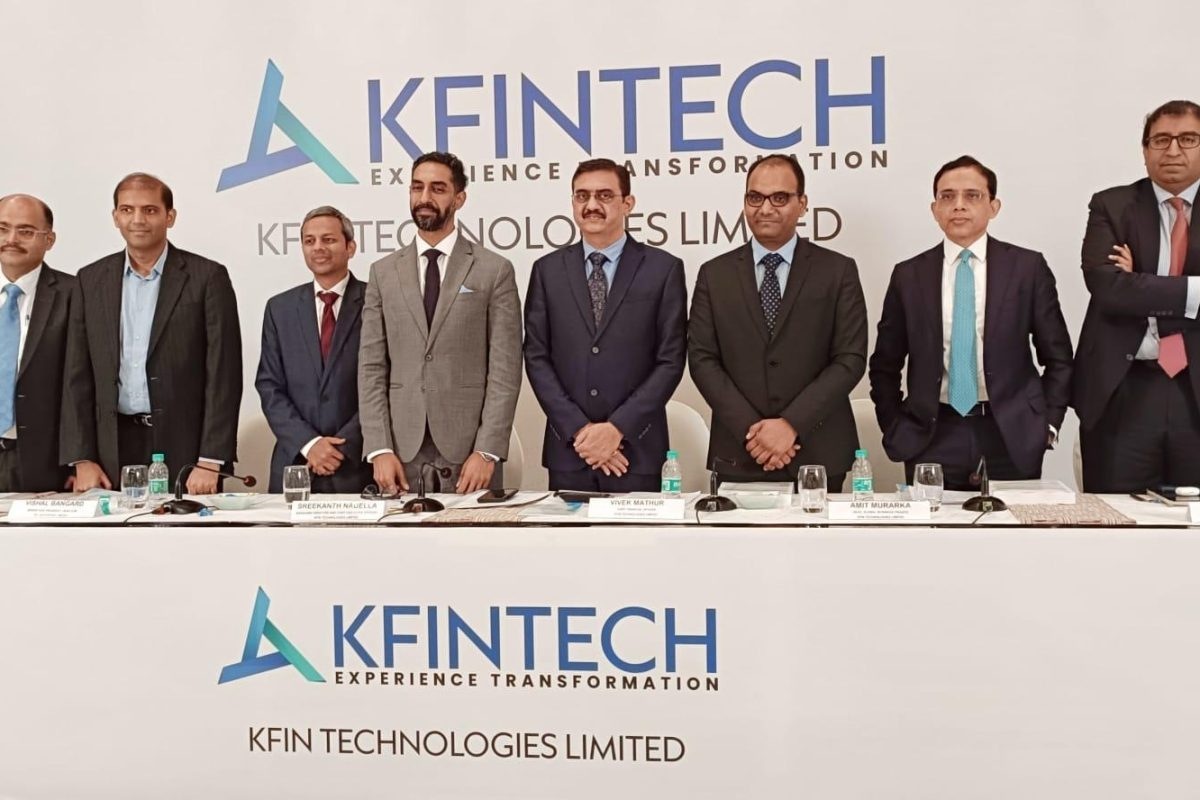
KFin Technologies Q4 & FY26: Revenue Up 22.9%, PAT Down 4.6% — The Ascent Acquisition Is Eating Margins For Breakfast
Date of Publishing -
Spotted a factual error — a wrong number, date, or fact? Tell us and we will check the source.
A 40-year-old plumbing company for the Indian mutual fund industry just bought a 6-year-old global startup in Singapore. Full-year EPS of ₹19.81. Stock at ₹896. The market is now asking: when does the acquisition start paying, and how much margin pain must shareholders absorb in the interim?
1. At a Glance
Picture a company that processes 2.5 million financial transactions every single day. Not a bank. Not an exchange. A company most retail investors have never heard of, yet one that almost certainly holds your mutual fund folio, your NPS account, or the share registry of a company you own. That company is KFin Technologies.
On April 29, 2026, KFin announced its Q4 FY26 and full-year results. The headline reads respectably: full-year revenue of ₹13,014.9 million, up 19.3% year on year. Full-year Core PAT of ₹3,531.4 million, up 6.2%. A dividend of ₹12 per share proposed. The company now serves 986 global clients, administers US$357 billion of global AUM, and operates across 18 countries.
Dig one layer deeper and the picture gets more interesting. EBITDA margins are compressing. Q4 FY26 consolidated EBITDA margin came in at 37.0%, down a painful 625 basis points year on year. PAT margin dropped from 30.1% in Q4 FY25 to 23.4% in Q4 FY26. The culprit is Ascent Fund Services — the Singapore-headquartered global fund administrator KFin acquired 51% of in October 2025 for USD 34.68 million.
The stock has not been celebrating. At ₹896 as of April 30, 2026, it sits 35% below its 52-week high of ₹1,388. Over the past year: negative 25.2% return. The market is clearly asking the same question every analyst dialing into a KFin concall is asking — when does the Ascent investment start paying off?
₹13,015 mnFY26 Revenue
19.3%Revenue Growth YoY
40.7%FY26 EBITDA Margin
₹19.81FY26 Diluted EPS
-25.2%1-Year Stock Return
This analysis tears apart Q4 FY26 results, holds management’s February 2026 concall commitments against actual Q4 outcomes, walks through the balance sheet expansion from the acquisition, and attempts a sensible valuation range for a company genuinely transitioning from a domestic fintech utility into something with global ambitions.
The detective’s first rule: follow the money. In KFin’s case, the money is currently moving from India’s mutual fund register rooms to the fund administration hubs of Singapore, Cayman Islands, and Saudi Arabia. Whether that turns out to be a brilliant pivot or an expensive mid-life crisis will determine whether ₹896 looks cheap or fair in hindsight.
2. Introduction
KFin Technologies was founded in 1985 — a full decade before the internet became a commercial phenomenon. For nearly four decades, it operated as the back-office for India’s capital markets: registrar and transfer agent for mutual funds, corporate issuers, and increasingly pension schemes and alternative funds. It listed on the NSE and BSE in December 2021 and has been a General Atlantic portfolio company since 2019.
For most of its life, KFin’s revenues were pleasantly correlated with the growth of India’s mutual fund industry. Overall industry AAUM stood at ₹81.6 trillion in FY26, up from ₹38.4 trillion in FY22. As the largest RTA by AMC count — serving 31 out of 59 AMCs as of March 2026 — KFin participated directly in that wealth creation.
The problem with being a beneficiary of India’s mutual fund boom is that you are also exposed to its mood swings. Management flagged this repeatedly in the February 2026 concall: “continued outperformance of passives over actives” was eating into per-folio realisations. A near-200-basis-point shift in AUM mix toward passives compressed domestic MF yields meaningfully. When equity markets went sideways for 18 months, retail participation in secondary markets weakened.
The strategy pivot began well before Ascent. KFin had been methodically building issuer solutions, AIF and wealth administration, and NPS businesses for years. What Ascent does is vault the international business from a small organic experiment in Southeast Asia to a genuine multi-geography platform. In Q4 FY25, international investor solutions contributed just 4.1% of revenue. In Q4 FY26, with Ascent, that number is 20.4%. That is a dramatic revenue mix shift in a single year.
At this point the honest question to ask yourself: are you looking at a platform company building durable competitive moats across geographies, or a mature domestic utility paying a premium for international optionality it may not capitalise on quickly enough? Drop your view in the comments.
3. Business Model — WTF Do They Even Do?
Think of KFin as the DMV for your financial assets. Except instead of making you wait three hours and sending you to the wrong window, they process 2.5 million transactions daily without your mutual fund statement ever being wrong. That is the core value proposition.
More formally, KFin provides four categories of service:
Domestic Mutual Fund Investor Solutions (61.4% of Q4 FY26 revenue): This is the legacy engine. KFin is the transfer agent for 31 AMCs managing ₹26.4 trillion in AAUM. It processes SIP registrations, redemptions, switches, and folio creations for over 167 million investor folios. A 36.4% market share in monthly SIP inflows means one in three SIPs processed in India touches KFin’s infrastructure.
International and Other Investor Solutions (20.4% of Q4 FY26 revenue): Post-Ascent, this segment has nearly quintupled in revenue share. KFin now serves 499 global clients — 390 under Ascent and 109 under its legacy Southeast Asia operations. Combined AUM of US$45.7 billion, up from US$9.5 billion a year ago, across 18 countries.
Issuer Solutions (9.4% of Q4 FY26 revenue): India’s largest corporate registrar by client count, serving 10,603 corporate clients. This segment had a weak Q4 — revenue fell 16.5% year on year because corporate action volumes were seasonally softer than Q3. Management had flagged this as early as the February concall: “Q4 corporate activity expected to be lower than Q3, already see a reduction.” They walked that talk.
Alternates, NPS, and Other (8.6% of Q4 FY26 revenue): The younger, faster-growing businesses. NPS subscriber base grew 35.6% year on year versus 11.7% for the industry. AIF fund count stands at 716 with 38.1% market share. These segments are subscale today but growing at multiples of their respective industries.
In the February 2026 concall, the CEO described KFin as an “XaaS provider — everything as a service.” Fund managers outsource the plumbing to KFin and focus on generating returns. The stickiness is real: transition risk in the RTA business is catastrophic for fund houses, which is why the win-rate for new AMC launches has been approximately 60% over the last several years.
4. Financials Overview
Result type locked: This is Q4 (March 2026) — full-year audited EPS is used directly, no annualisation required.
EPS calculation: Full-year FY26 diluted EPS = ₹19.81 (as stated in the investor presentation). Full-year FY25 diluted EPS = ₹19.27. The growth is 2.8% — modest against 19.3% revenue growth. The gap is entirely explained by Ascent integration costs, higher depreciation from purchase price allocation amortisation, and the Labour Code one-time provisions (₹125.9 million over FY26).
All figures consolidated including Ascent Fund Services from Oct 13, 2025. Source: KFin Technologies Q4 FY26 Investor Presentation, April 29, 2026.
Management Walk-The-Talk Check — February 2026 Concall vs Q4 / FY26 Actuals
Commitment Made (Feb 2026)
Actual Outcome
Verdict
Revenue growth 15–20% FY26
19.3% delivered
Delivered
EBITDA margin 40–45% FY26
40.7% full year; Q4 at 37.0%
Floor only; Q4 breach
NPS subscriber growth ~35% YoY
35.6% YoY in Q4
Exactly on target
Domestic MF revenue below ~60%
61.4% in Q4 FY26
Near target, not quite
Q4 Issuer Solutions lower than Q3
Q4 revenue ₹326 mn vs Q3 ₹491 mn
Accurately flagged
Ascent margin improvement, 3-year plan
Q4 group margins at 37%
Too early to grade
Management’s revenue guidance track record in FY26 is creditable. Where they were less precise was margins — the 40–45% EBITDA guidance was technically met at the full-year level but Q4 FY26 at 37.0% is a clear breach on a standalone quarterly basis. To be fair, the February concall had explicitly warned that Ascent margins are “well below KFin margins” and that Q4 corporate actions would see a reduction. This was honest and forward guidance that proved accurate. The underlying domestic business (KFin excl. Ascent) delivered Q4 EBITDA margin of 41.9% — perfectly within the guided range.
The Ascent integration drag on margins is the central variable for FY27. If Q1 FY27 shows EBITDA margin recovering toward 39–40% consolidated, the market may re-rate quickly. If it drifts further, the 45x P/E becomes very hard to defend. Which scenario do you think plays out first?
5. Valuation — Fair Value Range Only
Method 1: Price-to-Earnings
FY26 Diluted EPS: ₹19.81. CMP: ₹896. Current P/E: 45.2x. Direct peer CAMS trades at 41.2x with superior ROCE (54.8%) and cleaner margins. KFin’s acquisition premium arguably deserves a modest discount to CAMS in the near term. A fair P/E range of 35x to 45x: lower end assumes Ascent integration drags margins further; upper end assumes visible improvement within 18 months.
At 35x FY26 EPS: ₹19.81 × 35 = ₹693. At 45x: ₹19.81 × 45 = ₹891. P/E range: ₹693 to ₹891.
On a forward basis assuming FY27 EPS of approximately ₹22 (modest 11% growth): ₹22 × 35 = ₹770; ₹22 × 45 = ₹990. Forward P/E range: ₹770 to ₹990.
Method 2: EV/EBITDA
Enterprise Value: ₹15,298 crore = ₹152,980 million (from screener). FY26 EBITDA: ₹5,297 million. EV/EBITDA = 28.9x. A reasonable multiple range for KFin given growth profile and integration costs: 22x to 28x. At 22x: EV = ₹116,534 mn; add net cash (₹5,707 mn cash minus ₹550 mn borrowings = ₹5,157 mn); equity value ≈ ₹121,691 mn; per share (172.52 mn shares) ≈ ₹705. At 28x: EV = ₹148,316