KCP Sugar & Industries Corporation Ltd — FY2026: ₹260 Cr in Revenue, ₹29 Cr in Portfolio Gains, and the Operating Core That Quietly Hates Itself
Spotted a factual error — a wrong number, date, or fact? Tell us and we will check the source.
General information and entertainment, not investment advice. The author is not a SEBI-registered adviser or research analyst. No recommendation, no promised returns. Markets carry risk including loss of capital. Figures may not be current. Consult a registered adviser before acting.
1 — At a Glance
Figures are consolidated, in ₹ crore.
KCP Sugar & Industries Corporation Ltd closed FY2026 with consolidated revenue of ₹259.95 Cr — down 16.3% from ₹310.46 Cr in FY25 — and a consolidated PAT of ₹11.13 Cr, itself down 22.7% from ₹14.39 Cr. On the surface, that is a company with a profit. Beneath the surface, the operating business — sugarcane crushing, distillery, chemicals — ran at roughly ₹1 Cr of operating profit on ₹260 Cr of revenue, producing an OPM of 0.33%. The remaining ₹28.56 Cr of other income (dividends, fair-value adjustments, and FD interest from a sizeable investment portfolio) did the heavy lifting that kept PAT positive.
The market currently pays 22.5x earnings on that combination. ROCE sits at 4.13% and ROE at 2.45%. The balance sheet carries ₹292.76 Cr in investments against ₹127.71 Cr in borrowings, making the company technically net-cash-positive, which is the one structural fact that makes the story complicated rather than simple.
Cane crushing volumes collapsed in FY25 — from 4.4 lakh MT in FY24 to 2.6 lakh MT per the CARE rating report, as farmers in the Krishna district preferred other cash crops. The sugar recovery rate also declined, per CARE, from 8.50% in FY24 to 8.05% in FY25. FY26 results reflect the aftermath of that season. The engineering subsidiary (EIMCO-KCP) contributed meaningfully at the consolidated level, providing the segment diversity that the standalone balance sheet doesn’t fully capture.
What the market is actually paying for here — the investment portfolio, the engineering franchise, the latent operating recovery, or the eight-decade brand — is the tension this entry sets out to describe.
2 — Introduction
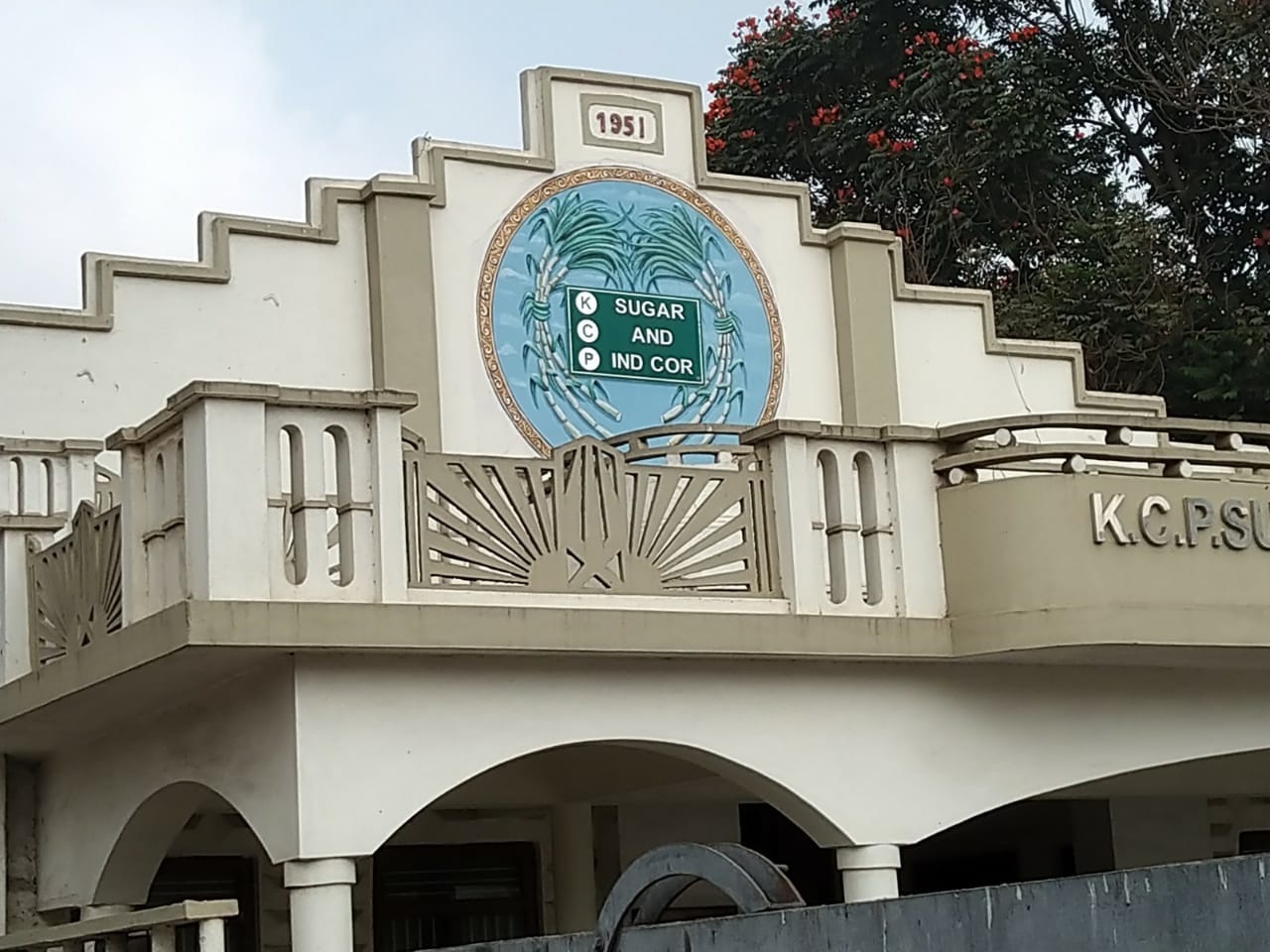
K.C.P. Sugar and Industries Corporation Ltd was incorporated in 1995 as a demerger from K.C.P. Limited, the flagship entity promoted by the late V. Ramakrishna in 1941. The group had diversified into cement and engineering over its history; KCP Sugar took over the sugar mills and KCPL’s engineering workshop. The registered office sits in Chennai; the main manufacturing operations are in Vuyyuru, Krishna District, Andhra Pradesh.
The company operates at the intersection of several businesses that are united mostly by geography and history rather than obvious strategic synergy: sugarcane crushing and refined sugar, industrial and pharmaceutical alcohol, power co-generation from bagasse, pharma-grade calcium lactate, bio-fertilizers and mycorrhiza inoculants, and a urad dal (black gram) processing unit that opened in February 2023. The group also consolidates EIMCO-KCP Limited, a subsidiary that fabricates heavy industrial machinery and contributes a significant portion of consolidated engineering revenue.
The FY2026 results (year ended March 31, 2026) were approved by the Board on May 27, 2026. The statutory auditor, M/s. B. Purushottam & Co., issued an unmodified opinion on both the standalone and consolidated financial statements.
On the personnel front, the Board approved the re-appointment of Managing Director Irmgard Velagapudi through 2027, and re-appointed cost, tax, and internal auditors for FY2026-27. The auditor noted that managerial remuneration of ₹25.28 lakhs paid to the Executive Director is the minimum statutory remuneration for a fourth consecutive year of inadequate profits, subject to shareholder approval under Section 197(10) of the Companies Act.
Promoter group entities Sethi Funds Management Pvt. Ltd. and related parties conducted a series of open-market acquisitions through June 2026, raising their collective stake incrementally. The promoter holding stood at 41.55% as of March 2026.
3 — Business Model: WTF Do They Even Do?
Imagine a sugar mill that got bored in the 1990s and started collecting hobbies. That is roughly the story here.
Sugar is the ancestral business. The Vuyyuru plant in Krishna District, Andhra Pradesh crushes sugarcane at 7,500 tonnes per day (TCD) capacity. Farmers bring cane, the company crushes it, extracts sugar, bags it, and sells it into a market whose prices are set in part by government-mandated minimum selling prices and fair and remunerative prices (FRP). The FRP was ₹315/quintal in FY24, rose to ₹340/quintal in FY25, and is expected at ₹355/quintal in FY26 per the CARE report — a 13% cost increase over two years that the company’s selling price may or may not accommodate. The sugar segment ran at a loss of ₹17.31 Cr at the PBT level in FY26 per the filing’s segment disclosure.
The distillery runs at 50 KLPD (kilo litres per day), producing rectified spirit, extra neutral alcohol, ethanol, and surgical spirit. Co-generation runs at approximately 15 MW, using bagasse from the crush as fuel. The chemical division manufactures pharma-grade calcium lactate (~500 TPA), carbon dioxide, bio-fertilisers (~1,200 TPA), and mycorrhiza inoculants (~1,400 TPA). These are real products with real clients; they are also small.
Urad Dal is the new entrant. In February 2023, the company converted the shuttered Lakshmipuram sugar plant (closed in FY20, sold in FY23) into a black gram processing facility with 22,000 MTPA capacity. The CARE report notes this division contributed 20.2% of total operating income in FY25, up from 3.9% in FY24 — a fast ramp for what is essentially a cleaned-up shed.
Engineering is where the consolidated numbers get interesting. The EIMCO-KCP subsidiary fabricates heavy industrial machinery. At the consolidated level, the engineering segment contributed ₹78.64 Cr in revenue (FY26 per the filing’s segment table, in lakhs: ₹7,863.55 L = ₹78.64 Cr) and produced a segment profit of ₹24.63 Cr — comfortably the group’s largest earning segment.
The business model, in summary: a seasonal, weather-dependent sugar core that loses money in most recent years, surrounded by an alcohol-and-chemicals ring, a new dal operation learning to walk, and an engineering subsidiary that makes the consolidated P&L look better than the standalone. The investment portfolio — ₹292.76 Cr in mutual funds, listed equities, and other instruments at March 2026 — functions as a fourth business, providing other income that has at times exceeded operating profit.
Does ₹293 Cr of financial assets in a ₹251 Cr market-cap company change the story, or does it raise a different set of questions about capital allocation in a business that hasn’t compounded earnings?
4 — Financials Overview
Figures are consolidated, in ₹ crore. The result type is Yearly (Annual). Latest period: FY2026 (year ended March 31, 2026).
Metric
FY2026
FY2025
YoY Change
Revenue from Operations
259.95
310.46
–16.3%
EBITDA (PBT + Int + Dep)
29.43
43.20
–31.9%
PAT
11.13
14.39
–22.7%
EPS (₹)
0.98
1.27
–22.8%
For context on Q4 FY2026 (March 2026 quarter, the balancing quarter):
Metric
Q4 FY26
Q4 FY25
YoY
Q3 FY26
Revenue
68.80
63.99
+7.5%
64.58
Operating Profit
–4.84
30.13
—
3.07
PAT
–15.20
–22.22
Improvement
6.75
The Q4 FY26 PAT of –₹15.20 Cr deserves a footnote: other income turned sharply negative in Q4 at –₹8.91 Cr (fair-value adjustments on investments swung against), whereas Q4 FY25 also had negative other income of –₹53.29 Cr. These fair-value swings make quarter-to-quarter comparison mechanically unreliable for the company.
The full-year picture shows revenue declining for the third consecutive year: ₹345.68 Cr (FY24) → ₹310.46 Cr (FY25) → ₹259.95 Cr (FY26). The CARE report attributes the FY25 decline to a 41% drop in cane crushed (from 4.4 lakh MT to 2.6 lakh MT) and a weaker recovery rate, as farmers in the Krishna district shifted to alternative crops. FY26 revenue continues that trajectory.
The operating business — as measured by operating profit before other income — generated approximately ₹0.94 Cr on ₹259.95 Cr of revenue in FY26, an operating margin of 0.33%. The ₹11.13 Cr PAT rests almost entirely on the ₹28.56 Cr