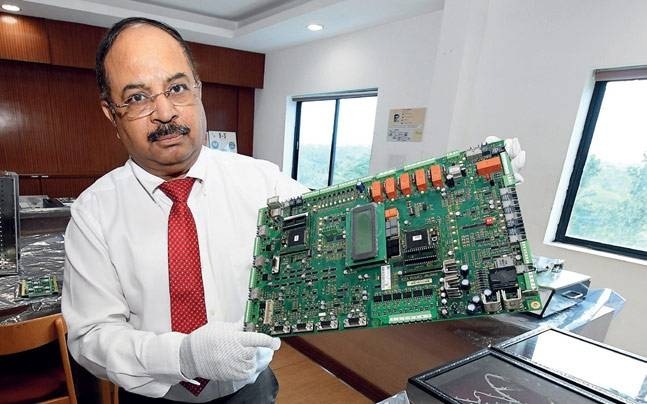
Kaynes Technology India Ltd Q2FY26 – From Circuit Boards to Stock Market Fireworks: 102% Profit Growth, ₹6,047 Cr Order Book, and a 118x P/E That Defies Gravity
Date of Publishing -
Spotted a factual error — a wrong number, date, or fact? Tell us and we will check the source.
1. At a Glance
Kaynes Technology India Ltd (NSE: KAYNES, BSE: 543664) has officially joined the “premium pricing for premium narratives” club. With a market cap of ₹44,635 crore, a P/E ratio of 118, and a quarterly PAT of ₹121 crore, this Mysuru-based electronics design and manufacturing powerhouse has turned its PCB dreams into a ₹6,658-per-share reality.
Q2FY26 results? Revenue ₹9,062 million (₹906.2 crore), EBITDA ₹1,480 million, PAT ₹1,214 million, and a cool 102% YoY profit growth. The company’s order book now stands at ₹80,994 million (₹8,099 crore) – a backlog so healthy it could be mistaken for a government infrastructure budget.
And yet, despite all that cash flow drama, the dividend yield remains 0.00% — because apparently, Kaynes believes in spiritual rather than financial returns for shareholders.
Still, with ROCE at 14.3%, ROE at 10.7%, and a debt-to-equity ratio of 0.19, the balance sheet looks more disciplined than a Mysuru yoga retreat.
Ready? Let’s crack open this ESDM (Electronics System Design and Manufacturing) masterpiece.
2. Introduction
There are electronics manufacturers, and then there’s Kaynes — the kid in class who not only finishes the exam early but also builds a microprocessor on the answer sheet.
Founded in 2008 and operating in automotive, industrial, aerospace, defense, outer space, nuclear, medical, railways, and IoT, Kaynes has built a reputation as the poster child of India’s ESDM revolution.
From humble PCB assembly lines, the company now builds entire IoT-enabled systems, works on outer-space projects, and designs embedded solutions for EVs. It’s like your friendly neighborhood electronics lab that somehow ended up in NASA’s contact list.
In FY25, Kaynes didn’t just expand — it multiplied. With 16 manufacturing facilities, a growing presence in Europe and Southeast Asia, and a recent Austrian acquisition (Sensonic GmbH) for its railway sensors, the company has turned globalization into a high-speed circuit.
But let’s not ignore the elephant in the lab — that 118x P/E. Investors clearly think Kaynes can walk on water, or at least solder it.
3. Business Model – WTF Do They Even Do?
Kaynes calls itself an end-to-end and IoT solutions-enabled integrated electronics manufacturer. Translation? They’ll do everything from design to production to lifecycle support, and even hand you the test results.
Their three business segments:
OEM – Turnkey PCB Assembly (47% of revenue in 9M FY25): The bread and butter. Kaynes makes and assembles printed circuit boards for industrial and automotive clients. It’s like assembling the nervous system for machines.
OEM – Box Build (43%): The soul of system integration — complete product assembly, cable harnessing, testing, and packaging. Essentially, Kaynes builds devices that look ready for the shelf at Croma.
ODM & IoT Solutions (10%): The “smart” part. The company designs electronics products, embedded systems, and IoT solutions. Think sensors, software, and custom designs that make even dumb machines look genius.
And because that wasn’t enough, they’ve ventured into semiconductor assembly and testing (OSAT) and HDI PCB manufacturing, marking their entry into deep-tech territory usually guarded by Taiwan and South Korea.
In short: Kaynes is India’s ESDM Swiss Army knife.