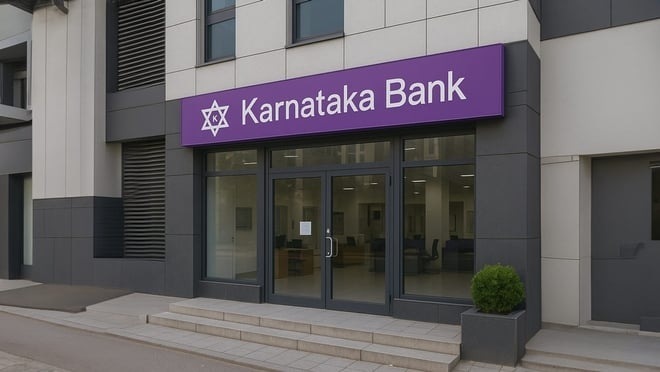
1. At a Glance
Karnataka Bank Ltd, the Mangaluru-based veteran of India’s private banking scene, just dropped its Q2FY26 numbers – and boy, it’s been a quarter of calm profits and chaotic management changes.
The stock trades around ₹181, about 22% below its 52-week high of ₹231, while the market cap sits at a modest ₹6,842 crore. For a bank that’s older than most fintech founders’ grandfathers, it’s still fighting its battles.
In Q2FY26, the bank posted a net profit of ₹319 crore, up 9% QoQ, but still 2% below Q1 in sales at ₹2,179 crore. The Net Interest Margin (NIM) held at a healthy 3.6%, while Gross NPA eased to 3.46% and Net NPA stood at 1.44% – a relief considering how some small private banks still treat NPAs like family members.
The book value per share is ₹333, yet the stock trades at just 0.54x book. It’s practically a discount bazaar for value hunters.
With a P/E of 5.96, an ROE of 11.1%, and a dividend yield of 2.76%, Karnataka Bank looks like that frugal uncle who still makes money on a fixed deposit while everyone else is chasing crypto.
2. Introduction
If Karnataka Bank were a person, it’d be that serious, conservative relative from the Konkan coast — old-school, disciplined, but occasionally dramatic. Over a century old, it has seen colonial regimes, multiple economic reforms, and now, Gen Z clients who think UPI is banking.
In Q2FY26, this coastal warrior delivered steady profits despite musical chairs in management – with CFOs, COOs, and Treasury heads resigning faster than a cricket captain under BCCI pressure. Yet, the bank continued its “work hard, pray harder” routine.
Over the years, Karnataka Bank has carved its niche as a mid-sized private sector bank with 904 branches and 1,482 ATMs, mainly across southern India. It thrives on retail, MSME, and agricultural loans — basically funding everything from your neighborhood kirana store to your cousin’s dream of owning a Mahindra tractor.
Sure, growth is modest, but stability is the name of the game. In the wild world of fintech disruptions, this old-school banker still earns, lends, and smiles — occasionally topping it off with a ₹5 dividend to remind shareholders that tradition still pays.
3. Business Model – WTF Do They Even Do?
Karnataka Bank is the kind of financial institution that does everything your neighborhood bank does — just with fewer headlines and more compliance.
Three Pillars of its Banking Empire:
- Retail Banking:
Home loans, car loans, gold loans, education loans, personal loans – basically, if it can be pledged or mortgaged, KBL has a product for it. With retail now forming 47.5% of advances, it’s clearly their favorite child. - MSME & Corporate Banking:
The bank lends to small and mid-corporates through working capital and term loans. The mid-corporate share stood at 26.5%, while large corporates crept up to 26%, hinting at a cautious shift toward bigger balance sheets and better-rated clients. - Agricultural Banking:
The agri portfolio includes farm loans, mechanization, and rural development funding — think tractors, drip irrigation, and every other dream under the Indian sun that starts with “loan sanctioned by Karnataka Bank.”
Add to that, a para-banking and insurance cross-sell play through tie-ups with PNB MetLife, LIC, Bharti AXA (life) and Universal Sompo & Bajaj Allianz (general) — meaning the bank sells everything from loans to life insurance to “no-claim” policies.
Their new collaboration with Fisdom for 3-in-1 trading accounts (savings + demat + trading) is their way of saying,