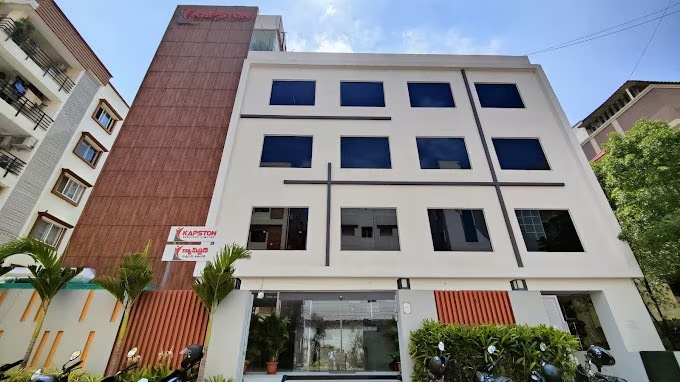
Kapston Services FY26: A Thinly Margined Outfit Learning to Charge
General information and entertainment, not investment advice. The author is not a SEBI-registered adviser or research analyst. No recommendation, no promised returns. Markets carry risk including loss of capital. Figures may not be current. Consult a registered adviser before acting.
1 — At a Glance
Kapston ended FY26 with ₹830 Cr in revenue and ₹28 Cr in net profit — capped by a PAT margin of 3.37%. That’s the kind of margin you’d see from a company still figuring out how to charge for the work it does.
The market pays 35.8x on that EPS (₹9.21). Compare that to a peer band averaging 16.8x, and the stock sits in a different universe.
On the flip side: revenue has climbed from ₹213 Cr in FY20 to ₹830 Cr in FY26 — a five-year CAGR of 31%. And the company just folded in a bonus (1:2 approved in Jan 2026) and spun up a new subsidiary for home services in February.
One reader question before we proceed: Does a 34% profit CAGR over five years, paired with margins still in the low 3%, point to operational leverage about to arrive, or to a business that competes on price and scale, not margin?
2 — Introduction
Kapston Services, founded in 2009 and listed on NSE Emerge in 2018, anchors itself in a trio: facility management, security staffing, and contract labour. The company collects fees from corporates — pharma, auto, FMCG, IT, hospitals, government — for handling the humans: guards, housekeeping, landscaping, electrical maintenance, canine units, and now (as of February 2026) a B2C home services startup called Kapston Home Services.
The business is straightforward: labour-on-demand. The economics are messy.
In February 2026, the board approved a 1:2 bonus (issued March 2026), bumping shares from 10.14 Cr to 20.29 Cr. The company also created an authorised capital increase to ₹20 Cr and formed Kapston Home Services as a 100% subsidiary — a sideways move into consumer home services (cleaning, plumbing, AC repair).
The company operates out of 14-odd branch offices across India. Promoter Srikanth Kodali holds 71% and co-promoter Kanti Kiran Doddapaneni holds 1.85%, leaving the public 27.13% of the cap table. On March 17, 2026, the postal ballot reappointed Kodali as MD for three years at a revised ₹3.60 Cr per annum (up from prior terms).
3 — Business Model: WTF Do They Even Do?
Kapston is a labour platform with two main arms: B2B staffing for large corporates (security, housekeeping, M&E, landscaping, IT staffing) and B2C home services (a very recent addition).
The B2B arm works like this: a pharma factory needs 500 guards. Kapston hires, trains, deploys, and manages those guards on-site — a commodity service priced per headcount per month. The company collects revenue per head, minus the cost per head (wages, admin, insurance, training). The spread is the margin.
Segments by revenue contribution (FY23 data from filings): Security Service Charges ~40%, Housekeeping ~30%, Contract Staffing Income ~30%. No published breakdown for FY26 yet, but the ratio likely hasn’t shifted much.
The company pitches itself as an “end-to-end” provider — a one-vendor shop for all your labour needs. In reality, it competes in a market where clients can ask for price cuts anytime a contract comes up for renewal.
The new home services arm (launched Feb 2026) is a B2C bet: cleaning, EPC (electrical, plumbing, carpentry), beauty, AC repair. No financials yet; the filings describe it as a “beta launch” in Hyderabad on April 19, 2026, with a commercial launch planned next. This is a probe, not a revenue engine yet.
The company serves 650+ clients (per investor deck, Q3 FY25 data) and employs 28,000+ people. The revenue-per-employee sits at ~2.26 lakh per annum, a key productivity metric in labour services — it’s not high, reflecting the low-margin nature of guard and housekeeping work.
4 — Financials Overview
Figures are consolidated, in ₹ crore.
Metric
FY26
FY25
YoY
FY24
YoY
Revenue
830
689
+20.5%
520
+32.5%
EBITDA
44
31
+42%
23
+35%
PAT
28
18
+57%
13
+38%
EPS (₹)
9.21
5.87
+57%
4.13
+42%
Quarterly descent into Q4 and FY26 results:
The company filed unaudited Q3 FY26 results on Feb 6, 2026 (quarter ended Dec 31, 2025): ₹212 Cr revenue, ₹7.4 Cr PAT. By May 28, 2026, audited Q4 (Mar 31, 2026) landed: ₹218 Cr revenue, ₹7.5 Cr PAT.
Full-year FY26 arithmetic: ₹830 Cr revenue, ₹28 Cr net profit.
The narrative: Revenue is compounding steadily (FY20–26 CAGR: 31%), but profit is running faster (FY20–26 CAGR: 34%), which sounds healthy — except the headline margin hasn’t budged much. Operating Profit Margin (OPM) in FY26 landed at 5.29%, versus 4% in FY24 and 5% in FY25. It’s flatline with slight variability.
The real pivot is in the PAT margin: it swung from ~1% in FY23 to 3.37% in FY26. Why? Tax. FY23–25 saw heavy tax reversals (negative tax) because the company was burning losses or had tax credits. FY26 flipped: positive tax of ₹0.67 Cr, but at just 2.4% of PBT — a very low effective rate, hinting at carried-forward losses still being utilized.
Interest and depreciation: Interest rose from ₹4 Cr in FY20 to ₹14 Cr in FY26, driven by debt scaling alongside expansion. Depreciation similarly climbed: ₹3.6 Cr in FY20 to ₹4 Cr in FY26, then spiked to ₹4 Cr in FY26 (likely from the CapEx for fixed assets, visible in the balance sheet jump noted below).
5 — Valuation Discussion: Fair Value Range (Educational Only)