01 — At a Glance
The CNC Machine Maker That’s Out of Machines to Make
- 52-Week High / Low₹1,331 / ₹750
- Q3 FY26 Revenue₹576 Cr
- Q3 FY26 PAT₹89 Cr
- Q3 FY26 EPS₹3.89
- Annualised EPS (Q3×4)₹15.56
- Book Value₹80.5
- Price to Book9.61x
- Dividend Yield0.00%
- Debt / Equity0.40x
- Order Book₹4,585 Cr
Auditor’s Notes: Jyoti CNC printed ₹576 crore revenue in Q3 (+28.1% YoY), ₹89 crore PAT (+10.3% YoY), and an order book that’s now 1.5–2 years of delivery backlog — meaning growth isn’t constrained by demand, but by manufacturing muscle. The P/E of 49.7x screams “we are growth,” but the dividend yield screams “we spend every paisa on capex, not your portfolio.” Stock is off 18.5% in 52 weeks while delivering 28% revenue growth. The cognitive dissonance should concern you.
02 — Introduction
Welcome to India’s Precision Machine Tool Circus
Jyoti CNC makes machines that make parts for cars, aerospace, defence, and industrial equipment. Their 5-axis CNC machines are the Indian answer to Mazak, Haas, and the European incumbents. They’ve got a 10–12% market share domestically, installed 130,000+ machines globally, and are now in execution mode to 6x their production capacity in the next 12 months.
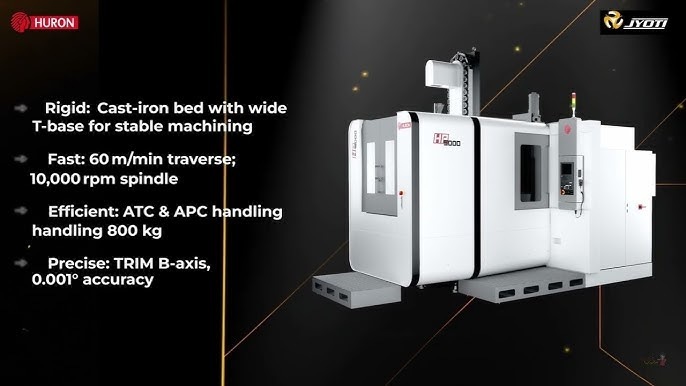
Revenue growth running at 20%+ compound. Aerospace & defence is now 45% of revenues (vs. 8% five years ago). Huron (their French acquisition from 2024) just commissioned its facility in November 2025. A new ₹425-crore capex is 90% complete with expected commissioning in September 2026. They’re launching semiconductor equipment R&D efforts and claiming they’ll have commercial products in 2 years.
The stock is up 0% YTD. Down 18.5% over 12 months. Meanwhile, the company is printing 20%+ revenue growth, crossing 60%+ order-book-to-revenue ratios, and admitting in the latest concall that they are “turning away customers” because lead times exceed 18 months. This is a company drowning in success. The question is whether the market will reward scaling through or punish the execution risk.
Concall Note (Feb 2026): Management stated: “We have reached the order book to almost 1.5 to 2 years delivery commitment. No more customers are ready to wait more than 18-month delivery commitment.” Translation: they’re not hungry anymore. They’re full. And scaling a foundry + assembly operation in a capital-intensive sector is where valuation multiples go to die.
03 — Business Model: We Make the Machines That Make Everything Else
The Unglamorous King of Precision Engineering
Jyoti manufactures CNC machines — computer-driven lathes and machining centers used to cut, shape, and finish metal and other materials. Their customer base spans aerospace (HAL, Airbus), automotive (Tata, Mahindra, Bosch), defence (government orders), and general engineering. They offer 200+ product variants across 44 SKUs, from entry-level (₹20.5 lakh per unit) to high-end aerospace-grade (₹9.6 crore per unit).
Production cycles are long — entry-level takes 3–6 months, mid-range 9 months, large/complex 12–18 months. They have two facilities in Rajkot (total capacity: 6,000 machines/year as of FY25), plus the Huron facility in France (now 121 machines/year, doubled). They’re building a new 10,000-machine facility in Tumakuru, expected to commission in September 2026. They also hold a 7% stake in ki Mobility (EV charging infrastructure), but that’s pocket lint relative to the core machine tool business.
Gross margin sits around 36–40%. EBITDA margin has expanded from 22.87% (FY24) to 28.38% (FY25) due to scale and mix shift toward higher-realization machines. Entry-level machines (1,207 units in Q3) generate ₹20.46 lakh per unit. High-end machines (23 units in Q3) generate ₹9.6 crore per unit. You do the math: selling one aerospace VMC is like selling 470 entry-level lathes.
Aerospace Mix41%–46%Order Book
Auto Mix28–30%Order Book
General Engg22%Order Book
Domestic Cap U6,000 / yrBefore Expansion
Product Mix Note: The shift toward aerospace (high-realization) machines explains the margin expansion better than any operating leverage story. A 10% swing in mix between entry-level and high-end is equivalent to 300–400 bps of EBITDA margin expansion. Management is actively optimizing for this.
💬 If you were a defence ministry or aerospace OEM, would you commit orders to a small Gujarat manufacturer, or sleep easier with a Mazak or Haas? What’s the moat here, really?
04 — Financials Overview
Q3 FY26: The Numbers You Need to Care About
Result type: Quarterly Results | Q3 FY26 EPS: ₹3.89 | Annualised EPS (Q3×4): ₹15.56 | 9M FY26 EPS: ₹10.79
| Metric (₹ Cr) |
Q3 FY26
Dec 2025 |
Q3 FY25
Dec 2024 |
Q2 FY26
Sep 2025 |
YoY % |
QoQ % |
| Revenue | 576 | 450 | 508 | +28.1% | +13.4% |
| Operating Profit | 155 | 113 | 125 | +37.3% | +24.0% |
| OPM % | 26.9% | 25.1% | 24.6% | +180 bps | +230 bps |
| PAT | 89 | 81 | 86 | +10.3% | +3.5% |
| EPS (₹) | 3.89 | 3.53 | 3.76 | +10.3% | +3.5% |
The Weird Part: Revenue grew 28.1% but PAT grew only 10.3%. Why? Finance costs jumped due to capacity expansion capex (new ₹300 crore Term Loan from Union Bank in Sept 2025). Management also emphasized higher intra-group shipments to Huron (70% of Huron material sourced from Rajkot) reduce consolidated reported revenue until sold externally. Strip out consolidation effects, and the underlying profitability is tighter than the headline PAT suggests.
05 — Valuation: Fair Value Range
What’s a Machine That Makes Machines Worth?
Join 10,000+ investors who read this every week.