Jindal Drilling Q4 FY26: A ₹100 Crore Courtroom U-Turn Shakes the Bottom Line
Section 1 — At a Glance
A dramatic shift in non-operational variables has created a stark divergence between operational stability and reported net profitability for Jindal Drilling & Industries Ltd (JDIL). In the financial year ended March 31, 2026, the company achieved a multi-year high in scale, posting annual revenue from operations of ₹997 crore, representing a 20.4% expansion year-on-year. This top-line progression was driven directly by the deployment of the company’s asset fleet at structurally superior charter rates under long-term contracts with Oil and Natural Gas Corporation (ONGC).
However, a closer look reveals significant pressure on final reported metrics. The company’s fourth-quarter performance was overshadowed by a massive legal development: the sudden reversal of a ₹100.43 crore income item previously recognized in the second quarter. This accounting adjustment was necessitated by ONGC appealing a favorable Bombay High Court arbitration award in the Supreme Court, rendering the entire matter sub-judice. Consequently, net profit for the latest quarter plunged into negative territory at -₹33 crore, dragging down full-year net profit to ₹211 crore, compared to ₹214 crore in the preceding twelve-month period.
This divergence highlights a core market reality: when legal outcomes dictate accounting entries, accounting earnings can quickly become decoupled from core economic realities. While operational efficiency metrics, including fleet uptime, remained above 99%, the company’s near-term reported numbers remain heavily tied to unresolved judicial timelines and intense domestic tendering dynamics.
Section 2 — Introduction
Jindal Drilling & Industries Ltd, an established member of the Dharam Pal Jindal Group, operates in the capital-intensive and highly cyclical offshore oilfield services domain. The company’s operational perimeter centers on providing offshore jack-up rigs, directional drilling, and mud logging capabilities tailored almost exclusively to India’s public sector hydrocarbon exploration initiatives.
Over the past two fiscal years, management has shifted its strategic posture from managing older assets to executing significant capital expenditure. This is evidenced by the acquisition of the jack-up rig Jindal Pioneer for USD 75 million (~₹622 crore) from Discovery Drilling Pte. Ltd., Singapore. While this enhances technical capacity, it ties the company’s return profile tightly to state-directed upstream capex cycles, exposing it to the pricing mechanisms governed by public tender systems.
Section 3 — Business Model: WTF Do They Even Do?
Jindal Drilling specializes in the mechanical extraction of subsurface marine oil and gas by drilling deep boreholes into the seabed. The business operates across three distinct service lines, though calling it a diversified portfolio is quite a stretch.
The primary business line is the rental and operation of offshore jack-up rigs, which generated 80% of total revenue. The second line is directional and horizontal drilling—a specialized technique for navigating complex wellbore trajectories at multiple angles—which contributed 19% of revenue. The final 1% comes from mud logging services, where rock chips are analyzed to determine if the rig has hit black gold or just expensive dirt.
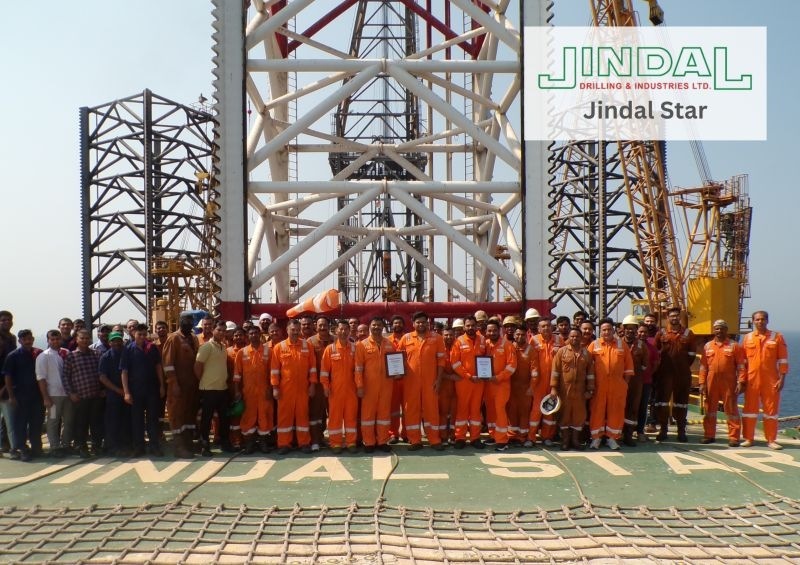
The operational asset base consists of 6 jack-up rigs (3 owned, 3 rented via inter-corporate arrangements). Five of these rigs are currently deployed on multi-year contracts. The catch? The company has a striking revenue concentration, with nearly 100% of its domestic billing linked directly to a single counterparty: ONGC. If ONGC decides to slow down its tendering process, Jindal Drilling’s business model faces immediate utilization pressure.
Section 4 — Financials Overview
Figures are consolidated, in ₹ crore.
Metric
Latest Quarter (Mar 2026)
YoY
QoQ
Revenue
₹263.00
7.29%
8.68%
EBITDA / Operating Profit
₹78.00
-15.22%
8.33%
PAT
₹45.00
-16.67%
236.36%
EPS
₹15.66
-15.90%
236.36%
What is Management Promising in the Coming Quarters?
During recent management discussions, the commercial team emphasized that despite a volatile bottom-line appearance, core operational performance has remained steady. Management noted that ONGC is currently concluding one tender round and is expected to issue a subsequent tender for an additional four rigs in the near term. Management stated:
“Our aim is to get the rigs as and when they get dehired and get a contract for them.”
Regarding capital allocation, management committed to a step-by-step push for higher charter rates, acknowledging that historical competitive pressures in domestic tenders led to unviable pricing floors. A key focus remains on the Jindal Pioneer rig, which stopped earning revenue in October 2025 to undergo major refurbishment in the UAE. Management intends to bid this rig into upcoming domestic cycles upon its return to India, though utilization continuity depends heavily on aligning tender awards with refurbishment lead times.
Section 5 — Valuation Discussion: Fair Value Range Only
1. P/E Method
With a current market price (CMP) of ₹593 and a reported full-year FY26 EPS of ₹72.67, the stock trades at a trailing P/E of 8.04x. Historically, the broader