Jeena Sikho Lifecare: FY26 Results — 71% Revenue Jump on a Trebling Profit
General information and entertainment, not investment advice. The author is not a SEBI-registered adviser or research analyst. No recommendation, no promised returns. Markets carry risk including loss of capital. Figures may not be current. Consult a registered adviser before acting.
Jeena Sikho Lifecare (JSLL) served up FY26 numbers that made the sector’s growth memes look tame: revenue jumped 71% to ₹801 Cr; net profit scaled 178% to ₹222 Cr. The market prices this at 34x reported earnings—tied with its own 5-year average multiple of 47x (down from peak disgrace).
The tension: raw profit scaling faster than revenue looks like operating leverage, but one-time provisions (~₹21 Cr) masked the floor. The cash flow from operations hit ₹262 Cr against capex of ₹211 Cr, leaving free cash positive.
IPD volumes climbed 65% to 40,454 patients; OPD volumes 69% to 5.7 lakh. The hospital bed count sits at 2,300 with another 445 in pipeline—capacity already baked in for next two years. Occupancy remains the dial to watch.
Management expects ₹3,000 Cr revenue in 3–5 years and ₹300 Cr minimum PAT in FY27. That’s a 275% profit jump on a 275% revenue jump. Either the spreadsheet works, or the boil-down gets harder.
2. Introduction
Ten years ago, Acharya Manish Ji founded Jeena Sikho with a bet on ancient Ayurveda winning the modern health anxiety narrative. The company went public in April 2022 on the NSE, then migrated to the mainboard in August 2025 after proving numbers scaled faster than board membership rules allowed.
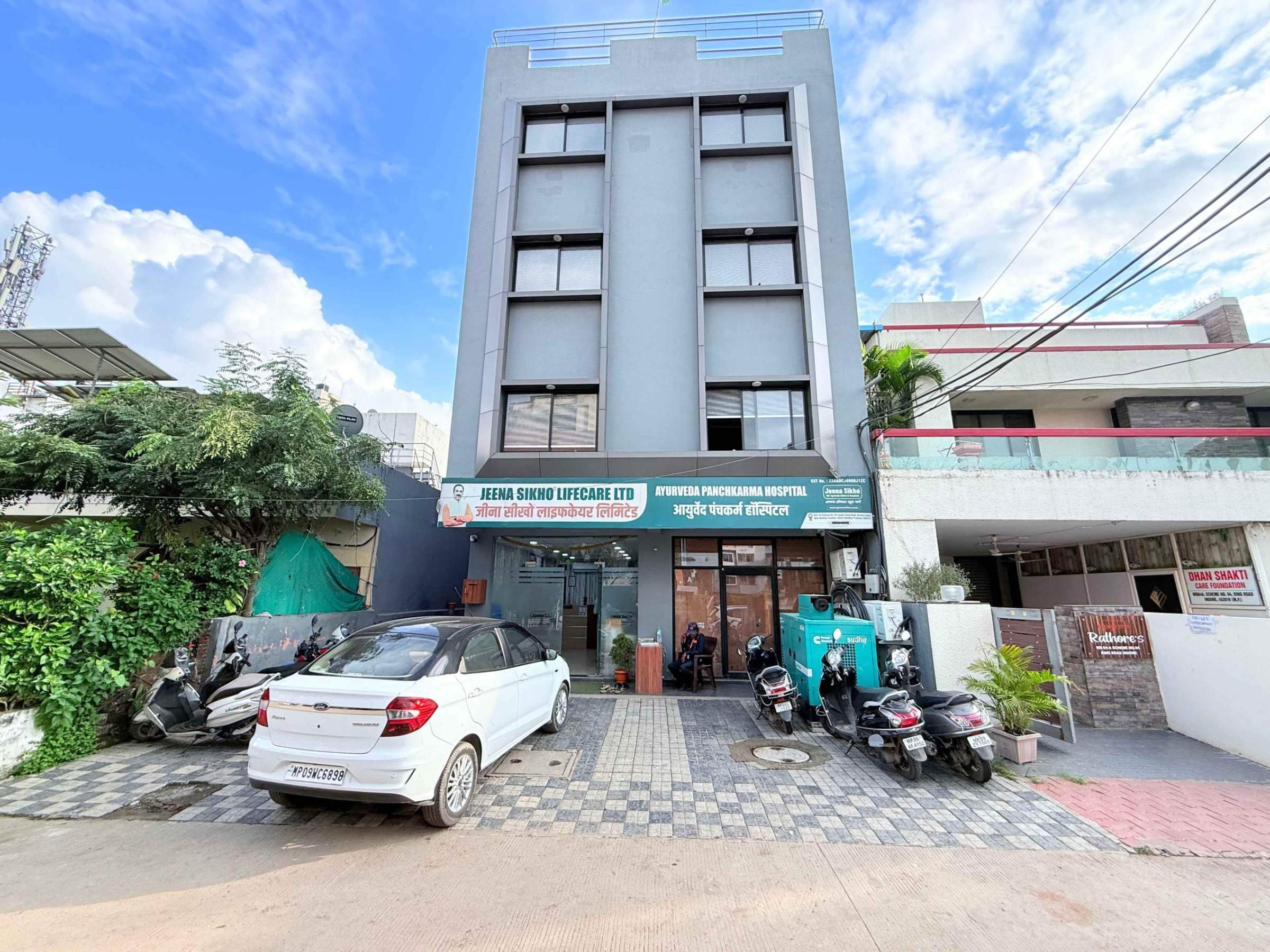
JSLL operates 61 hospitals and 58 clinics/daycare centres across 23 states and 100+ cities. Only 33 are franchised; the rest are company-run or payroll-locked, a model designed to lock patient flow into products.
The business splits 48:52 between services and products—deliberate, recurring, synergistic. Services (₹385 Cr in FY26) anchor volume and pricing power; products (₹416 Cr) supply the durable, high-margin tail.
Last quarter, management flagged a ₹21 Cr pile of provisions: labour code amendments, ESOP costs, performance bonuses, lease adjustments under the new auditor (Grant Thornton, first year). These are real money out, but management argues they don’t repeat at this scale. Read that carefully.
Government business dropped from ₹118 Cr to ₹36 Cr on purpose—the sector hates government payment terms. Private and retail sales grew to offset: from ₹136 Cr + ₹215 Cr to ₹349 Cr + ₹415 Cr. The flywheel, not a pivot.
3. Business Model: WTF Do They Even Do?
JSLL runs what it calls a hub-and-spoke Ayurveda network. Clinics feed patients into hospitals; hospitals feed patients back to products; products customers call support, convert to IPD cases, buy more products.
The services arm delivers Panchakarma therapies (the ayurvedic deep-clean), IPD (inpatient), OPD (outpatient), and 72-hour camps that convert 30% of attendees into paying patients at ₹30–60 lakh per camp. Camps are explicitly profit centers, not marketing spend.
The products arm: 330+ SKUs across immunity, pain, organs (kidney/liver/thyroid), weight loss, and OTC launches just starting. Gross margins exceed 85%; manufacturing is outsourced; distribution runs through company call centers, e-commerce, and now retail pharmacy shelves.
A 100-bed facility costs ₹3–4 lakh per bed to set up (₹300–400 lakh total), breaks even at 35% occupancy, and hits payback in <6 months at decent utilization. The CFO claims capital-light; the balance sheet agrees. ROCE at 46% (3-year average) sits in the 70% orbit management claims only when you annualize good quarters.
What makes it work: repeat. Hospital IPD patients are 26% repeat; product customers are 34% repeat. That’s not trial; that’s behavior. Word-of-mouth supplants paid marketing—the company runs social media and TV, but it measures success by patient camps drawing 100–120 visitors per quarter.
4. Financials Overview
Figures are consolidated, in ₹ crore.
Recent Quarterly Performance
Metric
Q4 FY26
Q3 FY26
YoY Change (Q4 FY26 vs Q4 FY25)
QoQ Change (Q4 FY26 vs Q3 FY26)
Revenue
216
222
+55%
-3%
EBITDA
78
101
+70%
-23%
Net Profit
45
67
+79%
-32%
EPS (₹)
3.65
5.37
(Q4 FY25: 10.19)
-32%
Q4 delivered ₹216 Cr revenue, up 55% YoY, but QoQ softness of 3% came with a 23% EBITDA dip. Management blamed geopolitical jitters (Trump-Iran narrative) deferring discretionary preventive visits; separately, the company stopped booking advances as revenue post-Grant Thornton audit, shifting timing between quarters. One-time provisions hit ₹21 Cr (~INR 7 Cr labour/ESOP, ~INR 5 Cr ECL, ~INR 9 Cr lease provisions). Adding back half of that suggests EBITDA margin runs closer to 46% ex-noise.
Full-Year FY26 vs FY25
Metric
FY26
FY25
YoY Change
Revenue
801
469
+71%
EBITDA
349
140
+149%
EBITDA Margin
44%
30%
+1,400 bps
PAT
222
91
+177%
PAT Margin
28%
17%
+1,100 bps
EPS (₹)
17.87
7.30
+145%
FY26 EBITDA margin jumped 1,400 basis points to 44%, driven by operational leverage (fixed clinic/hospital footprint absorbing 71% higher revenue) and products’ recurring gross margin (85%+). PAT jumped 177% to ₹222 Cr on 178% earnings-per-share growth.
Balance Sheet Shape
The balance sheet flipped. FY25 showed ₹11 Cr borrowings; FY26 shows ₹127 Cr. This is not debt creep—it’s structured investment. Cash from operations was ₹262 Cr; capex consumed ₹211 Cr. The company borrowed to fund growth, not plug holes.
Management claims “absolutely no debt” in the FY26 call, a claim auditors would dispute (₹127 Cr sits on the sheet). The distinction likely hinges on purpose: if borrowings funded imminent hospital capex, management sees it as good leverage (ROCE 71% > cost of debt); if it’s floating liability, it’s debt.
5. Market Expectations & Historical Multiples
This section describes how the market is currently pricing the company and how that compares with its own history and peer group. It is descriptive, not predictive.