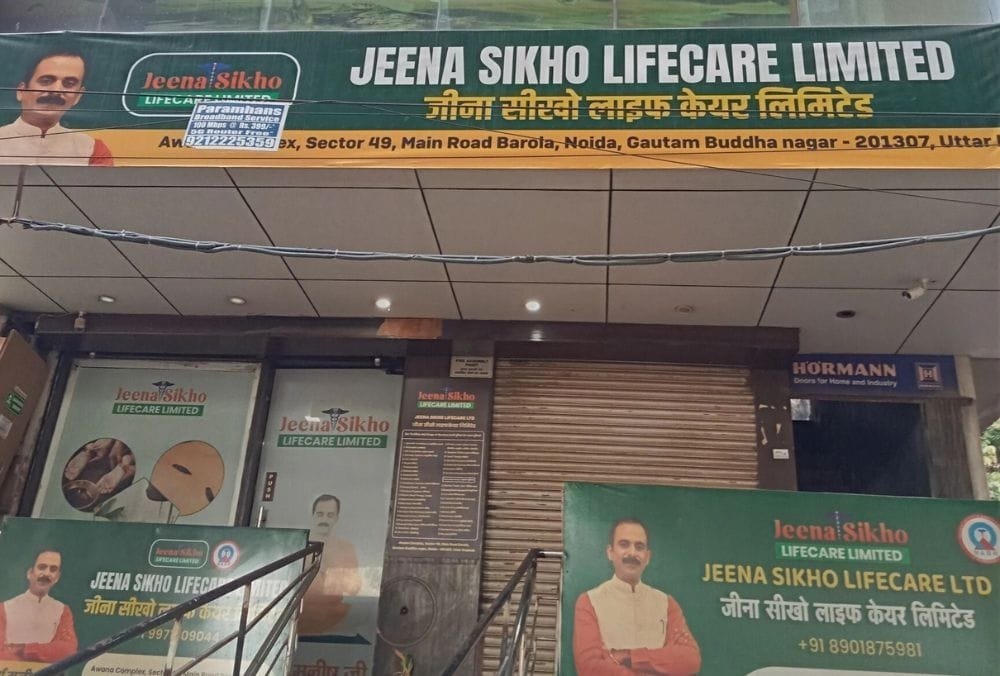
If Baba Ramdev ever dreamt of a corporate cousin that could beat the FMCG titans at their own game, Jeena Sikho Lifecare Ltd (JSLL) is probably that dream — just with better PowerPoint decks and more bed capacity. The company, which claims to “heal India with Ayurveda,” has now added a modern twist: quarterly earnings that look like they were brewed in a cauldron of steroids and herbal concoctions.
At ₹794 per share and a market cap of ₹9,867 crore, Jeena Sikho has had the kind of run retail investors dream of and auditors double-check. In just three months, the stock is up 45%, and over the last year — brace yourself — a 135% return. For a company that sells Ayurvedic detoxes, that’s one hell of a cleansing rally.
Its Q2FY26 numbers are spicier than ginger chai:
Revenue: ₹190 crore (up 70% YoY)
PAT: ₹59 crore (up 135% YoY)
Operating margin: 48% (from 35% YoY)
EPS: ₹4.73 this quarter → annualized ₹18.9
With an ROCE of 50.2%, ROE of 37.9%, and Debt to Equity at 0.04, Jeena Sikho has achieved the holy trinity of high margin, low debt, and ridiculous valuation — trading at a P/E of 64x and a price-to-book of 36x.
And if you think these numbers are overhyped — wait till you see their expansion plans. The next section might just make you believe that Ayurveda is the new SaaS.
2. Introduction
Some companies cure diseases; others cure boredom. Jeena Sikho seems to be curing both. Born in the early 2010s as a humble Ayurvedic product seller under the brand “Shuddhi,” it now runs 36 hospitals and 74 clinics across 21 states, proving that with enough TV ads and call-center enthusiasm, even Ayurveda can scale like a startup.
From Derabassi to Dubai, the company’s strategy is simple — get customers through the “spiritual” door, and then escort them through a medical corridor of detox, Panchkarma, and herbal subscription plans. The clinics funnel patients into hospitals, the hospitals funnel them into Ayurvedic treatments, and the treatments funnel them into long-term loyalty (and maybe a Shuddhi protein powder).
The hub-and-spoke model ensures that every small-town detox dream feeds into a bigger hospital — and by extension, a bigger balance sheet. With a 51% occupancy rate and an ARPOB (average revenue per bed) of ₹8,100, the economics are already aligning better than most private healthcare peers.
But here’s the kicker: they’re doing all this without owning factories. Manufacturing is outsourced, and the company pockets a 90% gross margin on its 350+ Ayurvedic products. Imagine flipping a soap bar for ten times its cost — that’s the Shuddhi way.
And just when you think it’s peaked — they’re setting up six centers in Dubai. Because apparently, Ayurveda needed a Burj Khalifa branch.
3. Business Model – WTF Do They Even Do?
Let’s decode the herbal enigma.
Jeena Sikho Lifecare Limited operates on two cylinders: (a) Hospitals & Clinics (53% of revenue) – the “service” business. (b) Ayurvedic Products (47% of revenue) – the “margin machine.”
The hospitals aren’t your typical sterile white-walled places. They’re NABH-accredited Ayurvedic sanctuaries where Panchkarma meets PowerPoint. 36 hospitals, 74 clinics, 1,530 beds — and another 518 beds coming up. The five flagship facilities in Meerut, Lucknow, Derabassi, Navi Mumbai, and Panchkula are already buzzing with herbal IV drips and detox packages.
Their hub-and-spoke model ensures that small clinics act as lead generators, sending patients to the larger hospitals. 40% of these clinics are franchised — the company doesn’t spend; others do. It’s like Zomato, but with herbs instead of biryani.
Then there’s the product empire. Over 350 SKUs of Ayurvedic formulations are sold under “Shuddhi” through their own network, call centres, and e-commerce. They outsource manufacturing — meaning minimal capital expenditure, maximum margin.
Think of it as Ayurveda-as-a-Service (AaaS) — recurring customers, recurring treatments, recurring cash flow.
Commentary: Those 70% revenue jumps are not herbal coincidence — the company’s scaling faster than your metabolism after Triphala. EBITDA margins now at 48%, showing that for once, Ayurveda can be capital-efficient.
EV/EBITDA = 41x (rich) Fair range = 25–35x → Implied EV ₹6,000–₹8,400 Cr → Price Range ₹490–₹685
Method 3: DCF (Simplified) Assume FCF growth 20% for 5 yrs, terminal growth 5%, discount rate 12%. Implied range ₹650–₹900.
✅ Fair Value Range (Educational Only): ₹620–₹850
(This range is for educational purposes only and not investment advice. Please consult your inner guru before acting.)
6. What’s Cooking – News, Triggers, Drama
The last six months have been a herbal soap opera.
Diagnostic Deal: In October 2025, Jeena Sikho inked an exclusive five-year diagnostic partnership with Chandan, a well-known lab chain. Translation: every Panchkarma